
Yes, an Employer of Record (EOR) can sponsor work visas in countries where it holds a registered legal entity. The EOR becomes the legal sponsor on the visa application — handling government filings, compliance, and ongoing payroll — enabling companies to hire and relocate talent internationally without establishing their own foreign entity. Processing timelines range from 2 weeks in the UAE to 6+ months for US H-1B visas, and costs typically run $500–$2,000 per month in EOR fees plus $1,000–$5,000 in immigration costs per application. This guide covers which countries accept EOR-sponsored visas, specific processing timelines, what happens if a visa is denied, and how EOR sponsorship compares to PEO and direct entity sponsorship.
Can an Employer of Record sponsor visas?
An Employer of Record (EOR) can sponsor work visas in countries where it holds a registered entity. The EOR becomes the legal sponsor on the visa application — taking on compliance responsibility, filing paperwork with immigration authorities, and managing the employee’s work authorization throughout their assignment. This means your company can hire and relocate talent internationally without setting up your own foreign entity.
How long does an EOR take to set up employee visas?
Typically, this process can take a few months to set up. Depending on who you’re working with, it may be faster. Some EOR services can have an employment visa set up within two weeks.
It really depends on your provider. There can also be delays and complications that your EOR may have to deal with which can increase the amount of time it takes to get it done.

Do EORs help with dependent visas too?
Yes, most EORs can sponsor dependent visas for spouses, children, and qualifying family members alongside the primary work visa. Dependent visa sponsorship follows the same legal framework as the employee’s work visa — the EOR, as the legal employer, includes dependents on the visa application or files a parallel dependent visa petition. This covers spouses, unmarried children under 18 (or under 21 in some countries), and in certain jurisdictions, elderly parents or same-sex partners.
Dependent visa processing adds 2–8 weeks to the overall timeline depending on the country. In the UAE, dependent visas process in 1–2 weeks; in Germany and the Netherlands, dependents are typically included in the same application but may require separate biometrics appointments. Some EOR providers include dependent visa sponsorship in their standard fee, while others charge $500–$2,000 per dependent for the additional immigration processing.
How do EORs help with visas and work permits?
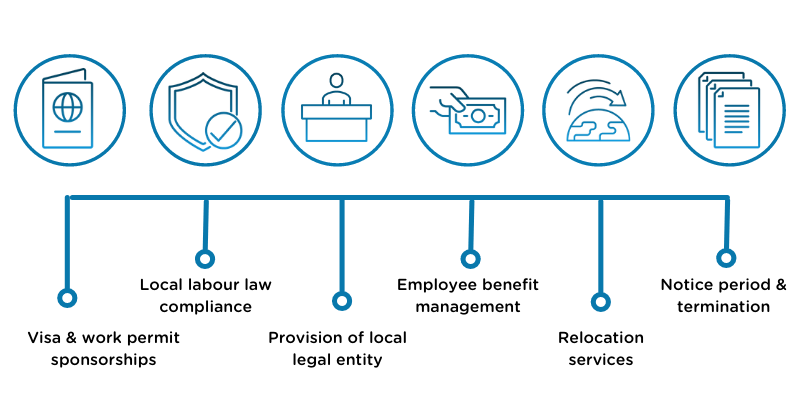
Typically, EOR providers can help with the following visa-related challenges:
- Visa guidance to help determine which visa is best for your employee
- Visa application support and sponsorship
- Immigration and taxation guidance (see: EOR tax implications)
- Navigating local labor laws
- Moving and relocation services (not always)
- Working on additional relocation efforts like background checks and medical checks

Visa-related challenges for EORs
Most of the time, visas and immigration are too time-consuming and costly to make hiring remotely worth the trouble. That’s where an EOR comes in handy.
While using an EOR for visas can be a lot easier than doing it yourself, there are still some challenges you should be aware of.
Political issues
Because immigration is a political topic, visas are never going to be a straightforward, seamless, easy process. Some countries may not want to take in additional workers, or will only be considering refugee applications during certain time periods.
Delays
Visa processing times have increased across many jurisdictions due to ongoing immigration backlogs and heightened scrutiny. The US, UK, and EU have all reported multi-month processing delays since 2023. Immigration departments are backlogged with visa applications. So you should be prepared for time delays in the process.
Additional costs
There can be additional costs related to background checks or medical checks.
If your employee needs to relocate to a different country like the US, immigration laws can also cause delays and additional paperwork.
Denied applications
Sometimes a visa application can be denied for a myriad of reasons. This can cause additional delays. Luckily, an EOR provider will typically deal with these issues.
When you partner with an EOR you’re putting your trust and faith in another company’s expertise, resources, and processes for your global hiring and many important aspects of your global HR.
It can be difficult when you’re not in control of your global HR team when things don’t go as planned. But it’s still a lot easier than trying to figure it all out by yourself with limited resources and knowledge.
EORs have the entities, expertise, systems, processes, and resources you need to be able to hire remotely quickly and cost-effectively compared to setting up your own entities and building a global HR team.
What countries accept EOR-sponsored visas?
An EOR can sponsor work visas in any country where it holds a registered legal entity. Major EOR providers like Remote, Deel, and Oyster maintain entities in 150+ countries, but not every jurisdiction permits third-party employer sponsorship. Countries where EOR visa sponsorship is well-established include the United Kingdom (Skilled Worker visa), UAE (work permits), Singapore (Employment Pass), Germany (EU Blue Card pathways), Netherlands (highly skilled migrant permit), Portugal (D7 and work authorization), and Canada (certain LMIA-exempt categories), according to the Gloroots EOR visa sponsorship guide. Countries with stricter sponsorship requirements — including the United States and Japan — often require the sponsoring entity to demonstrate a direct employment relationship, which can limit EOR visa sponsorship in those markets. Always verify country-specific eligibility with your EOR provider before initiating a visa application.
EOR Visa Sponsorship by Country — Where It Works and Where It Doesn’t
EOR visa sponsorship availability varies significantly by country, with some jurisdictions permitting third-party employer sponsorship and others requiring a direct employment relationship with the sponsoring entity. The key determinant is whether the country’s immigration law recognizes an EOR’s registered entity as a qualifying employer for visa sponsorship purposes.
Countries where EOR visa sponsorship is well-established and generally available:
- United Kingdom — EORs with a UK entity can sponsor Skilled Worker visas. The sponsor license process takes 8 weeks for first-time applicants, but established EORs already hold sponsor licenses.
- Netherlands — recognized sponsors (which most EORs are) can file highly skilled migrant permits with IND processing in 2–4 months. The Dutch system explicitly accommodates EOR arrangements.
- Germany — EORs with a German entity can sponsor EU Blue Cards and work permits. Processing takes 2–4 months through local Ausländerbehörde offices.
- UAE — EORs with a local trade license sponsor work permits in 1–4 weeks. The UAE’s visa system is designed for third-party employer sponsorship.
- Singapore — EORs with a registered company can sponsor Employment Passes and ONE Passes. MOM processes in 3–6 weeks for established sponsors.
- Portugal — EORs can support D7 visas and work authorization through their Portuguese entity. Processing times run 2–4 months.
- Canada — limited EOR sponsorship available. LMIA-exempt categories (intra-company transferees, CUSMA professionals) are the primary viable pathways.
Countries where EOR visa sponsorship is restricted or unavailable:
- United States — H-1B visas require the sponsoring employer to have a direct employment relationship with the beneficiary. Only EORs that are the actual employer of record (not PEO or co-employment arrangements) can sponsor H-1Bs, and these are subject to the annual cap lottery.
- Japan — strict requirements for the sponsoring entity to demonstrate direct control over the employee’s work. EOR sponsorship is possible but heavily scrutinized.
- India — employment visas require the sponsoring organization to be operating in India, and the visa is tied to that specific employer. EOR sponsorship is possible but subject to frequent regulatory changes.
Always verify country-specific eligibility with your EOR provider before initiating a visa application, as immigration regulations change frequently.
EOR visa sponsorship vs. setting up your own entity
Companies face two paths when they need to sponsor an employee’s work visa: establish their own legal entity in the destination country or use an EOR to sponsor the visa on their behalf. Entity setup typically requires 3–6 months and costs $15,000–$50,000 per country, covering corporate registration, tax enrollment, local payroll infrastructure, and ongoing compliance, per Safeguard Global’s employer-sponsored visa guide. An EOR eliminates that setup timeline and cost because the EOR already holds a registered entity, pays local taxes, and runs compliant payroll. For companies hiring 1–5 employees in a new country, EOR visa sponsorship is almost always the faster and cheaper path. Entity sponsorship becomes cost-effective only when headcount in a single country exceeds roughly 15–25 employees, at which point the per-employee EOR fee exceeds the amortized entity setup cost.
What types of visas can an EOR sponsor?
EORs typically sponsor employment-based work visas, not investor or entrepreneur visas. Common visa categories that EORs handle include skilled worker visas (UK, Singapore), EU Blue Cards (Germany, Netherlands), post-study work visas (UK Graduate Route), and intra-company transfer permits where a local entity is required. According to Deel’s EOR-sponsored visa guide, an EOR can also support non-immigrant visas like the US H-1B and green card sponsorship, though these require the EOR to be the direct employer of record for immigration purposes. EORs generally cannot sponsor family-based visas, student visas, or humanitarian visas — those fall outside the employment relationship an EOR maintains.
EOR visa sponsorship process: step by step
The typical EOR visa sponsorship workflow follows five stages. First, eligibility assessment — the EOR reviews the employee’s nationality, target country, role, and qualifications to confirm visa eligibility and select the appropriate visa category. Second, document collection — the EOR gathers required documents: employment contract, educational credentials, passport copies, health insurance proof, and any country-specific requirements like police clearances. Third, application filing — the EOR submits the visa application to immigration authorities on behalf of the employee, acting as the legal sponsor. Fourth, processing and compliance — processing times range from 2 weeks in fast jurisdictions (UAE, Singapore) to 6+ months in slower ones (US, Japan). During this period, the EOR monitors the application and handles any government requests for additional information. Fifth, onboarding and renewal — once approved, the EOR onboards the employee under a local compliant contract, manages payroll and benefits, and tracks visa renewal dates to prevent lapses.
How much does EOR visa sponsorship cost?
EOR visa sponsorship costs include two components: the EOR’s service fee (typically $500–$2,000 per employee per month, covering payroll, compliance, and benefits administration) and immigration-specific fees (government filing fees, legal costs, translation and notarization, and the EOR’s immigration management surcharge, which usually adds $1,000–$5,000 per visa application). Government filing fees alone range from under $200 in jurisdictions like the UAE to over $2,500 for US H-1B petitions, according to immigration fee schedules published by Safeguard Global. Many EOR providers bundle immigration support into their standard fee for countries where they hold entities, while others charge a separate immigration fee. Ask your EOR provider for a per-country breakdown that separates monthly employment costs from one-time visa costs.
Our Recommended EORs

Remote is a robust and modern platform for remote-first teams. EOR, contractor management, payroll, benefits, and more.

Oyster is an intuitive platform that allows you to hire, pay, and care for a global team in more than 180 countries. EOR, contractor management, payroll, benefits, and more.

TFY has features for applicant tracking, freelance management, payroll, and more in a single platform. The platform supports diversity hiring and Corporate Social Responsibility (CSR) initiatives.
Lano is both a B2B & B2C platform. Businesses can use it to process global payroll, hire remote talent and manage contractors, while employees and freelancers can benefit from its payslip service, invoicing app, multi-currency wallet, and more.
See also: determine if you need an EOR

What an EOR Can Do for Visa Support
While an EOR cannot directly sponsor work visas in most countries, it plays a critical role in immigration compliance and support. Understanding what an EOR can and cannot do helps set realistic expectations and avoid costly mistakes. For guidance on which employer of record to use, see our detailed comparison guide.
Here’s what an EOR typically handles:
- Employment verification letters. EORs can provide official employment documentation that supports visa applications, even if they’re not the sponsoring entity.
- Local compliance guidance. An EOR with operations in your target country understands the immigration landscape and can advise on which visa types are available and realistic.
- Payroll and tax compliance for sponsored workers. If an employee secures a visa through another pathway, the EOR can manage their ongoing payroll, benefits, and tax obligations in-country.
- Coordinating with immigration lawyers. Many EORs partner with or recommend immigration attorneys who specialize in the relevant jurisdiction.
For a broader overview of what EORs handle, see our guide on what an EOR does and its core responsibilities.
Visa Options by Region
Visa availability varies dramatically by country. Here’s a practical overview of the most common pathways for remote workers and their employers:
| Region | Common Visa Types | Sponsorship Required? | Typical Processing Time |
|---|---|---|---|
| EU (Netherlands, Germany, Estonia) | Digital nomad visa, freelancer visa, blue card | Varies — nomad visas usually no, blue card yes | 2–6 months |
| UK | Skilled Worker visa, Global Talent visa | Yes, for Skilled Worker | 3–8 weeks |
| UAE | Virtual working program, freelancer permit | No for nomad visa, yes for employment | 1–4 weeks |
| Singapore | Employment Pass, ONE Pass | Yes | 3–6 months |
| Australia | 482 Temporary Skill Shortage, 186 Employer Nomination | Yes | 2–6 months |
| Brazil | Digital nomad visa, work visa | No for nomad, yes for work | 1–3 months |
EOR vs. Direct Sponsorship: When Each Makes Sense
Choosing between an EOR and direct visa sponsorship depends on your situation:
Use an EOR when:
- You’re hiring in a country where you don’t have a legal entity
- You need to onboard employees quickly and can’t wait for visa processing
- You’re testing a new market and don’t want the overhead of establishing a local entity
- The employee already has the right to work (EU passport, digital nomad visa, spousal visa)
Pursue direct sponsorship when:
- You’re committed to a long-term presence in the country
- You need to relocate key employees who require visa sponsorship
- You’re hiring multiple employees in the same jurisdiction, making entity setup cost-effective
- Local law requires a direct employer-employee relationship for the visa category
For more on the legal nuances, see our article on EOR and permanent establishment risks.
The Compliance Risks of Getting It Wrong
Immigration violations carry serious consequences for both employers and employees. The risks include:
- Deportation of the employee. Working on a tourist visa or without proper authorization can result in immediate removal and bans on re-entry.
- Fines and penalties for the company. US Immigration and Customs Enforcement collected over $100 million in penalties from employers in a single year for I-9 violations alone.
- Permanent establishment risk. Having employees in a country without proper corporate structure can create an unexpected tax presence, triggering obligations you didn’t plan for.
- Reputational damage. Publicized immigration violations damage employer brand and make it harder to attract international talent.
The safest approach: always verify visa requirements with an immigration attorney before moving an employee to a new country. An EOR can facilitate this process, but it cannot substitute for legal counsel on immigration matters.
Understanding the full scope of EOR services and limitations is essential — our complete guide to EOR benefits and limitations covers this in detail.