
You need an employer of record when hiring employees in countries where your company has no legal entity — and the stakes for getting it wrong are significant. Misclassifying a single international worker can cost $25,000 in penalties (IRS data), setting up a foreign entity runs $15,000–$50,000 and takes 3–6 months, and permanent establishment exposure can trigger unexpected corporate tax liability. This guide covers exactly how to determine if you need an employer of record, with a decision framework, cost comparisons, and compliance checkpoints for 2026.
For companies engaging international contractors, an employer of record for independent contractors absorbs misclassification liability and handles local compliance. For a full breakdown of what an EOR covers, see what employment tasks an EOR handles.
How to Determine if You Need an Employer of Record
You need an employer of record if you want to hire employees in countries where your company lacks a legal entity, and you need to do it quickly and compliantly. The decision comes down to three factors: whether you have a legal entity where the worker lives, how many people you plan to hire in that country, and how complex the local employment regulations are.
Hiring one employee in Argentina, for example, requires setting up a legal entity — a process that costs $15,000–$50,000 and takes 3–6 months. An EOR can onboard that same employee in 5–14 business days for $400–$700 per month, according to Deel’s 2025 Global Hiring Report. The break-even point between EOR fees and entity setup typically falls at 15–20 employees in a single country.
Using an EOR is the right choice when speed, compliance, and cost-efficiency matter more than having direct control over a local entity. If you have the resources and timeline to establish your own entity — and you’re hiring 30+ people in one country — you may not need an EOR.

5 Signs You Need an Employer of Record
Most companies discover they need an EOR after encountering one of these five scenarios. If any of these describe your situation, an employer of record is likely the right solution:
1. You’re making your first international hire. You’re a U.S.-based company that just found the perfect candidate — but they’re in Berlin. Setting up a German entity takes 3–6 months and costs $15,000–$50,000 in legal fees alone. An EOR can onboard her in as little as 5 business days. Deel’s 2025 data shows companies using EORs for first international hires reduce onboarding time from an average of 3–6 months to 5–14 business days.
2. You’re expanding into multiple countries simultaneously. You’re scaling into Brazil, the Philippines, and Spain at the same time. Each country has different labor laws, benefit requirements, and tax structures. Setting up three entities costs $45,000–$150,000 and takes 9–18 months combined. An EOR with coverage in all three markets handles compliance across the board with a single agreement.
3. You face contractor misclassification risk. You’ve been paying a developer in Colombia as a contractor for 18 months. Under Colombian labor law, the working relationship may qualify as employment — exposing you to back taxes, penalties, and benefit obligations totaling 30–50% of the worker’s compensation. An EOR retroactively converts that contractor relationship into compliant employment, absorbing the legal risk.
4. You have short-term or project-based international needs. If you need a team in another country for a 6–12 month project, setting up a local entity makes no financial sense. The $15,000–$50,000 setup cost alone exceeds 12 months of EOR fees for 2–4 employees. An EOR lets you hire for the project duration and wind down cleanly when it ends.
5. You need compliance certainty in high-regulation countries. Countries like Germany, France, and Brazil have complex labor codes with strict termination protections, mandatory benefits, andWorks council requirements. An EOR with a local legal entity absorbs compliance risk — the NAPEO reports that companies using EORs experience 30% fewer employment law violations compared to those managing international employment independently.
What is an Employer of Record?
An employer of record is a third-party organization that legally employs workers on your behalf in countries where your company has no entity. The EOR becomes the legal employer on paper — handling employment contracts, tax withholdings, social contributions, and compliance — while your company retains day-to-day control over the employee’s work, assignments, and performance.
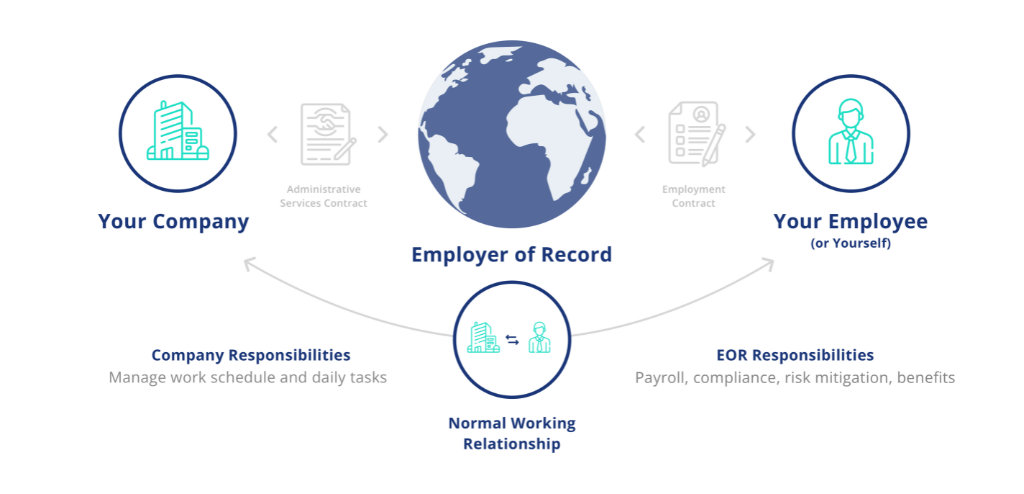
You typically pay a monthly fee of $400–$700 per employee for EOR service. In return, the EOR handles all legal compliance, payroll, benefits, and tax filings — and helps avoid permanent establishment tax risks in foreign jurisdictions, though employer of record tax implications extend beyond payroll withholding. This eliminates the cost and complication of hiring abroad and allows you to focus on finding great candidates.

Why Companies Use an Employer of Record
Companies use an employer of record because most organizations lack the resources, legal expertise, or time to manage international employment compliance on their own. The global EOR market reached $5.97 billion in 2026 and is projected to reach $10.46 billion by 2035 (CAGR 6.8%), reflecting how EOR services have moved from niche solution to strategic necessity for companies expanding internationally.
Setting up a legal entity in a foreign country was historically the only option — and it was only worthwhile if you were hiring many roles in that country. Partnering with an EOR that already has established entities is faster and more cost-effective for most hiring volumes. EORs also reduce misclassification risk: if you hire someone as a contractor but local law classifies them as an employee, an EOR absorbs that legal liability. Most EORs employ in-house legal teams with country-specific expertise, which helps you avoid costly compliance violations.
What an EOR Doesn’t Do
An employer of record is not a staffing agency, a payroll company, or a professional employer organization (PEO). While many EORs offer staffing and payroll services alongside their core offering, a staffing agency, payroll provider, or outsourced HR department cannot legally represent your business entity in another country. You either have to set up that entity yourself or use an EOR.
What an EOR Does
Employers of record handle the full employment lifecycle on your behalf:
- Centralize management of international hiring and onboarding
- Make it easy to hire contractors and remote employees compliantly
- Deliver locally compliant benefits packages (health insurance, pension, paid leave)
- Avoid misclassification legal issues by serving as the legal employer
- Manage termination, probation, and severance according to local law
- Protect intellectual property (IP) through proper assignment clauses
- Process international payroll with correct tax withholdings and social contributions
EOR Decision Framework: When You Need One vs When You Don’t
The decision of whether you need an employer of record depends on your entity presence, hiring volume, and compliance complexity. Use this framework to evaluate your situation:
| Factor | You NEED an EOR | You DON’T Need an EOR |
|---|---|---|
| Legal entity in worker’s country | No local entity | Already registered locally |
| Hiring volume | 1–15 employees per country | 30+ employees in one country |
| Time to onboard | Need someone in days/weeks | Can wait 3–6 months for entity setup |
| Compliance complexity | High (France, Germany, Brazil) | Low (Singapore, UAE) |
| Budget tolerance | $400–$700/mo per employee | $15,000–$50,000 entity setup + $5,000–$20,000/yr ongoing |
| Country spread | Multiple countries, few hires each | One country, many hires |
For most companies hiring fewer than 20 people per country — especially across multiple countries — an EOR is the clear financial winner. The break-even point between cumulative EOR fees and entity setup typically falls at 15–20 employees in a single country, according to KPMG’s 2025 Global Employment Report.
What Happens If You Hire Internationally Without an EOR
Hiring employees in foreign countries without an employer of record or a local legal entity exposes your company to significant legal and financial risk. The consequences vary by jurisdiction but can be severe:
Misclassification penalties. Treating an employee as a contractor when local law classifies them differently can result in back taxes, penalties, and benefit obligations. In the US, California’s AB5 law imposes $5,000–$25,000 per violation. The UK’s IR35 framework generated £4.3 billion in compliance costs in 2024. Germany can impose fines up to €500,000 for misclassification. See our guide on employer of record for independent contractors for detailed misclassification risks by country.
Permanent establishment tax liability. Employing someone in a country without a registered entity can trigger permanent establishment — meaning your company owes corporate tax in that jurisdiction. The OECD reports that 30% of cross-border employment arrangements face PE challenges. KPMG’s 2025 data shows a 15% increase in PE-related audits globally. For a detailed breakdown, see our guide on employer of record permanent establishment risks.
Employment law violations. Without a local entity or EOR, you cannot offer compliant employment contracts, mandatory benefits, or proper tax withholdings. The ILO reports that 72% of companies operating without local employment infrastructure experience at least one significant compliance violation within 24 months.
Data privacy and IP exposure. Without proper employment agreements governed by local law, intellectual property created by the worker may not automatically assign to your company. GDPR, LGPD (Brazil), and other privacy regulations require specific data processing agreements — which informal arrangements cannot satisfy.
EOR vs. Setting Up Your Own Entity: Cost Comparison
Many companies wonder whether it’s cheaper to establish their own legal entity in a target country rather than paying EOR fees. The answer depends on scale and timeline:
- Entity setup costs: $15,000–$50,000 in legal and registration fees, plus 3–6 months of lead time.
- Ongoing entity costs: $5,000–$20,000 per year in local accounting, tax filing, and compliance administration.
- EOR fees: Typically $400–$700 per employee per month, with no setup fees or long-term commitments.
At 15–20 employees in a single country, the cumulative EOR fees ($72,000–$168,000 per year for 20 employees) begin to approach the total cost of entity setup and operation ($20,000–$70,000 in year one, decreasing in subsequent years). Below that threshold, an EOR is the clear financial winner. It also eliminates the risk of maintaining a dormant entity if your international hiring plans change.
Do You Need an EOR or a PEO? Understanding the Key Difference
If you’re determining whether you need an employer of record, the answer often depends on whether a PEO or an EOR is the right fit. Many businesses confuse the two, but the distinction is critical for compliance and cost.
A PEO operates under a co-employment model — both the PEO and your company are legally responsible for the worker. This means you must already have a registered entity in the worker’s country or state, because the PEO cannot act as the sole legal employer.
An EOR, by contrast, is the sole legal employer on paper. Your company retains day-to-day control over work assignments, performance management, and strategic decisions — but the EOR absorbs all legal liability for employment compliance. If you need to hire someone in a jurisdiction where your company has no legal presence, only an EOR can make that hire compliant. A PEO requires you to already have that presence.
When You Do Not Need an Employer of Record
An employer of record is not the right solution in every hiring situation. Understanding when you can skip an EOR saves unnecessary fees and administrative overhead:
- You already have a legal entity in the worker’s country. If your company is registered where the hire lives, you can employ them directly. Adding an EOR layer creates cost without benefit.
- You are hiring domestically in your home country. If your business operates in the same jurisdiction as the employee, your existing HR and payroll infrastructure handles the hire. An EOR adds no value for same-country employment unless you need multi-state payroll support.
- You are hiring fewer than 5 people in one country and plan to scale. In this gray zone, the break-even point between EOR fees ($400–$700/month per employee) and entity setup costs ($15,000–$50,000) typically sits around 15–20 employees in a single country. Below that threshold, an EOR is usually more cost-effective, but if you have concrete plans to hire 30+ people in one country within 12 months, it may be worth establishing your own entity instead.
- The worker is a true independent contractor. If the role qualifies as independent contractor status under local law — the worker controls their own schedule, uses their own tools, and has multiple clients — you can engage them without an EOR. Be careful with misclassification risk, though: countries like Spain, France, and Brazil have strict contractor classification tests.
- You are in a country with simple, employer-friendly regulations. Some jurisdictions make it straightforward for foreign companies to employ workers directly. Singapore and the UAE, for example, have relatively streamlined processes for foreign employers.
The decision comes down to three factors: whether you have a legal entity where the worker lives, how many people you plan to hire in that country, and how complex the local employment regulations are.
Employer of Record Legal Risks You Should Know Before Deciding
Determining whether you need an employer of record requires understanding the legal risks an EOR can and cannot absorb. Using an EOR transfers employment liability to the provider, but it does not eliminate all risk. Understanding the remaining compliance obligations helps you evaluate providers and protect your business:
- Co-employment risk. In some jurisdictions, particularly the United States, the line between EOR and client company can blur. If your company directs day-to-day work too closely in a way that the local labor court interprets as an employment relationship, you could face joint-employer liability claims. Reputable EORs include indemnification clauses, but you should verify the specific language in your service agreement.
- Permanent establishment risk. Hiring an employee in a new country through an EOR can trigger permanent establishment (PE) — a tax status that means your company has a taxable presence in that country. EORs typically structure their agreements to minimize PE risk, but it remains a consideration, particularly for long-term placements in high-tax jurisdictions. See our guide on employer of record permanent establishment risks for a detailed breakdown.
- Data privacy and intellectual property. The EOR holds the employment contract, which means they also hold certain employee data. Ensure your EOR agreement includes robust data processing provisions compliant with GDPR, LGPD (Brazil), and other local privacy laws. For IP, the agreement should explicitly assign all intellectual property created by the worker to your company — not the EOR.
- Termination compliance. Different countries have dramatically different termination protections. In Germany, works councils may need to approve terminations. In Indonesia, severance can exceed 12 months’ salary. Your EOR should guide termination procedures for each jurisdiction, but you are responsible for making the business decision — and the cost.
For a deeper dive into the specific risks employees face when working through an EOR, see our guide on EOR risks for employees.
Do You Need an Employer of Record? FAQ
Most EOR providers charge between $400 and $700 per employee per month, though pricing varies by country and provider. Some EORs charge a flat monthly fee, while others add per-payroll-run fees or benefits administration surcharges. For a detailed cost breakdown, see our guide on employer of record costs.
Some EORs can sponsor work visas in certain countries, but not all. Visa sponsorship depends on whether the EOR holds the necessary immigration licenses in that specific jurisdiction. Our guide on whether an EOR can sponsor visas covers which countries and providers support visa sponsorship.
Yes. An employer of record is a legally recognized employment arrangement in most countries. The EOR is a registered business entity that serves as the legal employer, fulfilling all statutory obligations — payroll taxes, social contributions, workers’ compensation, and employment contracts — on your behalf. For specifics, see our guide on whether an EOR is legal.
A staffing agency recruits and places workers in temporary roles, charging a markup on the worker’s hourly rate. An EOR does not recruit or source candidates — you find the talent, and the EOR handles the legal employment relationship. The EOR model gives you control over who you hire and what they do; the staffing model gives you pre-screened talent for temporary assignments.
Most EORs can onboard a new hire in 2–5 business days once you provide the employee’s information. This compares to 3–6 months for setting up your own legal entity in a new country. The speed advantage is one of the primary reasons companies choose EORs for international hiring.
How to Evaluate Whether You Need an Employer of Record
Determining whether you need an employer of record comes down to evaluating your specific hiring situation against five criteria. If you answer yes to any of these, an EOR is likely the right choice:
- Do you lack a legal entity where the worker lives? If your company is not registered in the worker’s country, an EOR is the fastest and most compliant way to hire there.
- Do you need to onboard in days, not months? EOR onboarding takes 2–5 business days vs 3–6 months for entity setup. If speed matters, an EOR wins.
- Are you hiring in fewer than 15–20 people per country? Below this threshold, cumulative EOR fees are almost always cheaper than entity setup and maintenance costs.
- Are you hiring across multiple countries simultaneously? Each additional country means another entity, another legal regime, another set of compliance obligations. An EOR simplifies this to a single agreement.
- Is compliance a priority? EORs with direct entities (not partner networks) in your target countries provide deeper compliance coverage and faster resolution of employment issues.
For guidance on choosing a specific provider, see our 7-criteria EOR evaluation guide.
Recommended EOR Platforms

Remote is a robust and modern platform for remote-first teams. EOR, contractor management, payroll, benefits, and more.

Oyster is an intuitive platform that allows you to hire, pay, and care for a global team in more than 180 countries. EOR, contractor management, payroll, benefits, and more.

TFY has features for applicant tracking, freelance management, payroll, and more in a single platform. The platform supports diversity hiring and Corporate Social Responsibility (CSR) initiatives.

Lano is both a B2B & B2C platform. Businesses can use it to process global payroll, hire remote talent and manage contractors, while employees and freelancers can benefit from its payslip service, invoicing app, multi-currency wallet, and more.
See also: Tasks an employer of record takes on
For more on this topic, see our guide on whether an EOR can sponsor visas.