
On this page
An employer of record Germany provider is the legal employer of your German worker on its own German entity for about $599 a month per employee, the fee Deel currently charges, so you can hire employees in Germany without founding a GmbH. An employer of record (EOR) employs someone on your behalf: it signs the German contract, runs payroll and carries the employer obligations, while you direct the day-to-day work. On top of salary you fund the employer’s share of social insurance, 21.3% of gross pay at the 2026 standard rates, plus the industry accident-insurance rate, which employers in Germany carry alone.
The 21.3% is the standard rate, not a universal one: the employer’s care-insurance share is 1.3% in Saxony instead of 1.8%, with the employee paying the difference, per Techniker Krankenkasse’s care contribution rates, so the employer total is lower there. Germany also adds a question most country pages skim: employing through a third party can count as employee leasing under the AÜG (Arbeitnehmerüberlassungsgesetz), the German leasing statute, and providers handle it either by holding the permit it requires or by being the genuine employer themselves. The $599 fee works out to $7,188 a year per worker, so your own GmbH starts to win on cost once that figure times your headcount passes the fixed annual cost of running one.
Germany hiring costs at a glance
| Cost item | Who pays | Amount (2026) | Source |
|---|---|---|---|
| EOR monthly fee | You, the client company | $599 per employee per month (USD) | Deel pricing |
| Employer social insurance | Employer | 21.3% of gross pay at the standard rates (21.15% split by branch plus a 0.15% insolvency levy; the employer care share is 1.3% in Saxony, so the total is lower there), plus the industry accident-insurance rate, employer only | GKV-Spitzenverband 2026 factsheet |
| Minimum wage | Employer | €13.90 an hour from 1 January 2026, €14.60 from 1 January 2027 | BMAS minimum wage ordinance |
| Paid annual leave | Employer | 24 Werktage a year, which is 20 days on a five-day week | § 3 BUrlG |
| Sickness pay | Employer | Full pay for up to 6 weeks per illness | § 3 EntgFG |
| Childless care surcharge | Employee | 0.6 percentage points on the care contribution from age 23 | Techniker Krankenkasse |
| Entity setup instead | You | GmbH share capital of €25,000, at least half paid in at registration | § 5 GmbHG |
The EOR fee is the flat part of the monthly cost; the social insurance contributions scale with salary up to the contribution ceilings, and their rates are reset each year. An EOR folds all of it into one invoice, which is most of the appeal at low headcount.
How an EOR works
An employer of record in Germany is the legal employer of your worker on a German employment contract through its own German entity, so you direct the work without becoming the employer. The provider registers the worker with a statutory health insurer and the industry’s accident insurance institution (Berufsgenossenschaft), runs Lohnsteuer income tax withholding each month, and applies the German working time, leave and dismissal rules to the role.
German law requires the core terms of employment in writing and signed, with names, pay and working hours by the first day of work, further terms within seven days and the rest within a month, per § 2 of the Nachweisgesetz, Germany’s written-terms law; the provider issues that paperwork as employer.
Onboarding typically takes a few days to a few weeks, depending on the provider and the worker’s documents, against the months of founding your own GmbH. You keep the hiring decision, the pay you offer and the day-to-day management of the work.
Cost comparison
| Headcount | EOR fee (USD per year) | Crossover: when a GmbH is cheaper |
|---|---|---|
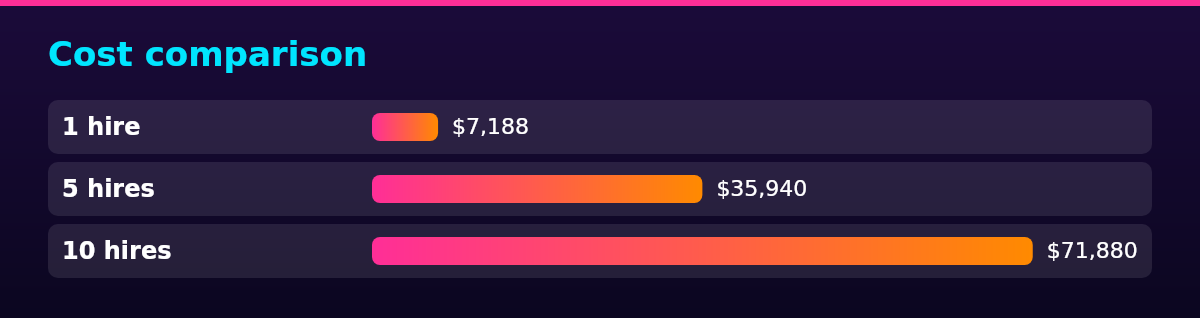
| 1 hire | $7,188 | Its fixed annual cost is under $7,188 a year |
| 5 hires | $35,940 | Its fixed annual cost is under $35,940 a year |
| 10 hires | $71,880 | Its fixed annual cost is under $71,880 a year |
The EOR side scales linearly: the $599 monthly fee on Remote’s pricing page works out to $7,188 a year per worker, $35,940 for five people and $71,880 for ten. Both routes carry the same employer social insurance on the same salary, so the comparison comes down to the flat EOR fee versus the mostly fixed cost of a German entity.
The entity side is mostly fixed: a GmbH needs €25,000 of share capital with at least half paid in at registration, notarized articles, ongoing accounting, and a managing director who is usually on the payroll; those costs barely rise with headcount, which is what makes the crossover work.
The cost of employer of record services guide breaks down how the monthly fee varies across countries and providers.
Legal compliance in Germany
German employment law attaches to whoever employs the worker, and under an EOR that is the provider’s German entity, which is what lets a foreign employer hire in Germany without a local company. The obligations sit with the provider as employer while you carry the direction of the work.
The working day is capped at eight hours, extendable to ten if the average stays at eight hours within six months or 24 weeks, per § 3 ArbZG, the Working Time Act.
Paid annual leave runs at 24 Werktage, every day that is not a Sunday or a public holiday, or 20 days on a five-day week, per § 3 BUrlG.
An employee is owed full pay for up to six weeks per illness after four weeks of service, per § 3 EntgFG.
After that the health insurer pays Krankengeld, statutory sickness benefit, at 70% of gross pay capped at 90% of net, per § 47 SGB V.
A fixed-term contract without a material reason is limited to two years, with up to three extensions inside that, per § 14 TzBfG.
A works council (Betriebsrat) can be elected from five permanent employees, per § 1 BetrVG. Where your German team works through an EOR, that right belongs to the employees of the entity that employs them; how it plays out for a client-side team varies with the arrangement, so it is a fair question for a provider.
The statutory minimum wage is €13.90 an hour from 1 January 2026, rising to €14.60 from 1 January 2027, per the BMAS minimum wage ordinance.
Hiring a freelancer instead of an employee shifts the payroll but keeps the status question: a contractor integrated into your work organization risks reclassification as an employee with back social contributions. The Deutsche Rentenversicherung Bund runs status determination proceedings on request, including on the client’s request, and can rule before the work starts, per § 7a SGB IV.
Because the EOR’s German entity is the employer, a first hire through a provider does not by itself make your company the employer of German staff. The exposure to watch is a worker who habitually concludes contracts in your name, which can create a permanent establishment for your company; German tax law defines a Betriebsstätte as a fixed business facility or installation serving the enterprise, per § 12 AO, and the permanent establishment guide covers how that risk builds.
The AÜG question for EORs
Hiring out employees as temporary agency work requires a permit in Germany, per § 1 AÜG, and the lender and hirer must label the arrangement as employee leasing in their contract before an assignment starts. An EOR arrangement can be qualified as exactly that, so the question to put to a provider is whether it holds the permit or employs the worker as the genuine employer on its own entity.
Two rules in the same section shape the risk: if the lender does not carry the usual employer obligations or risk, the law presumes employment placement instead, and a lease to one hirer may not run longer than 18 consecutive months, extendable by collective agreement, per the same § 1 AÜG.
Unpermitted leasing is an administrative offense with fines up to €30,000 per violation, per § 16 AÜG. The €500,000 tier sometimes quoted for Germany covers a different group of violations, such as placing foreign workers without the required permits, not the licensing question.
How providers handle it, per Taylor Wessing’s note on EOR pitfalls in Germany (2022): EORs obtain the leasing permit from the Bundesagentur für Arbeit, the Federal Employment Agency, or make their own entity the genuine employer. If an arrangement were treated as unlicensed leasing, the risks run to a deemed direct employment of the worker with your company, with the employee able to opt for the EOR contract in writing within one month, permanent establishment exposure where the worker concludes contracts in your name, and fines.
Payroll taxes in Germany
| Social insurance branch | Employer share (2026) | Employee share (2026) | Source |
|---|---|---|---|
| Statutory health insurance | 7.3% plus half the Zusatzbeitrag, 8.75% at the 2.9% average | 7.3% plus half the Zusatzbeitrag, 8.75% at the average | BMG |
| Care insurance | 1.8%, or 1.3% in Saxony | 1.8%, or 2.3% in Saxony, plus 0.6 percentage points childless from age 23 | Techniker Krankenkasse |
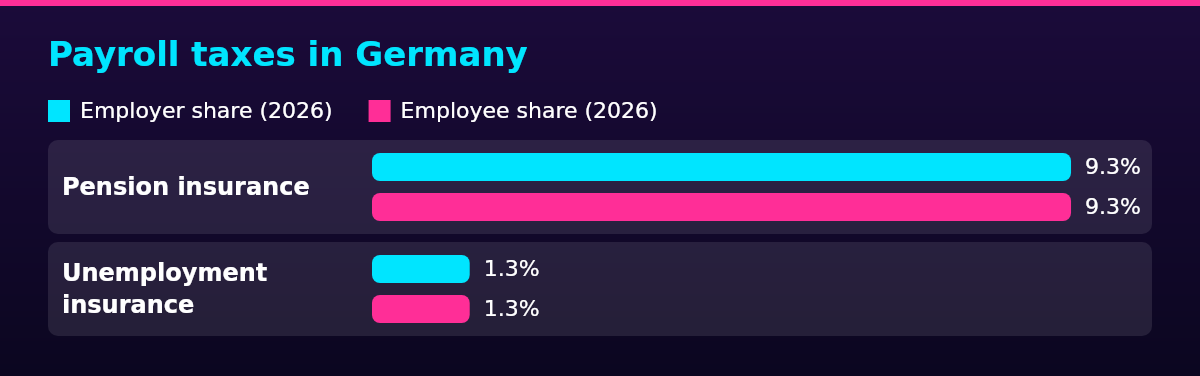
| Pension insurance | 9.3% | 9.3% | GKV-Spitzenverband 2026 factsheet |
| Unemployment insurance | 1.3% | 1.3% | GKV-Spitzenverband 2026 factsheet |
| Insolvency levy | 0.15% | None | GKV-Spitzenverband 2026 factsheet |
The Zusatzbeitrag is the additional health contribution each insurer sets, averaging 2.9% in 2026 and split half and half between employer and employee. Payroll also withholds Lohnsteuer, progressive income tax on wages, plus the solidarity surcharge of 5.5% of the income tax, per § 4 SolzG.
Contributions are capped at monthly ceilings of €5,812.50 for health and care (€69,750 a year) and €8,450 for pension and unemployment (€101,400 a year) in 2026, per the BMAS contribution-benchmark ordinance.
Statutory accident insurance sits outside the split: contributions are carried by the employers alone, with the rate set per industry by the accident insurance institution, per § 150 SGB VII.
The arithmetic on a salary under the ceilings, per the GKV-Spitzenverband’s 2026 contribution figures: 9.3% pension plus 7.3% health plus 1.45% as half the average Zusatzbeitrag plus 1.3% unemployment plus 1.8% care is 21.15%, and the 0.15% insolvency levy takes the employer total to 21.3% at the standard rates, plus the accident-insurance rate, employer only. On a €60,000 salary that is €12,780 a year in employer contributions plus accident insurance; in Saxony the total is lower, because the employer care share is 1.3% with the employee paying the difference.
Visas for foreign hires
EU citizens need no German work permit. A hire from outside the EU generally needs a work permit, most often the EU Blue Card: the 2026 thresholds are €50,700 gross a year for the general route, with no Federal Employment Agency approval needed, and €45,934.20 for shortage occupations, recent graduates within three years of the qualifying degree, and IT specialists without a degree who have three years of experience in the last seven, which do need agency approval, per the Bundesagentur für Arbeit.
An EOR can sponsor a work permit only through its own German entity, and whether a given provider does varies. Whether an employer of record can sponsor visas comes down to that entity and the provider’s willingness to sponsor, so if the hire needs a permit, ask first.
EOR versus a German entity
An EOR fits a first hire or a small German team, when speed matters and you want the obligations handled without a local presence. Your own entity fits scale, or when you need to hold German intellectual property, grant equity to local staff or sponsor visas in-house. A freelancer is the cheapest route on paper, but one integrated into your work organization risks reclassification as an employee, per § 7a SGB IV.
A GmbH requires €25,000 of minimum share capital, with at least one quarter of each cash share paid in at registration and the total reaching at least half the minimum capital, €12,500 in practice, per § 7(2) GmbHG.
The articles of association must be notarized, per § 2(1) GmbHG.
The UG (haftungsbeschränkt) is the variant formed below the €25,000 minimum: its capital must be fully paid in, and it moves one quarter of each year’s profit into a statutory reserve, per § 5a GmbHG.
A GmbH pays corporation tax at 15% for assessment periods to 2027, per § 23 KStG, plus the 5.5% solidarity surcharge on the tax, for 15.825% combined.
Trade tax adds a 3.5% base rate on trade income, per § 11 GewStG.
The base rate is multiplied by each municipality’s multiplier (Hebesatz), which defaults to 280% where the municipality sets none, per § 16 GewStG.
The crossover is the one in the cost comparison: once your EOR fees pass your fixed annual entity cost, the GmbH wins on money alone. A German EOR is also not a professional employer organization (PEO): the EOR is the legal employer on its own entity, while a PEO shares employer duties with you under a co-employment arrangement; the PEO vs EOR comparison sets the two models side by side.
Scaling framework
| Stage | Headcount | Model (EOR or German entity) | When to move on |
|---|---|---|---|
| First hire | 1 | EOR | You need entity control or equity grants |
| Early team | 2 to 5 | EOR | Admin load rises or you add a second country |
| Growing team | 6 to 10 | EOR or UG | EOR fees start to rival your own fixed running cost |
| Scale | 10+ | GmbH | You need IP holding, equity or a large payroll |
Most employers start on an EOR because it needs no setup and carries the German obligations from day one, then move to their own entity once the flat fees exceed the fixed cost of running one. The triggers to plan for are cost at scale, holding German intellectual property or granting equity, visa sponsorship in-house, and the headcount thresholds in German labor law, above all the 10 full-time-equivalent mark where protection against unfair dismissal applies.
Termination rules in Germany
| Rule | What German law requires | Source |
|---|---|---|
| Basic notice | 4 weeks to the 15th or the end of a calendar month in the first two years; then 1 month to month end after 2 years of service, 2 months after 5, 3 after 8, 4 after 10, 5 after 12, 6 after 15, 7 after 20 | § 622 BGB |
| Probation | Trial period capped at 6 months, with 2 weeks’ notice for either side | § 622 BGB |
| Unfair dismissal protection | Applies after 6 months’ service and only in businesses with more than 10 full-time-equivalent employees | § 1 KSchG |
| Optional severance | 0.5 month’s pay per year of service where the employer offers it in the dismissal letter and the employee does not sue | § 1a KSchG |
Dismissal in Germany is not at-will: outside probation the employer needs a reason, a person-related, conduct-related or urgent operational one, and redundancies require social selection among comparable employees, per § 1 KSchG.
The size threshold matters for small teams: protection against unfair dismissal applies only in businesses with more than 10 full-time-equivalent employees, with part-timers counted fractionally, per § 23 KSchG.
FAQ
About $599 per employee a month in fees, the amount Deel currently charges, plus the employer costs on top: the 21.3% standard social insurance share in 2026, the industry accident-insurance rate, and the salary itself. At one hire that is $7,188 a year in fees before salary and contributions.
Yes: an employer of record employs your worker on its own German entity, so you can hire someone without founding a GmbH. You direct the work and fund the salary and employer costs through the provider.
Either through an employer of record, the fast route without a German company, or through your own GmbH once one exists. Through an EOR the provider becomes the legal employer, issues the written terms § 2 of the Nachweisgesetz requires by the first day of work, registers the worker with a health insurer and the accident insurance institution, and runs Lohnsteuer payroll, while you pick the person, set the pay and manage the work.
Yes, employing through an EOR is legal in Germany; the provider must either hold an AÜG permit where the arrangement counts as employee leasing or employ the worker as the genuine employer on its own entity. Unpermitted leasing carries fines up to €30,000 per violation, per § 16 AÜG, so the diligence is on the provider’s structure.
It can: German law can qualify an EOR arrangement as employee leasing, which requires a permit under § 1 AÜG, so some providers hold the leasing permit and others employ the worker as the genuine employer on their own entity. Ask the provider which structure it uses before you sign.
The company that legally employs your worker in the country where they work: it signs the local employment contract, runs payroll, withholds taxes and pays employer contributions on its own local entity, while you direct the day-to-day work. In Germany, that employer is the provider’s own German entity.
Four weeks to the 15th or the end of a calendar month during the first two years of employment, rising with tenure to between 1 and 7 months to month end, per § 622 BGB. During probation, capped at six months, notice is two weeks for either side.
Not by itself: the worker is employed by the EOR’s German entity, not yours. The exposure to watch is a worker who habitually concludes contracts in your name, which can create a permanent establishment for your company.
Only through its own German entity, and whether a given provider sponsors visas varies from provider to provider. If your hire needs a permit, most often an EU Blue Card at €50,700 gross a year in 2026, ask the provider about sponsorship before you sign.