

On this page
Yes, employee monitoring is legal in the US for remote employees on company systems, and federal employee monitoring laws set no general duty to tell staff they are monitored. The notice and consent duties vary by jurisdiction: New York, Connecticut and Delaware require written or electronic notice before monitoring starts, at penalties up to $3,000 per offense in New York.
For remote staff the employee monitoring laws follow each worker’s location, not the company’s. Employee monitoring law lets employers observe or track employee activities: computer usage, email, internet and social media usage, phone calls and GPS location, with proper notice. The state electronic monitoring laws, a written monitoring policy in Ontario, employee consent under Canada’s PIPEDA privacy law, and a lawful basis plus transparency under the EU GDPR and UK GDPR set the duties. Intercepting or recording workplace communications without consent or an exception is what federal law prohibits.
How US monitoring law works
Federal law does not ban employer monitoring of company systems. The Electronic Communications Privacy Act (ECPA), the federal baseline, instead makes it unlawful to intentionally intercept wire, oral or electronic communications without an exception applying, under 18 U.S.C. § 2511.
Employers rely on two of those exceptions. The provider exception covers interception in the normal course of employment that is a necessary incident to providing the service or protecting the provider’s rights or property, and the consent exceptions apply when one party to the communication has given prior consent.
Reading stored email and files is a separate statute. The Stored Communications Act makes knowingly accessing stored communications without authorization unlawful under 18 U.S.C. § 2701, with its own exceptions.
No federal statute requires employers to tell employees they are being monitored, so a handful of states and several countries fill that gap themselves. Most US states add no general monitoring notice statute: the California attorney general’s workplace privacy summary describes the baseline as employers generally being allowed to monitor workplace communications, business phone calls, computer usage, voicemail and email.
Notice rules by jurisdiction

| Jurisdiction | What is covered | Notice or consent required | Penalty or enforcement | Source |
|---|---|---|---|---|
| US federal (ECPA) | Phone, email and internet communications on employer-provided systems | No notice duty; interception needs the provider or consent exception; stored email has its own statute | Damages and criminal penalties under the ECPA | 18 U.S.C. § 2511 (Cornell LII) |
| New York | Phone, email and internet monitoring by private employers of any size | Written notice at hiring, acknowledged in writing or electronically, plus a posted notice | Up to $500 first offense, $1,000 second, $3,000 each later one, enforced by the attorney general | NY Civil Rights Law § 52-c |
| Connecticut | Electronic monitoring of employees on the employer’s premises | Prior written notice and a posted notice, with an exception to investigate suspected misconduct | Up to $500 first offense, $1,000 second, $3,000 each later one, levied by the Labor Commissioner | Conn. Gen. Stat. § 31-48d |
| Delaware | Phone, email and internet monitoring | Daily electronic notice, or one written notice acknowledged in writing or electronically | $100 civil penalty per violation | 19 Del. C. § 705 |
| European Union | Personal data collected by monitoring workers | A lawful basis and transparency under the General Data Protection Regulation (GDPR); member states may add employment rules | Administrative fines set by national authorities | Opinion on data processing at work (European Commission) |
| United Kingdom | Monitoring workers, including remote and home working | Lawful basis, proportionality and transparency under the UK GDPR and the Data Protection Act 2018; an impact assessment for high-risk monitoring | Enforcement by the Information Commissioner’s Office (ICO) | ICO monitoring workers guidance |
| Canada, federal (PIPEDA) | Employees’ personal information handled in commercial activity | Consent at the core, under the fair information principles | Complaints to the Privacy Commissioner | PIPEDA (Justice Laws) |
| Ontario | Electronic monitoring of employees | A written monitoring policy, given to every employee within 30 calendar days | Employment standards enforcement | Ontario written monitoring policy guide |
The pattern across the rows is simple. The US state statutes are notice laws: they say what to disclose, to whom and when, and leave the monitoring itself alone. The EU, UK and Canadian rules are data protection regimes: they ask why you collect the data, whether the means fit the purpose and whether workers know it is happening.
For a remote team the operative rule is location. The statute that binds you is the one where each employee sits, so one distributed team can straddle every row of the table, and the notice you write has to clear the strictest rule that applies to each person.
State notice laws in detail
All three state statutes share one shape: notice before or at the start of monitoring, in a form the employee has acknowledged.
New York’s Civil Rights Law § 52-c reaches any private employer with a place of business in the state, whatever its headcount, and covers telephone, email and internet monitoring. The notice has to come at hiring, in writing, an electronic record or another electronic form, and be acknowledged by the employee in writing or electronically. The same notice also has to be posted conspicuously where employees work. The attorney general enforces the section, with penalties up to $500 for a first offense, $1,000 for a second and $3,000 for each one after, and untargeted processes that manage the type or volume of email, voicemail or internet use solely for system maintenance or protection are carved out.
Connecticut’s section 31-48d of the Connecticut General Statutes defines electronic monitoring as collecting information on an employer’s premises about employees’ activities or communications by any means other than direct observation, and it requires written notice plus a posted notice before monitoring starts. That premises-based definition matters for remote staff: whether it reaches an employee working from a Connecticut home is not settled, so the safe reading is to treat Connecticut staff as covered. An exception allows monitoring without prior notice when the employer has reasonable grounds to believe employees are engaged in conduct that violates the law, the legal rights of the employer or its employees, or that creates a hostile workplace. The Labor Commissioner levies the penalties: up to $500 for a first violation, $1,000 for a second and $3,000 for each subsequent one.
Delaware’s title 19, section 705 of the Delaware Code covers telephone, email and internet monitoring and gives employers two compliance routes. An electronic notice can be given at least once each day the employee accesses the employer’s email or internet systems, or a one-time notice can be given in writing, an electronic record or another electronic form and acknowledged in writing or electronically. Like New York, the section carves out untargeted processes that manage the type or volume of use solely for system maintenance or protection, and state employers are covered alongside private ones. Each violation carries a $100 civil penalty, and other remedies are preserved.
EU monitoring rules
In the EU, monitoring remote staff means processing personal data, so it needs a lawful basis and transparency with workers before the monitoring starts. The General Data Protection Regulation (GDPR) governs how employment personal data is processed in every member state, and member states may add employment-specific rules of their own, per the European Commission’s data protection overview.
Consent is rarely the lawful basis that works at work, because a worker cannot freely refuse their employer. The UK’s Information Commissioner’s Office (ICO) makes the point in its monitoring guidance: consent is unlikely to be freely given in an employment context, so employers rely on a different basis and keep the monitoring proportionate to its stated purpose.
The EU-level advisory reference on monitoring at work is the Article 29 Working Party opinion on data processing at work, the advisory body since continued as the European Data Protection Board. It was adopted in 2017 to inform the national employment rules member states may legislate on top of the GDPR.
UK monitoring rules
UK employers may monitor workers, but the UK GDPR and the Data Protection Act 2018 require a lawful basis, proportionate means and transparency with the people being monitored, and the ICO’s monitoring guidance spells out what that means in practice. For high-risk monitoring the ICO expects a data protection impact assessment (DPIA) before anything switches on.
The guidance is written for employers and covers remote and home working explicitly, along with device activity, email and messages, call recording, and camera and vehicle monitoring.
Its rules of thumb get specific. It is not usually proportionate to monitor or record the content of calls in all cases, while monitoring business calls for evidence of transactions, training or quality control is the accepted use. Facial recognition and fingerprint time clocks are special category data, needing an appropriate lawful basis and condition and a DPIA because they are high risk.
Purpose limitation applies after collection: under the UK rules, information gathered by monitoring must not be reused for a different purpose unless the new use is compatible with the original one, consented to, or legally required. The guidance was under review following the Data (Use and Access) Act as of October 2026, so the ICO’s current page is the version to check.
Monitoring in Canada
Canada’s federal private-sector law, the Personal Information Protection and Electronic Documents Act (PIPEDA), puts consent at the center of how employee monitoring works. Its fair information principles require accountability, identifying purposes, consent, limiting collection, limiting use, disclosure and retention, accuracy, safeguards, openness, individual access and the right to challenge compliance.
Ontario adds a written policy duty under its Employment Standards Act. Employers with 25 or more employees in Ontario on January 1 must have a written electronic monitoring policy in place before March 1 of that year, counting everyone employed in the province on that date however the headcount moves afterward. The policy must say whether the employer monitors employees electronically and, if so, how, in what circumstances and for what purposes, and it must carry the date it was prepared and the date of any changes. Every employee gets a copy within 30 calendar days of the policy being put in place or changed, and new hires get one within 30 calendar days of starting.
Ontario’s rules are a transparency duty, not a monitoring ban: the Employment Standards Act’s own framing is that they create no right not to be monitored and no new privacy rights. A plainly written policy that says what is actually monitored is what the province asks for.
Under PIPEDA, workers who object to how their monitoring data was handled can complain to the Office of the Privacy Commissioner of Canada, the route the federal law itself sets out.
Pros and cons of monitoring
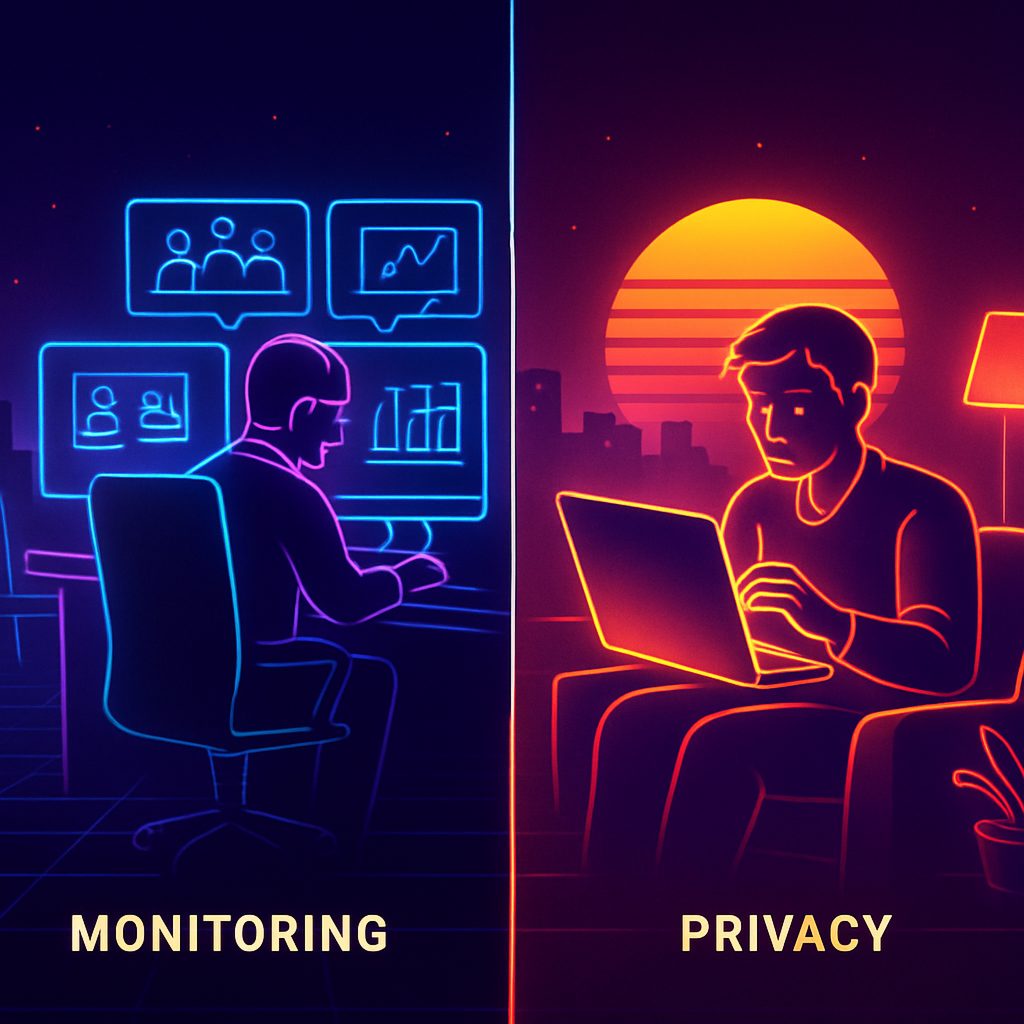
Monitoring remote staff buys accurate records, faster security detection and a visible output signal, and it costs compliance work across jurisdictions, boundary problems around personal devices and trust when it feels heavier than the job needs. The pros are why employers adopt monitoring; the cons are what the notice statutes and data protection regimes regulate.
Pros
- Accurate hours and activity records for payroll, overtime calculations and client billing
- Faster detection of security incidents, data leaks and policy breaches
- Timestamped evidence when a dispute or an investigation needs one
- A visible output signal for distributed teams whose hours do not track results
Cons
- Compliance work in every jurisdiction where a monitored employee sits: written notice in New York, Connecticut and Delaware, a written policy in Ontario, lawful basis and transparency in the EU and UK, consent-based rules in Canada
- Boundary problems around personal devices and home working hours, the exact territory a bring your own device policy draws
- Data protection exposure in the EU and UK, where enforcement turns on the lawful basis, proportionality and transparency duties rather than a fixed per-offense penalty
- Trust costs that surface in how people work and how long they stay
Outcome-based management covers most of the same needs without the watching. Managing a remote team through clear goals, communication rhythms and written updates, with remote team KPIs as the measurement layer, gives you the output signal, and monitoring keeps the narrower job: records, security and the disclosed purposes.
How to give notice
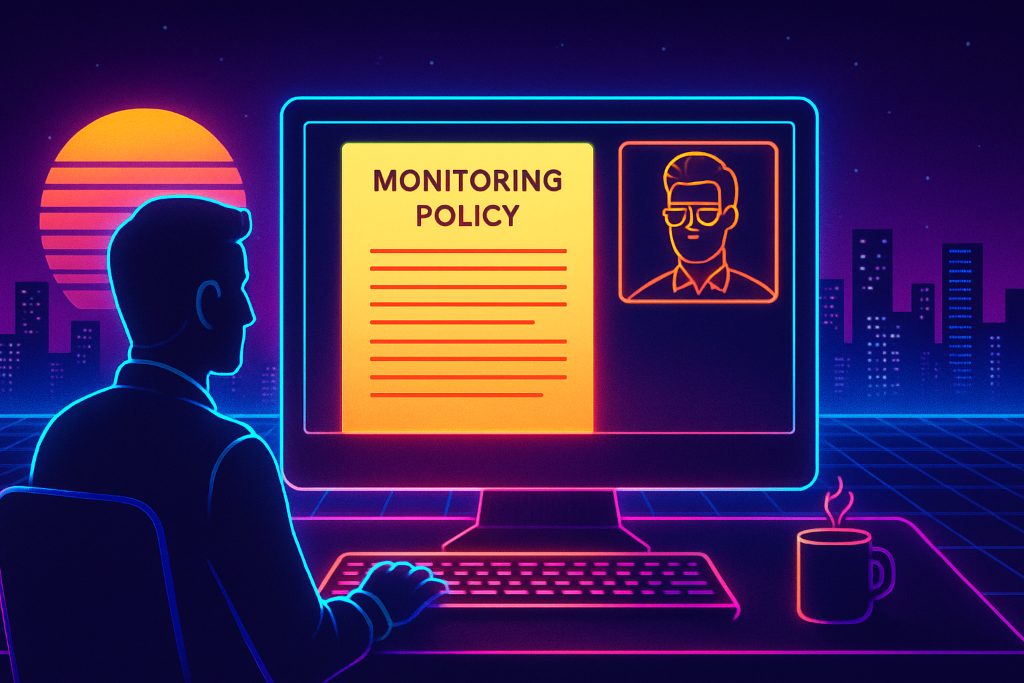
Notifying employees of monitoring takes one written notice that every notice statute accepts. State whether you monitor, what systems and devices are covered, when monitoring runs and what data is collected, have each employee acknowledge it once, and re-issue it whenever it changes. It belongs with your other HR policies for remote workers, alongside the employer responsibilities for remote employees you already carry, not in a one-off email.
- Write the notice or policy before monitoring starts, so the disclosure comes before the collection.
- State whether you monitor at all, what systems and devices are covered, when monitoring runs, during working hours or always, and what data is collected.
- Exclude personal accounts and personal devices explicitly, in writing.
- Get the acknowledgment in writing or electronically, the form New York and Delaware both accept.
- Post the notice where staff actually see it; for a distributed team the handbook and the intranet replace the break room wall.
- Re-issue the notice within 30 calendar days of any change, the window Ontario’s written policy rules set.
- Date the policy when it is prepared and whenever it changes, the record Ontario’s policy contents require.
What goes wrong
The state penalties look small per offense, and they stack per employee, so a monitoring program rolled out without notice across a distributed team multiplies fast. New York’s attorney general can seek up to $500 for a first offense, $1,000 for a second and $3,000 for each one after, Connecticut’s Labor Commissioner holds the same ladder, and Delaware’s $100 civil penalty applies per violation with other remedies preserved.
The expensive parts sit outside the US state penalty columns. Using monitoring data for a purpose never disclosed is a separate failure in the UK and the EU, on top of whatever was wrong with the collection, and monitoring that reaches personal life, home webcams and personal phones is where employers lose both legally and in trust.
None of this argues against monitoring; it argues for the narrow, disclosed version. The notice statutes ask for a paragraph of honest disclosure, the data protection duties for a basis and a purpose you can state in one sentence, and the team’s trust for keeping both visible.
FAQ
Yes: federal law permits monitoring on company systems where an ECPA exception applies, the provider exception or consent, and access to stored communications has to stay within the Stored Communications Act. New York, Connecticut and Delaware add notice duties on top of the federal floor.
No at the US federal level, and yes in the places that matter to a remote team: New York, Connecticut and Delaware require written or electronic notice, Ontario requires a written policy, and the EU, UK and Canada require transparency or consent. The workable default for a distributed team is to notify everyone.
Yes, federal US law can permit it where an ECPA exception applies, which is why undisclosed workplace monitoring exists at all. It is still the wrong default: undisclosed monitoring fails the New York, Connecticut and Delaware notice statutes and the transparency duties across the EU, the UK and Canada.
No, it requires a lawful basis, and consent is only one candidate, rarely the workable one at work. The ICO’s monitoring guidance is direct: consent is unlikely to be freely given in an employment context, so employers lean on a different basis and let transparency and proportionality carry the weight.
Yes, but the monitoring answers to the jurisdiction where each employee sits, not where the company is registered. A worker in Germany brings the GDPR, a worker in London brings the UK GDPR and ICO expectations, and a worker in Ontario brings the written policy duty, so the practical design is one monitoring program with notices per jurisdiction.