

On this page
An employer of record Australia provider is the legal employer of your worker in Australia, employing them on its own Australian entity for about $599 to $699 a month per employee, the range across the current published fees of Deel, Remote and Oyster. You pick the person and direct the work; the provider signs the Australian employment contract, runs payroll and carries the employer obligations Australian law attaches to the legal employer.
On top of salary you fund the superannuation guarantee, Australia’s compulsory employer-paid retirement contribution, at 12% of the worker’s ordinary time earnings for both the 2025-26 and 2026-27 years, per the Australian Taxation Office (ATO). The $599-a-month end of the fee range works out to $7,188 a year per worker, so an Australian entity of your own starts to win on cost once that total times your headcount passes the fixed annual cost of running one.
Australia hiring costs at a glance
| Cost item | Who pays | Typical amount | Source |
|---|---|---|---|
| EOR monthly fee | You, the client company | $599 to $699 per employee a month (USD) | Deel, Remote, Oyster |
| Superannuation guarantee | Employer | 12% of ordinary time earnings (2025-26 and 2026-27) | ATO |
| National Minimum Wage | Employer, as the salary floor | A$26.44 an hour or A$1,004.90 a week from 1 July 2026 | Fair Work Ombudsman |
| Annual leave | Employer | 4 weeks a year for full-time and part-time employees | Fair Work Ombudsman |
| Sick and carer’s leave | Employer | 10 days a year for full-time employees | Fair Work Ombudsman |
| Workers compensation insurance | Employer | Mandatory, arranged per state or territory | business.gov.au |
| State payroll tax | Employer | 4.85% to 5.45% above A$1,000,000 to A$1,500,000 state thresholds | Revenue NSW |
| Notice of termination | Employer | 1 to 4 weeks by years of service | Fair Work Ombudsman |
| Redundancy pay | Employer | 4 to 16 weeks by years of service, exempt under 15 employees | Fair Work Ombudsman |
| Entity setup instead | Employer | A proprietary limited (Pty Ltd) company via ASIC, varies | ASIC |
The EOR fee is the predictable part of the monthly cost; the super guarantee, leave and termination minimums travel with the role, whoever employs the worker. State payroll tax is the only item that scales with your total Australian wages rather than the individual role.
How an EOR works
An employer of record (EOR) is the legal employer of your Australian worker on an Australian employment contract through its own entity, so you direct the day-to-day work without becoming the employer yourself. The provider registers with the ATO for pay as you go (PAYG) withholding, runs payroll, withholds income tax from each pay and pays the super guarantee to your worker’s chosen superannuation fund, per the Fair Work Ombudsman’s tax and super guidance.
It also gives every new employee the Fair Work Information Statement on day one, which the National Employment Standards require, and applies the modern award that covers the role. Hiring employees in Australia in practice means picking the person first, then choosing the employment route: an EOR contract, your own Pty Ltd entity, or a contractor agreement if the role is genuinely independent.
Onboarding timelines vary by provider and by the role’s award, and providers quote them per case, so treat any timeline a provider gives you as indicative rather than fixed.
Cost comparison
| Headcount | EOR fee (USD per year) |
|---|---|
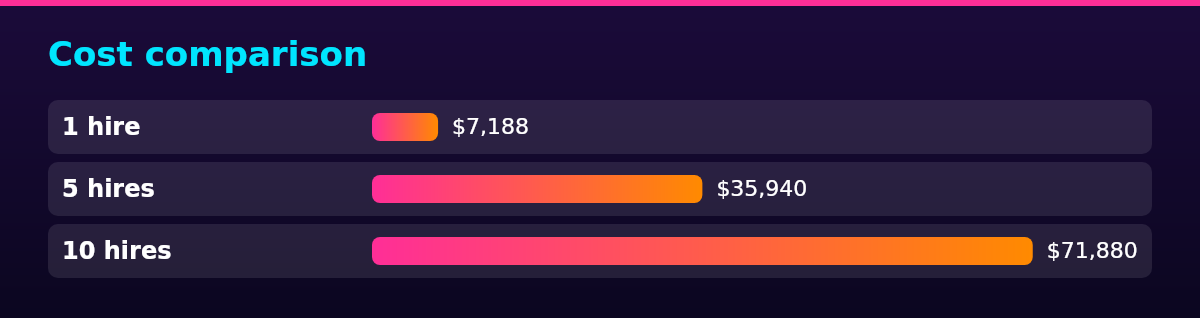
| 1 hire | $7,188 |
| 5 hires | $35,940 |
| 10 hires | $71,880 |
The EOR side scales linearly: the $599 monthly fee on Remote’s pricing page works out to $7,188 a year per worker, about $35,940 at five hires and about $71,880 at ten. The crossover against an Australian entity sits where that fee total passes the entity’s fixed annual cost; the EOR fee stops when someone leaves, and an entity’s costs do not.
Both routes carry the same 12% super guarantee on top of salary, so it does not swing the comparison: on a salary of A$100,000, super adds A$12,000 a year whoever employs the worker, per the ATO’s super guarantee rates.
The entity side is mostly fixed: a Pty Ltd registered with ASIC carries a registration fee, a registered office and ongoing company admin and accounting, and those costs barely rise with headcount. Those figures vary by advisor and state, so the comparison works from the EOR fees above.
State payroll tax only applies once total Australian wages pass your state’s annual threshold, so it rarely decides this comparison at small headcounts. The cost of employer of record services guide breaks down how these fees vary across countries and providers.
Legal compliance in Australia
Australian employment law attaches to whoever employs the worker, and under an EOR that is the provider’s Australian entity, which owes the National Employment Standards, the applicable modern award and every registration an Australian employer carries. The NES set the floor for all employees in the national system, and awards, agreements and contracts cannot provide less than them, per the Fair Work Ombudsman.
That floor includes superannuation contributions as a minimum entitlement, so the 12% guarantee is not optional, plus 4 weeks of paid annual leave for full-time and part-time employees, per the Fair Work Ombudsman.
Paid sick and carer’s leave runs at 10 days a year for full-time employees, pro-rata for part-time, and casual employees get 2 days of unpaid carer’s leave per occasion, per the Fair Work Ombudsman.
Modern awards set minimum pay and conditions for most private-sector roles above that floor, and each award carries its own role classifications, per the business.gov.au guide to hiring employees.
For award-free roles, the National Minimum Wage is A$26.44 an hour, or A$1,004.90 a week, from 1 July 2026, per the Fair Work Ombudsman, and award-covered employees get their award’s rates, which are often higher.
Workers compensation insurance is mandatory for employers in Australia, arranged with the insurer in each state or territory, per the same business.gov.au guide.
Contractor misclassification is the compliance risk to take seriously: since 26 August 2024 the employee-or-contractor call uses the whole of relationship test, weighing the real substance and practical reality of the whole relationship rather than the contract’s label, per the Fair Work Ombudsman. The factors include control over how work is done, financial responsibility and risk, who supplies tools and equipment, the ability to subcontract, hours of work and the expectation of continuing work, and a court decides the hard cases.
The permanent establishment exposure under an EOR is narrower than a direct contractor hire, because the provider’s Australian entity is the legal employer of your worker, so the first hire alone usually does not make your company the Australian employer. What to watch is authority: a worker, or the EOR acting for you, with authority to conclude contracts in your name is what a dependent-agent permanent establishment (PE) turns on. The permanent establishment guide sets out the triggers in detail.
Payroll taxes in Australia
| State | Standard payroll tax rate | Annual tax-free threshold | Source |
|---|---|---|---|
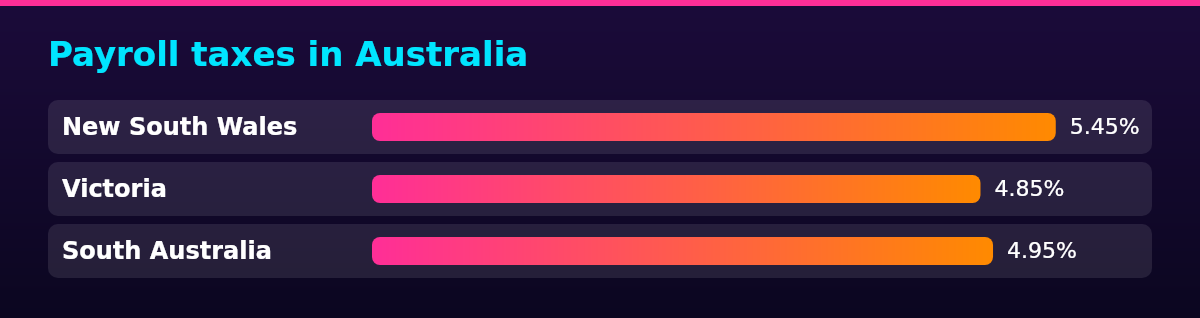
| New South Wales | 5.45% | A$1,200,000 | Revenue NSW |
| Victoria | 4.85% | A$1,000,000 | State Revenue Office |
| South Australia | 4.95% | A$1,500,000 | RevenueSA |
| Queensland | Published by the state office | Published by the state office | Queensland Revenue Office |
| Western Australia | Published by the state office | Published by the state office | Revenue WA |
Payroll tax is a state tax on the employer, not a deduction from the worker: it applies once the total Australian wages your paying entity runs pass the state’s annual tax-free threshold, at the standard rates in the table above. Victoria’s threshold moved to A$1,000,000 from 1 July 2025 and phases out between A$3,000,000 and A$5,000,000 of Australian wages, per the State Revenue Office.
Related businesses are usually treated as one employer for the threshold test: in NSW, businesses with a link between them are grouped, and only one member of a payroll tax group can claim the annual tax-free threshold, per Revenue NSW’s grouping rules. Grouping applies in the other states too, so check with the state office before assuming a single entity’s wages are under the threshold.
At the federal level, employers withhold income tax from wages under the PAYG withholding system and remit it to the ATO on progressive rates the ATO sets; the Fair Work Ombudsman’s tax and super page summarizes the employer side.
The super guarantee runs at 12% of ordinary time earnings for both the 2025-26 and 2026-27 years, with no guarantee owed on earnings above the A$270,830 maximum contribution base for 2026-27, per the ATO’s key super rates and thresholds. From 1 July 2026, Payday Super changes the timing: the guarantee must be paid for each payday rather than in the quarterly cycle that applies up to 30 June 2026.
EOR versus a local entity
An EOR fits a first hire, a fixed-term project or a headcount in the single digits, where $7,188 a year per worker, the $599 monthly fee on Deel’s pricing page, buys a fully employed person without an Australian company of your own. A Pty Ltd fits a longer commitment: it is your entity, your employees and your name on the contracts, and its registration and admin costs stay mostly flat as the team grows. A contractor agreement fits a genuinely independent role, with no EOR fee and no entity to run, and the reclassification risk decides whether it stays that way.
The entity also changes your tax position: an Australian company pays company tax at 25% as a base rate entity and 30% otherwise for 2025-26, per the ATO.
The contractor route is the third option, and it is where the reclassification risk sits: the whole of relationship test applies, and paying someone as a contractor does not make them one if the substance of the arrangement looks like employment.
The crossover from the cost comparison decides the first two routes: at lower headcounts the EOR fees are usually the smaller number, and past the point where they exceed an entity’s fixed annual cost, the entity is. Equity, IP ownership and in-house visa sponsorship can pull that decision earlier.
Scaling framework
| Stage | Headcount | Model that fits | Trigger to move on |
|---|---|---|---|
| 1 | 1 hire | EOR | None yet: one hire’s fee is far below any entity’s fixed cost |
| 2 | 2 to 5 hires | EOR | The annual fee total closing in on a fixed entity cost |
| 3 | 6 to 10 hires | EOR or Pty Ltd | The fee total passing the entity’s fixed cost, or a need for in-house visa sponsorship |
| 4 | More than 10 hires | Pty Ltd | Set up the Australian entity once payroll tax thresholds, equity and IP ownership matter at scale |
The EOR is the default through stage 2 because its fee scales with people and stops when someone leaves, while an entity’s costs do not. The move at stage 3 is a cost call rather than a compliance one, and the state payroll tax thresholds start to matter as the team grows, since the tax applies to total wages rather than per hire.
Termination rules in Australia
| Continuous service | Minimum notice |
|---|---|
| 1 year or less | 1 week |
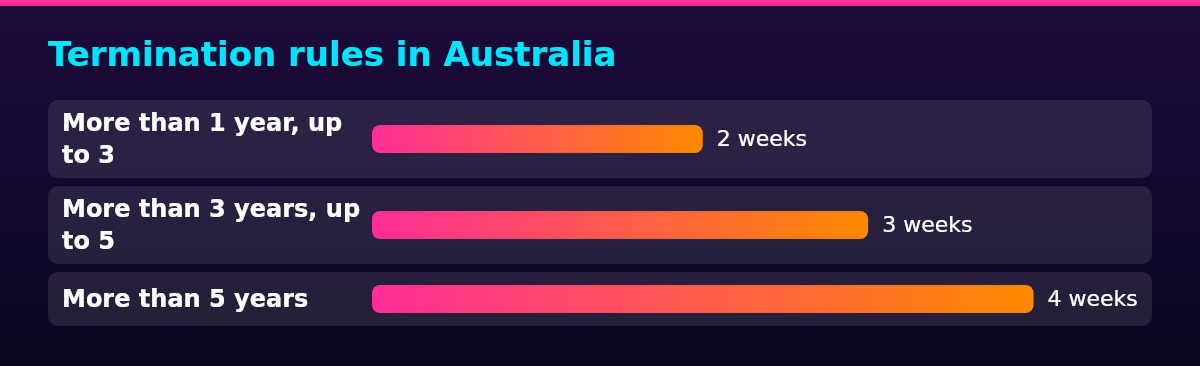
| More than 1 year, up to 3 | 2 weeks |
| More than 3 years, up to 5 | 3 weeks |
| More than 5 years | 4 weeks |
Employees over 45 with at least 2 years of service get an extra week on top of their notice, payment in lieu of notice is allowed, and the same notice minimums apply during probation, per the Fair Work Ombudsman’s dismissal rules.
NES redundancy pay runs from 4 weeks after a full year of service to a peak of 16 weeks between 9 and 10 years, dropping to 12 weeks at 10 years or more when long service leave takes over, per the Fair Work Ombudsman. Employers with fewer than 15 employees are exempt from NES redundancy pay altogether.
Unfair dismissal protection needs 6 months of service, or 12 months if the employer is a small business with fewer than 15 employees, per the Fair Work Ombudsman.
There is no at-will employment in Australia: the notice minimums above apply to every dismissal except for serious misconduct, and an award or agreement can add to them.
FAQ
An employer of record in Australia is a provider that employs your Australian worker on its own Australian entity: it signs the employment contract, runs payroll, pays the super guarantee and carries the employer obligations, while you direct the day-to-day work. It is how companies hire in Australia without registering a company there.
An employer of record in Australia currently costs $599 to $699 a month per employee: Deel starts at $599 per EOR employee a month on Deel’s pricing page, Remote starts at $599 and Oyster charges $699, per their current published fees. On top of the fee you fund the worker’s salary and the 12% super guarantee.
You hire employees in Australia by picking the person, then choosing the employment route: an EOR contract through a provider, your own Pty Ltd entity, or a contractor agreement when the role is genuinely independent. Companies without an Australian entity usually take the EOR route for their first hires, because it makes the provider the legal employer without a local company.
An EOR is the full legal employer of your worker, while a professional employer organization (PEO) is a co-employment arrangement in which you keep your own entity and share employment responsibilities with the provider. Australia is not a PEO market in the US sense, and the PEO vs EOR comparison sets out the differences in detail.
You find an employer of record by comparing providers on the criteria the choosing the right EOR guide names: whether it holds its own Australian entity, its fee per employee, its visa sponsorship capability and its local payroll and benefits support.
Yes, an employer of record is a lawful employment arrangement in Australia: the provider’s entity employs the worker under Australian employment law, and the National Employment Standards, the applicable award and PAYG withholding apply as they would to any local employer.
Yes, when the provider is an approved sponsor through its own Australian entity: employing a non-citizen requires sponsorship through Australia’s immigration system, per the Department of Home Affairs, and the employer-sponsored route is the Skills in Demand (subclass 482) visa. Whether a given EOR offers work visa sponsorship varies, because it depends on the provider’s own entity and sponsor approvals rather than the arrangement itself.
Usually not for a first hire alone, because the EOR’s own Australian entity is the legal employer, so your company is not the one employing people in Australia. The exposure to watch is authority: a worker, or the provider acting for you, with authority to conclude contracts in your name is what a dependent-agent PE turns on, so scope what your Australian hire can sign.