

On this page
How to pay international employees has three legal answers: an employer of record (EOR) that employs the worker in their own country, your own local entity with payroll run there, or a global payroll provider running payroll on your entity. An EOR costs $499 to $599 per employee a month at current list prices from Deel, Remote and Papaya Global; the entity routes trade that monthly fee for setup cost and fixed running costs.
Which route fits depends on three things: how many people you employ in the country, how long the team will exist, and whether you already have a legal entity there. A fourth option people reach for, paying the person as a contractor, is not a route: it is misclassification, a risk that costs more to unwind than any legal route costs to run.
The three legal routes
| Route | Legal employer | Entity in the worker’s country | Typical cost per employee | Best suited to |
|---|---|---|---|---|
| Own entity with local payroll | Your local company | Required, set up by you | Local payroll admin, no platform fee | Long-lived teams with in-country revenue |
| Employer of record (EOR) | The EOR’s local entity | Not required | $499 to $599 a month at current list prices | First hires and small teams that need speed |
| Global payroll on your entity | Your company | Required, already owned | About $29 a month plus entity running costs | Teams spread across several countries |
Routes one and three share one requirement, a legal entity in the worker’s country, and differ in who runs the payroll. Only the EOR route needs no entity, which is why it carries the highest monthly price and the least setup.
Your own entity
Route one is your own legal entity in the worker’s country: you incorporate locally, register that company as an employer, and run payroll through it, either in-house or with a local payroll firm. The entity is the legal employer on the contract, it withholds income tax at source, and it pays the local employer contributions from its own accounts.
Government setup fees are usually the smallest line item. In the UK, incorporating a private limited company currently costs £100 online, £124 on paper, or £156 same-day, per the Companies House fee schedule.
Employer registration is separate from incorporation and happens with each country’s tax and social security agencies:
- In the UK, you register the company for PAYE to tell HM Revenue and Customs you are employing people, a step the gov.uk company setup guide includes in online formation.
- In Canada, you open a payroll program account with the Canada Revenue Agency before the first pay run.
- In Mexico, you register as an employer with the Mexican Social Security Institute and pay its employer quotas.
The trade-off is permanent establishment (PE): once your entity has staff and revenue-earning activity in the country, corporate tax exposure usually follows, which is why the permanent establishment risk assessment belongs in the setup conversation. Entity payroll wins when the team is long-lived, the headcount in the country is meaningful, or you have in-country revenue that needs a local company anyway. It is also the slowest route: incorporation, employer registration and a first payroll run all sit on the critical path.
An employer of record
An employer of record (EOR) is a provider that employs your worker in their country on your behalf: its local entity is the legal employer on the contract and payroll, while your team manages the person’s work. You keep the hiring, the workload and the reporting line. The EOR keeps the employment law, the contract and the contributions.
Per-employee pricing, read on the day from each vendor’s own pricing page, currently sits in a narrow band:
- Deel lists $599 per EOR employee a month.
- Remote lists $599 per employee a month for its EOR.
- Papaya Global lists EOR from $499 per employee a month.
- Rippling sells an EOR and global payroll too but currently publishes no EOR price on its pricing page; its plans start at $8 per employee a month for the core platform.
The monthly fee is not the whole cost of an employer of record: employer contributions and benefits sit on top of it, and the employer of record cost breakdown covers how those stack up by country. The route wins when speed and flexibility matter more than fees: a first hire in a new country, a short-lived project, or a small team in a market you are still testing. It is also the only route with nothing to wind down if the team dissolves.
Global payroll on your entity
Route three applies once you own entities: a global payroll provider runs payroll, tax filings and statutory contributions across your own companies in several countries from one platform. You keep the legal employment, and the provider supplies the software, the local compliance and the filings.
Per-employee pricing, read on the day from each vendor’s own pricing page:
- Remote lists global payroll at $29 per employee a month.
- Papaya Global lists its Payroll Plus plan at $29 per employee a month.
Country coverage, platform depth and published prices are compared provider by provider in the global payroll providers roundup. The route wins when your headcount is spread across countries you already operate in: global payroll costs roughly $570 less per employee a month than an EOR at Remote’s current prices, and it survives mergers, where an inherited workforce comes with existing entities. It also gives you a clean way to come off an EOR once you incorporate: the entity takes over the employment, and the provider takes over the payroll.
Why contractor pay is misclassification
Paying an employee who lives abroad as a contractor is not a payment route: no contract, invoice or payment platform creates a legal employment where none was set up, and status is decided by the facts of the working relationship, not by the paperwork. In the US, the IRS independent contractor guidance weighs behavioral control, financial control and the relationship of the parties.
The consequences land on you as the employer: the worker’s country can order back payment of social contributions and unpaid wages, plus penalties, and the independent contractor misclassification tests set out country by country how regulators decide the question. Retroactive claims arrive years into a working relationship, when the back payments are largest.
Genuine contractors are different, and paying them abroad is routine: a freelancer with several clients, their own equipment and their own schedule is a contractor, and US payers handle 1099 reporting for foreign contractors with a W-8BEN form instead of payroll.
What employer contributions cost
| Country | Mandatory employer cost on top of salary | Source |
|---|---|---|
| United Kingdom | 15% National Insurance on earnings above the secondary threshold, 2026-27, less the £10,500 Employment Allowance where eligible | HMRC rates and thresholds |
| Canada | 5.95% Canada Pension Plan match on pensionable earnings, 2026 | CRA contribution rates |
| Mexico | An aguinaldo of at least 15 days of wages every December | PROFEDET aguinaldo guidance |
| Brazil | An 8% FGTS deposit of each month’s pay, by the 20th of the following month | Law 8.036 of 1990, art. 15 |
Canada adds Employment Insurance on top of CPP: employers pay 1.4 times the employee premium, $2.28 per $100 of insurable earnings in 2026, on earnings up to $68,900 a year, per the Employment Insurance Commission’s 2026 rate.
Brazil adds a 13th salary on top of FGTS: Law 4.090 of 1962 requires a December payment equal to 1/12 of the month’s pay for each month worked in the year. Mexico’s aguinaldo must reach the worker before December 20.
These costs ride on top of salary under every route: with an EOR they are billed through the provider, on your own entity the payroll provider calculates and remits them, and on a misclassified contractor they fall due retroactively if the status is corrected. That last case is why the contractor shortcut is the most expensive way to pay international employees.
Payroll for remote employees
Payroll for remote employees abroad is local payroll: wages in the local currency, statutory withholding and contributions on the country’s own schedule, and payslips that meet local format rules. Whatever route carries the employment, the money has to land like a local salary.
Pay dates and statutory extras differ by country, so the payroll calendar is a compliance document, not a preference. Brazil’s 13th salary adds an extra month of pay a year, paid in December on the schedule Law 4.090 of 1962 sets.
Mexico’s aguinaldo adds at least 15 days’ wages before December 20, per the PROFEDET guidance. Budget December cash for both obligations, because the year-end payments are on top of the regular salary run.
Foreign exchange sits on every cross-border payment: providers charge a margin above the mid-market rate, and an employee paid in local currency expects a stable net amount. Most EOR and global payroll platforms deliver funds through local bank rails and quote a monthly cost that includes the transfer, so the question to ask any provider is who absorbs the FX margin and where it appears on the invoice.
If your team is remote across US states rather than countries, the same problem appears as state income tax withholding, reciprocity agreements and unemployment insurance, which multi-state payroll processing covers state by state.
Choose the route by headcount
| Employees in one country | EOR fees a year | Global payroll fees a year | Difference |
|---|---|---|---|
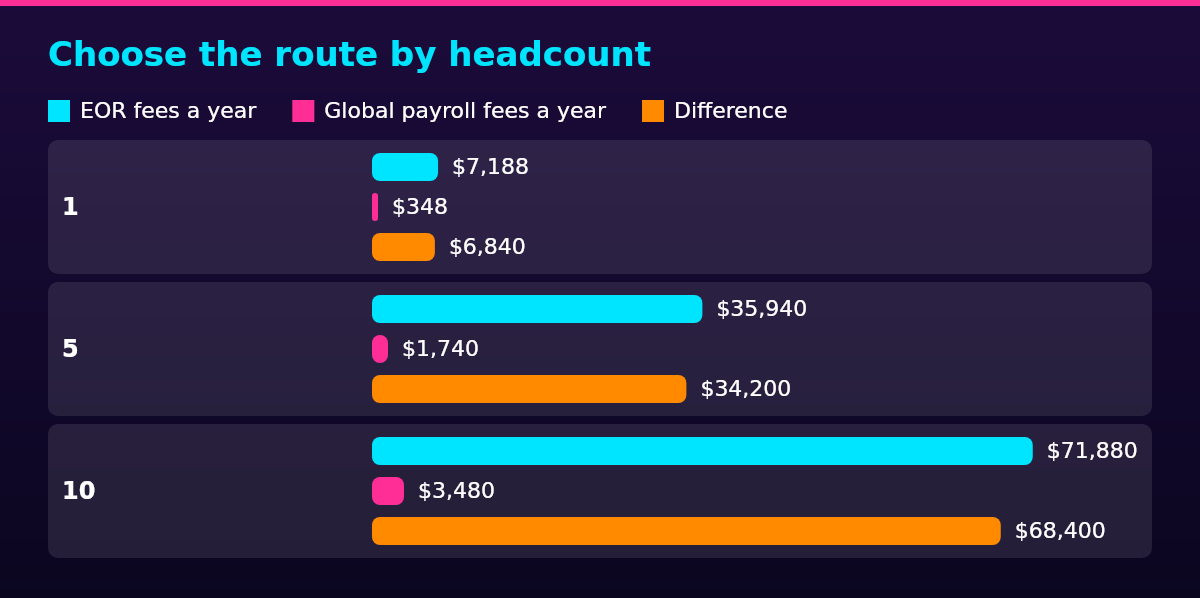
| 1 | $7,188 | $348 | $6,840 |
| 5 | $35,940 | $1,740 | $34,200 |
| 10 | $71,880 | $3,480 | $68,400 |
The EOR column multiplies the $599 a month that Deel currently lists for an EOR employee by 12 months; Remote lists the same price.
The global payroll column multiplies the $29 a month that Remote currently charges by 12 months; Papaya Global’s Payroll Plus lists the same. Entity running costs, legal, accounting, audit and local staff, are the missing number: the entity route beats the EOR once those fixed costs stay under the difference column.
The rule of thumb the table supports: under about five long-lived employees in a country, an EOR usually costs less than building and running an entity; past ten, an entity with global payroll usually wins if the fixed costs are held in check. What flips it: jurisdictions with audit and local director requirements raise the fixed costs, teams that will wind down within two years rarely repay a setup, and country complexity matters as much as headcount, since one engineer in a heavily regulated market can justify an entity while ten in a simple one might not.
Prices move, so re-run the table with quotes before committing: EOR fees vary by country, benefits add to both routes, and global payroll pricing is usually tiered by headcount and features.
Setting up your chosen route
Whichever route you pick, the sequence is the same six steps:
1. Confirm the country and the worker’s status
The worker’s country sets every rule that follows, and the facts of the working relationship set whether they are an employee or a contractor. Settle both before choosing a route.
2. Pick the route against the headcount table
Match your headcount per country and your time horizon to the headcount table: short-lived or under about five hires, an EOR; owned entities across countries, global payroll; a long-lived team of ten or more, your own entity.
3. Register the entity or sign the EOR
Route one means incorporation plus employer registration. Routes two and three mean signing a provider agreement, and only route one creates anything that outlives the contract.
4. Register with the local tax agencies
On an entity route, register for income tax withholding and social contribution remittance in the worker’s country. An EOR already holds those registrations, which is the service you are paying for.
5. Run the first payroll and file
Run a first pay run and check the withholding math against the local tables before the first real salary lands. Filing deadlines start with the first payroll, not at the end of the year.
6. Review the setup every year
Re-run the headcount table annually, and re-quote the EOR or payroll fee when you add a country. An entity that stops earning its keep can be closed and the team moved onto an EOR, though closing carries its own costs.
FAQ
A US company pays a foreign employee through an employer of record in the worker’s country, on its own local entity with local payroll, or through a global payroll provider on an entity it already owns there. Paying the person as a contractor when they work like an employee is misclassification, not a shortcut.
No, not if the person works like an employee: control, exclusivity and financial dependence are what the misclassification tests weigh, and a contract that calls the relationship contracting does not survive them. Genuine contractors exist, and paying one abroad is a forms problem, not a payroll problem.
No. An employer of record supplies the legal employment in the worker’s country without any entity of yours, which is what its monthly fee buys. Your own entity only pays off when headcount or longevity covers its fixed costs.
A genuine overseas contractor is paid by invoice against a contractor agreement, with the right tax forms on your side: US payers collect a W-8BEN and report the payments on Form 1042-S, the standard 1099 paperwork for foreign contractors.
There is no single best, because the tool follows the route: on your own entities, global payroll platforms such as Remote’s run payroll for about $29 an employee a month, and the global payroll roundup compares them provider by provider. Without entities, an EOR is the comparison class, at the monthly fees in the routes table.