

On this page
An employer of record Philippines setup puts a provider on record as the legal employer of your Philippine hire, for about $599 a month per worker, the current rate at Deel. On top of that fee, you fund the employer’s share of SSS (10%), PhilHealth (2.5%) and Pag-IBIG (2%) contributions, plus 13th month pay. An employer of record (EOR) is a company that legally employs a worker on your behalf in a country where you have no entity, running payroll, statutory contributions and local compliance while you direct the day-to-day work. Past a certain headcount, the export-oriented entity route (see the capital carve-out below) usually costs less than stacking EOR fees.
Philippines hiring costs at a glance
| Cost | Who pays | Rate or amount | Source |
|---|---|---|---|
| EOR fee | Employer | $599 a month per worker | Deel pricing, Remote pricing |
| SSS contribution | Employer 10%, employee 5% | Up to the ₱35,000 monthly salary credit ceiling | SSS Circular No. 2024-006, reported by Grant Thornton Philippines |
| PhilHealth contribution | Employer 2.5%, employee 2.5% | On salary from ₱10,000 to ₱100,000 a month | taxcalculatorphilippines.com PhilHealth table |
| Pag-IBIG contribution | Employer 2%, employee 1 to 2% | Capped at ₱10,000 monthly compensation, so at most ₱200 a month each side | ihri.ph salary deductions calculator |
| 13th month pay | Employer | 1/12 of basic salary earned in the year, no ceiling | the full text of Presidential Decree No. 851 |
| Entity setup instead | Employer, one time | ₱5,000 for export-oriented enterprises, $200,000 otherwise | respicio.ph on Foreign Investments Act minimums |
How EOR works in the Philippines
Employer of record services in the Philippines make the provider the legal employer on a Philippine employment contract: it registers your hire with the SSS, PhilHealth and Pag-IBIG, pays the 13th month benefit, runs withholding tax on compensation, and handles termination and notice requirements under the Labor Code. You direct the work and set pay, but the provider signs the contract and carries the statutory obligations. Onboarding typically takes a few days to a few weeks once the provider has the hire’s documents, faster than registering a Philippine entity from scratch.
Employer of record services Philippines providers draw from a large labor pool: the Philippine IT-BPM industry earned $40 billion in revenue and provided 1.9 million jobs in 2025, up 5% in revenue and 4% in employment over 2024, according to IBPAP figures reported by the Manila Times. That means English-proficient customer-support, back-office and software talent is already working inside the SSS, PhilHealth and Pag-IBIG compliance framework this guide describes, whether you hire employees in the Philippines through an EOR or set up your own entity. Most of that hiring happens in or around Metro Manila and other established BPO hubs, which is also why this guide’s minimum-wage figures use the National Capital Region as the worked example.
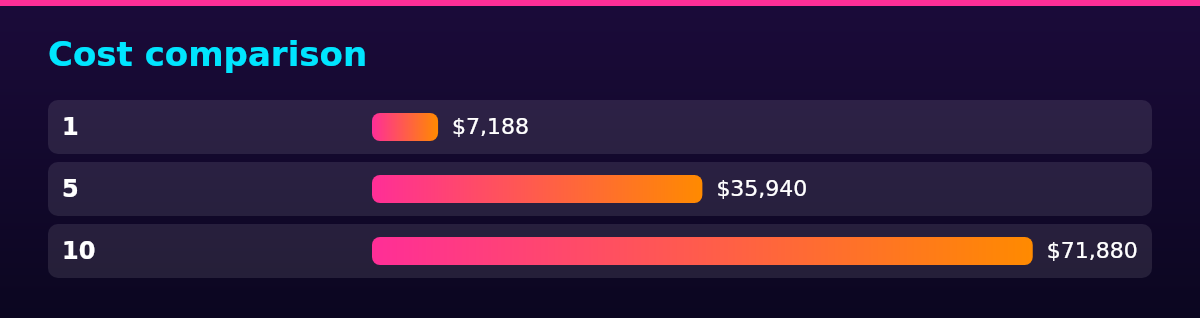
Cost comparison
| Hires | Annual EOR cost (at $599/month) | Entity setup cost |
|---|---|---|
| 1 | $7,188 | ₱5,000 (export-oriented) or $200,000 (domestic-market) |
| 5 | $35,940 | ₱5,000 (export-oriented) or $200,000 (domestic-market) |
| 10 | $71,880 | ₱5,000 (export-oriented) or $200,000 (domestic-market) |
Most foreign employers hiring remote or BPO staff in the Philippines qualify as export-oriented enterprises (exporting 60% or more of output or services), which drops the minimum paid-in capital to the ₱5,000 Revised Corporation Code baseline instead of the $200,000 minimum that applies to a domestic-market enterprise more than 40% foreign-owned, under the Foreign Investments Act. That minimum drops further to $100,000 if the enterprise uses DOST-certified advanced technology or employs at least 50 direct Filipino employees within its first three years. Once your own entity’s fixed running costs, SEC registration and in-house payroll compliance come in under what EOR fees would cost at your headcount, the entity route wins; for an export-oriented enterprise, that crossover often arrives well before ten hires.
A worked example, using the salary deductions calculator rates above: on a ₱40,000 monthly salary, employer contributions run to roughly ₱4,700 a month, about ₱3,500 for SSS at the ceiling, ₱1,000 for PhilHealth, and ₱200 for Pag-IBIG at its ceiling, plus one extra month’s pay a year for the 13th month benefit. Run the same arithmetic at your own salary level: 10% SSS up to the ₱35,000 ceiling, 2.5% PhilHealth on salary up to ₱100,000, and 2% Pag-IBIG up to ₱10,000 compensation.
Employer of record services cost run at a similar range across most countries RemoteTeamer covers, with the local statutory load as the real variable; the broader cost comparison across countries shows how the Philippines’ lighter contribution load compares.
Legal compliance in the Philippines
The standard workweek under the Labor Code is 8 hours a day, under Article 83 (renumbered Article 90).
Philippine courts use the four-fold test to decide whether a worker is an employee or a genuine contractor: selection and engagement, payment of wages, power of dismissal, and control over the means and method of the work, with control as the most determinative factor, according to laborlaw.ph’s summary of established jurisprudence. A worker found to be misclassified can be declared a regular employee, which exposes the hiring company to back SSS, PhilHealth, Pag-IBIG and 13th month obligations and security-of-tenure protections; this is one reason employers lean on an EOR rather than treat a Philippine hire as an independent contractor.
The Labor Code does not mandate a single contract language, but a written contract is standard practice, setting out position, salary, work location, benefits and probationary terms in English or Filipino so the employee understands it. An EOR drafts this contract to match the Labor Code’s required terms, so the probationary cap, pay schedule and termination grounds hold up in a Philippine labor dispute. Philippine employment is also not at-will: a worker can be dismissed only for a just or authorized cause the Labor Code recognizes, with the matching notice below.
Minimum wage is set region by region, not nationally. In the National Capital Region, Wage Order No. NCR-28 sets the daily minimum at ₱755 for non-agriculture employers and ₱718 for agriculture, small retail and service establishments, and small manufacturing firms, effective 26 September 2026. Rates outside the NCR are set by each region’s own wage board and run lower.
An earlier order, NCR-27, set the same ₱755 first-tranche rate for 25 July 2026, rising to ₱780 on a second tranche effective 20 January 2027, but it remains under litigation before the Pasig and Navotas regional trial courts: the Pasig court issued a temporary restraining order on 30 July 2026 and a writ of preliminary injunction on 13 August 2026, per mercans.com; NCR-28 was issued separately, so that litigation does not block it.
An EOR’s Philippine employment contract, not the foreign company’s own presence, is the taxable local employer of record, so the arrangement is built to avoid creating a Philippine permanent establishment for the hiring company.
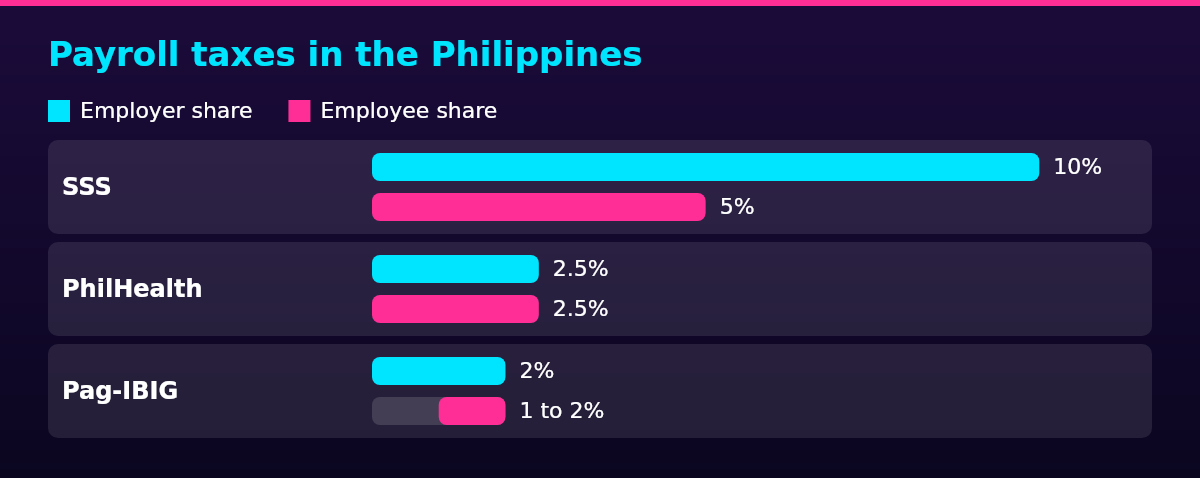
Payroll taxes in the Philippines
| Contribution | Employer share | Employee share | Income range |
|---|---|---|---|
| SSS | 10% | 5% | ₱5,000 to ₱35,000 monthly salary credit |
| PhilHealth | 2.5% | 2.5% | ₱10,000 to ₱100,000 monthly salary |
| Pag-IBIG | 2% | 1 to 2% | Capped at ₱10,000 monthly compensation |
SSS, PhilHealth and Pag-IBIG are the three mandatory contributions behind employer of record services Philippines pricing. On top of these, withholding tax on compensation follows the Bureau of Internal Revenue’s progressive table, with the top bracket applying to higher Philippine salaries; an EOR runs this withholding as part of its payroll service, so you don’t file it yourself.
Employers remit SSS, PhilHealth and Pag-IBIG contributions on a monthly schedule tied to the employer’s registration number, and file withholding tax returns with the Bureau of Internal Revenue on its own monthly and annual deadlines. A foreign employer with no Philippine entity never files any of these directly: the EOR, as the registered Philippine employer under its own SSS employer registration, handles every filing and remittance as part of its payroll service, and carries the penalties for a late or incorrect filing rather than passing that risk to you.
EOR versus a local entity
An EOR fits a first Philippine hire, or a small team where $599 a month per worker beats the cost and timeline of incorporating. A local entity fits once headcount is high enough that its fixed costs undercut stacked EOR fees, especially for an export-oriented enterprise facing only the ₱5,000 Corporation Code minimum rather than the $200,000 domestic-market threshold. A PEO is a different model: a Philippine EOR is not a PEO, since the EOR itself is the legal employer rather than a co-employer alongside your own registered entity. A contractor arrangement avoids both the EOR fee and entity setup cost, but only holds up where the four-fold test genuinely supports independent-contractor status; misclassifying a de facto employee as a contractor exposes you to the same back-contribution and security-of-tenure liability covered above.
Scaling framework
| Stage | Hires | Model | Trigger to move on |
|---|---|---|---|
| 1 | 1 | EOR | Fee total still beats entity setup cost |
| 2 | 2 to 5 | EOR or export-oriented entity | ₱5,000 entity minimum starts to beat stacked EOR fees |
| 3 | 6 to 10 | Export-oriented entity | Direct-employee count approaching the 50-employee capital-reduction threshold |
| 4 | 10+ | Full Philippine entity | In-house payroll and compliance capacity is in place |
When to set up a Philippines entity instead of staying on an EOR depends on how fast your Philippine headcount is growing and whether your hiring qualifies as export-oriented, since that status is what brings the ₱5,000 capital minimum instead of the $200,000 or $100,000 domestic-market thresholds, per the Foreign Investments Act minimums covered above.
Termination rules in the Philippines
| Cause | Notice | Separation pay | Source |
|---|---|---|---|
| Probationary period | Up to 6 months from start date (Article 296, renumbered from Article 281) | Not applicable | Labor Code Article 296 |
| Authorized cause (redundancy, labor-saving devices, retrenchment, closure) | At least 1 month to the employee and DOLE before the effective date (Article 298, renumbered from Article 283) | Redundancy: 1 month’s pay or 1 month per year of service, whichever is higher. Retrenchment or closure not due to serious losses: 1 month’s pay or half a month per year of service, whichever is higher | Labor Code Article 298 |
| Just cause (employee misconduct) | No statutory advance-notice period; twin-notice rule applies | Not applicable | Labor Code twin-notice rule |
A fraction of at least six months of service counts as one full year for separation pay. In the Philippines, just-cause termination carries no statutory advance-notice period under the Labor Code, but due process still requires the twin-notice rule, per Article 298 (renumbered from Article 283) of the Labor Code: a notice to explain, and after a hearing or written explanation, a notice of decision.
FAQ
An employer of record in the Philippines costs about $599 a month per worker at the current Deel rate, plus the employer’s 10% SSS, 2.5% PhilHealth and 2% Pag-IBIG contributions and 13th month pay on top.
In the Philippines, the Labor Code requires 5 days of service incentive leave a year after one year of service (Article 95, renumbered Article 102); many employers offer more as a separate policy, but the statutory floor is 5 days.
Yes. Using an EOR to employ staff in the Philippines is legal; the provider takes on the legal-employer role and statutory obligations that a foreign company without a local entity cannot carry directly.
A BPO company hires its own staff to perform outsourced work for your business, while an EOR legally employs your own hire on your behalf so you direct their work directly; the Philippines’ large BPO industry means EOR providers there draw on the same skilled labor pool.
No. Under the Philippine Labor Code’s twin-notice rule, even just-cause termination requires a notice to explain and, after a hearing, a notice of decision; authorized-cause termination also requires at least one month’s written notice to the employee and DOLE, per Article 298 (renumbered from Article 283) of the Labor Code.
You hire through an employer of record, which signs the Philippine employment contract, registers the worker with SSS, PhilHealth and Pag-IBIG, and runs payroll and withholding tax, so you never need to register your own Philippine entity.