

On this page
An employer of record Mexico arrangement makes a provider the legal employer of your Mexican hire for about $599 a month, the going rate for a flat, global plan rather than a Mexico-specific tier. On top of that fee, employer contributions to Mexico’s Instituto Mexicano del Seguro Social (IMSS) run to roughly 29 to 30% of payroll, according to a branch-by-branch breakdown in Rippling’s Mexico hiring guide, plus a flat 5% employer-only contribution to the national housing fund, INFONAVIT. An employer of record (EOR) in Mexico takes on the legal employment contract, the IMSS and INFONAVIT registrations, and the payroll filings, while you keep directing the day-to-day work, the same structural trade-off behind the broader case for hiring across Latin America.
A local entity usually starts to cost less than the flat per-worker EOR fee once headcount climbs past a handful of hires, and either way, a Mexico EOR needs its own current REPSE registration to stay distinct from the personnel-outsourcing arrangement Mexico’s 2021 labor reform banned.
Mexico hiring costs at a glance
| Cost item | Typical amount | Who pays | Source |
|---|---|---|---|
| EOR service fee | $599 per worker a month | You, to the EOR | Deel and Remote pricing pages, 2026 |
| IMSS employer contributions | About 29 to 30% of payroll | You, via the EOR | IMSS branch breakdown, Rippling and Howdy, 2026 |
| INFONAVIT (housing fund) | 5% of integrated daily salary, employer-only | You, via the EOR | Rippling and Intugo, 2026 |
| Aguinaldo (Christmas bonus) | 15 days’ salary minimum, due before December 20 | You, via the EOR | Ley Federal del Trabajo Article 87 |
| PTU (profit sharing) | Capped at 3 months’ salary, or your worker’s own 3-year average | You, via the EOR | LFT Article 127, fraction VIII |
| State payroll tax (ISN) | Up to about 3% more, depending on the state | You, via the EOR | Howdy Mexico payroll guide, 2026 |
| Entity setup instead | Two-shareholder S.A., no fixed minimum capital | You | Mexican corporate law (Ley General de Sociedades Mercantiles) |
These figures are ranges rather than fixed quotes, because IMSS contributions scale with each worker’s salary band and every provider prices its own fee. Treat the table as a budgeting starting point and ask each provider for a written breakdown of every line before you sign.
Aguinaldo, the mandatory year-end bonus of at least 15 days’ salary, is due before December 20 each year under Article 87 of the Ley Federal del Trabajo, and a worker employed less than a full year gets it pro-rated.
PTU profit sharing is capped at three months’ salary, or the average PTU your worker received over the last three years, whichever favors the worker, under the 2021 reform to LFT Article 127. The cap arrived in the same 2021 reform package that created REPSE registration, so both trace back to the same subcontracting overhaul.
How an EOR works in Mexico
An EOR in Mexico signs the employment contract as the legal employer on paper, registers your worker with IMSS and INFONAVIT, runs monthly payroll, and pays aguinaldo, PTU and payroll tax withholding on your behalf. You keep setting goals, assigning work and running performance reviews, exactly as you would with a direct employee.
To hire employees in Mexico through an EOR, you agree salary and a start date with your candidate, the provider drafts a compliant Mexican contract and registers the worker with the authorities, and payroll begins on the provider’s existing Mexican entity. Onboarding typically runs a few days to a few weeks, depending mostly on how quickly background checks and bank setup clear.
Because the provider already holds a Mexican entity and its own REPSE registration, you avoid both the entity formation process and the registration burden that REPSE places on anyone placing workers with a third party.
Cost comparison
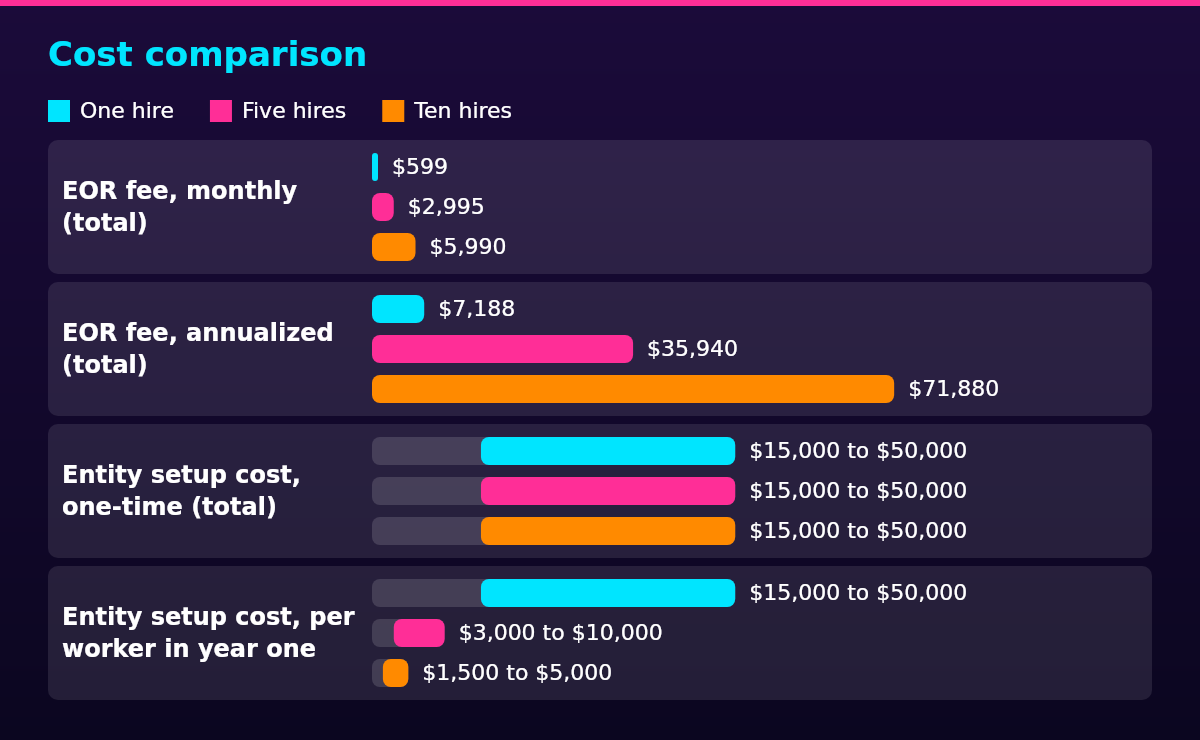
| Cost item | One hire | Five hires | Ten hires |
|---|---|---|---|
| EOR fee, monthly (total) | $599 | $2,995 | $5,990 |
| EOR fee, annualized (total) | $7,188 | $35,940 | $71,880 |
| Entity setup cost, one-time (total) | $15,000 to $50,000 | $15,000 to $50,000 | $15,000 to $50,000 |
| Entity setup cost, per worker in year one | $15,000 to $50,000 | $3,000 to $10,000 | $1,500 to $5,000 |
| Cheaper in year one | EOR | Depends on actual setup cost | Entity, at most setup-cost levels |
A Mexican Sociedad Anónima needs a minimum of two shareholders, and Mexican corporate law has set no fixed minimum capital figure since the 2016 reform to the Ley General de Sociedades Mercantiles. Entity setup itself still runs $15,000 to $50,000 in incorporation and legal costs and takes 3 to 6 months, according to Howdy’s Mexico payroll and benefits guide; spread across headcount, that one-time cost works out to $15,000 to $50,000 per worker at a single hire, falling to $1,500 to $5,000 per worker at ten hires, below the EOR’s $7,188 annualized fee at that point.
That crossover is why providers typically price EOR services as a flat monthly fee rather than a percentage of payroll: the fee stays fixed per worker no matter how many hires you add, while an entity’s one-time setup cost gets cheaper per worker as headcount grows.
On a salary where the employer’s fully loaded cost runs about 42 to 45% above base pay once IMSS, INFONAVIT, state payroll tax and prorated statutory benefits are included, according to Howdy’s Mexico payroll and benefits guide, that loaded cost is what you’re comparing against the flat $599 EOR fee at your own headcount. For a single hire, the EOR’s flat fee is nearly always cheaper than building Mexican payroll infrastructure from zero; the crossover depends on how many workers you can spread that infrastructure cost across, and on how much of that infrastructure (a payroll provider, an accountant who knows IMSS and INFONAVIT filings, a labor lawyer for contracts) you’d need to hire regardless of headcount.
Legal compliance in Mexico
Mexico employment law for foreign employers runs through the Ley Federal del Trabajo (LFT), and since the April 2021 subcontracting reform, any company that places its own workers at a third party’s disposal to perform specialized services outside the client’s main corporate purpose must register as a REPSE provider under Articles 13 and 15 of the LFT, a decree published in the Diario Oficial de la Federación on April 23, 2021. The reform banned pure personnel outsourcing, where a staffing company supplies workers to perform the client’s own core business activities.
The LFT also sets the workday at a maximum of 8 hours for a day shift, 7 hours for a night shift and 7.5 hours for a mixed shift, with overtime limited to 3 hours a day or 3 days a week, under Article 61.
A genuine EOR is not that outsourcing arrangement: it is the worker’s actual legal employer, running its own IMSS registration, its own payroll and full LFT benefits, rather than a labor broker placing workers into your core operations. The distinction isn’t automatic, though, so before you sign with a Mexico EOR, confirm it holds a current registration on STPS’s REPSE portal, since the registration is what keeps the arrangement distinguishable from the outsourcing model Mexico’s 2021 reform banned.
Permanent establishment risk is worth watching separately from REPSE. An EOR’s Mexican employment contract, not your company’s own presence, is the taxable local employer of record, which is the structural reason the arrangement is built to avoid creating a Mexican permanent establishment for the hiring company, though a worker who negotiates or signs contracts on your behalf can still raise PE questions regardless of who employs them on paper.
Payroll taxes in Mexico
IMSS employer contributions combine several branches: enfermedad y maternidad (healthcare and maternity) at about 20.4%, riesgo de trabajo (workplace injury, which varies by the employer’s risk class) at about 0.67%, invalidez y vida (disability and life) at 1.75%, cesantía en edad avanzada y vejez (retirement) at about 1.125%, retiro (SAR, a separate retirement-fund contribution) at about 5.15%, and guarderías y prestaciones sociales (childcare and social benefits) at 1%, which together total roughly 29 to 30% of payroll according to Rippling’s Mexico hiring guide.
INFONAVIT adds a flat 5% of the employee’s integrated daily salary, paid entirely by the employer with no worker-side match, under the same housing-fund rules Intugo documents for foreign employers.
On top of the federal IMSS and INFONAVIT load, most states add their own payroll tax (Impuesto Sobre Nómina), running from about 1% up to roughly 3%, depending on the state, according to Howdy’s Mexico payroll and benefits guide. Income tax withholding (ISR) applies on top at progressive rates the employer calculates and remits each pay period, separate from the employer-side contributions above.
None of these filings fall to you directly when you hire through an EOR: the provider calculates IMSS, INFONAVIT, ISN and ISR each pay period, remits them to the right federal and state authorities, and issues the payslips and year-end certificates your worker needs for their own tax filing. If you later move the worker onto your own entity, budget for the accounting and payroll capacity to take on those same filings in-house.
EOR versus a local entity
Choosing between an EOR, a Mexican entity or a contractor comes down to headcount and control. An EOR fits best for a first hire or a small team, since the flat per-worker fee avoids registering an entity, opening a Mexican bank account and building IMSS and INFONAVIT payroll capacity from zero. A local entity fits once headcount is large enough that running payroll in-house costs less per worker than the EOR’s flat fee, and once you want local managers signing contracts directly.
A contractor agreement is the third option some companies consider instead of either route, but Mexican labor law looks past the contract label: a worker who keeps fixed hours, uses your equipment and reports to your manager is an employee under the LFT regardless of what the agreement calls them, which is the misclassification risk an EOR or an entity is built to avoid.
An EOR in Mexico is not the same model as a professional employer organization: a PEO requires your own entity in the country already, while an EOR supplies the entity and the legal employment relationship itself. Companies that already use a PEO at home sometimes assume the same setup transfers abroad, and it doesn’t.
Scaling framework
| Stage | Headcount | Model | Trigger to move on |
|---|---|---|---|
| Test | 1 | EOR | A second hire makes the team worth building out |
| Build | 2 to 5 | EOR, confirm REPSE registration | EOR fees approach your own payroll running cost |
| Transition | 6 to 10 | EOR or a Mexican entity | In-house IMSS and INFONAVIT payroll capacity exists |
| Scale | 10 or more | Full Mexican entity | Ongoing, reviewed each year |
Most companies plan the entity decision during the build or transition stage, once total EOR fees start to approach what a Mexican entity’s own payroll and compliance overhead would cost at the same headcount. Re-confirm your EOR’s REPSE registration at each stage rather than only at signing, since the registration requirement and the reform behind it apply to the provider for the full life of the engagement.
Termination rules in Mexico
| Basis | Amount | Source |
|---|---|---|
| Constitutional indemnification (dismissal without just cause) | 3 months’ salary, or reinstatement | LFT Article 48 |
| Back pay where the employer can’t prove just cause | Capped at 12 months’ wages | LFT Article 48 |
| Alternative where reinstatement can be refused (Article 49’s cases) | 20 days’ salary per year of service | LFT Article 50 |
| Prima de antigüedad (seniority premium) | 12 days’ salary per year of service, capped at twice the general minimum wage | LFT Article 162 |
| Proportional aguinaldo | Pro-rated share of the 15-day minimum | LFT Article 87 |
| Accrued vacation plus premium | Unused vacation days, plus a 25% premium | LFT Articles 76, 79-80 |
| Resignation notice | None required by statute; binds the worker only if the contract sets one | n/a |
A worker dismissed without justified cause chooses between the two indemnification routes in the table above, under Article 48 of the Ley Federal del Trabajo; where the employer may lawfully refuse reinstatement under Article 49’s cases, Article 50’s 20-day alternative applies instead.
The prima de antigüedad cap uses twice the general minimum wage, which CONASAMI set at $315.04 MXN a day for 2026, putting the Article 162 cap at $630.08 MXN a day.
On the notice side, Mexican law sets no minimum resignation period for an employee; a notice period only binds the worker if the employment contract itself includes one, according to Biz Latin Hub’s Mexico employment law guide.
FAQ
An employer of record in Mexico costs about $599 per worker a month at current provider pricing, plus employer contributions of roughly 29 to 30% of payroll to IMSS and a flat 5% to INFONAVIT on top. Aguinaldo and PTU add further cost across the year, both of which the EOR calculates and pays on your behalf.
Yes, using an EOR is legal in Mexico as long as the provider is the worker’s genuine legal employer, holding its own IMSS and INFONAVIT registrations and current REPSE registration, rather than a labor broker supplying workers to perform your company’s own core activities. Your company still directs the work itself.
Yes, a Mexico EOR needs current REPSE registration under Articles 13 and 15 of the Ley Federal del Trabajo, the registration regime Mexico’s April 2021 subcontracting reform introduced. Confirm the registration directly on STPS’s REPSE portal before signing, since it’s what distinguishes a genuine EOR from the personnel-outsourcing model the reform banned.
Severance in Mexico depends on whether the dismissal is justified: an unjustified dismissal entitles the worker to three months’ salary or reinstatement under Article 48, plus 20 days per year of service where reinstatement can be refused under Article 50, plus a seniority premium of 12 days per year under Article 162. Proportional aguinaldo and accrued vacation are added on top in a full liquidación package.
Yes, a US company can hire employees in Mexico without a local entity by using an employer of record, which supplies its own Mexican entity, IMSS and INFONAVIT registrations and REPSE registration so you can put a worker on payroll in days rather than the months a new entity takes to register.