

On this page
An employer of record Singapore provider is the legal employer of your worker on its own Singapore entity for about $599 a month, the fee Deel currently charges, so you can hire in Singapore without registering a local company. The provider runs payroll, pays the Central Provident Fund (CPF) contributions owed for Singapore citizens and permanent residents, and applies the Employment Act rules that come with the role. The one thing the provider cannot do is apply for a work pass for a foreigner who would be working for your overseas company: Singapore’s Ministry of Manpower (MOM) treats that as an offence.
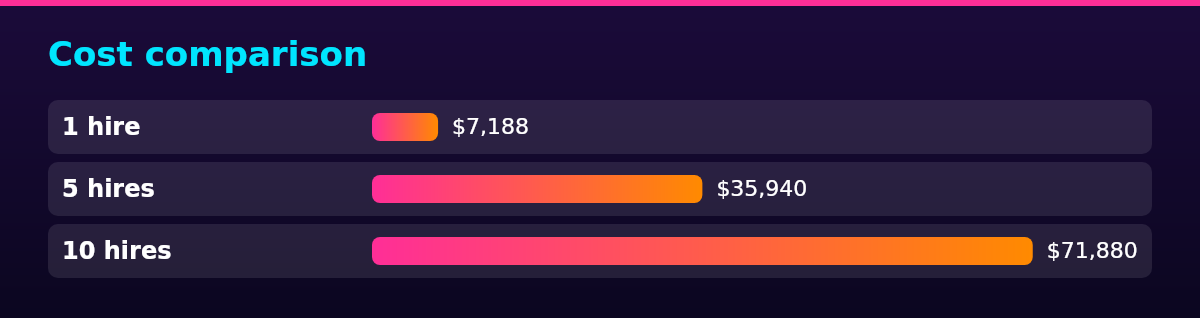
On top of the fee you fund the employer’s CPF contribution, 17% of monthly wages for citizens and permanent residents aged 55 and below in 2026, while work-pass holders pay none, per the CPF Board’s contribution rates. The $599 monthly fee works out to $7,188 a year per worker, so your own Singapore entity wins on cost once that figure times your headcount passes your fixed local running cost.
Singapore hiring costs at a glance
| Cost item | Who pays | Typical amount (2026) | Source |
|---|---|---|---|
| Employer of record cost per month | Employer | $599 per employee per month (USD) | Deel, Remote |
| Employer CPF contribution | Employer | 17% of monthly wages for citizens and permanent residents aged 55 and below, up to a monthly ceiling | CPF Board |
| Skills Development Levy | Employer | Charged on every employee, locals and foreigners alike | Law Society of Singapore |
| Annual leave | Employer | 7 to 14 days by length of service, after 3 months | MOM |
| Sick leave | Employer | 14 days outpatient, up to 60 days in total including hospitalisation leave | MOM |
| Maternity leave | Employer | 12 weeks under the Employment Act, with 3 months of service | MOM |
| Annual wage supplement | Employer | Not compulsory unless the contract or a collective agreement provides it | MOM |
| Entity setup instead | Employer | S$300 incorporation fee with ACRA, plus a resident director and annual filings | ACRA |
The flat fee is the predictable part of the monthly cost. The CPF contribution scales with salary up to a monthly ceiling and applies only to citizens and permanent residents, so a work-pass hire skips CPF but still draws the Skills Development Levy. The leave rows are Employment Act minimums, and a contract can improve on them.
How an EOR works in Singapore
The employer of record (EOR) holds the contract of service with your worker, so the provider, not you, is the employer Singapore’s rules attach to. It runs local payroll, pays CPF for citizens and permanent residents, pays the Skills Development Levy, and reports the worker’s annual earnings to the Inland Revenue Authority of Singapore (IRAS) on form IR8A or through the Auto Inclusion Scheme. Your worker keeps full Employment Act entitlements: MOM confirmed in a written parliamentary answer in November 2023 that a person employed by an EOR is an employee with a contract of service even though they perform work for the EOR’s client.
Onboarding is fast because the provider’s entity and its registrations already exist. Deel’s Singapore page currently lists time to first hire at one business day through an EOR, against about two months to incorporate and staff your own local company, per Deel’s Singapore guide.
Work passes for foreign hires
Singapore citizens and permanent residents need no work pass, so an EOR can employ them with no immigration step at all. A foreign hire needs a pass instead, and the Employment Pass currently requires a fixed monthly salary of at least S$5,600, or S$6,200 in financial services, for new applicants since January 2025, plus at least 40 points on MOM’s COMPASS framework, per MOM’s Employment Pass eligibility page. The same page lists higher minimums from 1 January 2027: S$6,000 for the general track and S$6,600 for financial services.
The S Pass, the mid-skilled route, currently requires a fixed monthly salary of at least S$3,300, or S$3,800 in financial services, with higher minimums of S$3,600 and S$4,000 listed for new applications from 1 January 2027, per MOM’s S Pass pages. MOM does not state when the current figures took effect, so treat them as the minimums in force today.
Whatever pass a foreign hire needs, an EOR cannot sponsor the Employment Pass or S Pass application. MOM’s position, set out in its work-pass FAQ published 9 July 2024, is that work passes are for foreigners to work for Singapore-based companies, and an EOR that applies for a pass for a foreigner to be based in Singapore while working for an overseas company would be committing an offence. MOM’s suggested routes for an overseas company are a representative office registered through Enterprise Singapore, incorporating a Singapore company with ACRA, or the Short-Term Visit Pass that allows up to 90 days a year for meetings.
The Law Society of Singapore’s July 2025 overview notes that this is a policy position rather than a tested prohibition: the Employment of Foreign Manpower Act does not expressly bar the arrangement and there is no case law on it. The risk for a provider that tries it is real anyway, from prosecution to revocation of the pass and a bar from future passes, per the Law Gazette feature.
Country by country, whether an employer of record can sponsor a visa ranges from routine to barred, and Singapore sits at the barred end for overseas companies. Plan the Singapore team accordingly: citizens and permanent residents through the EOR, foreign hires through your own entity or a representative office.
Cost comparison
| Headcount | EOR fee (USD per year) | When your own route is cheaper |
|---|---|---|
| 1 hire | $7,188 | Your fixed local running cost is under $7,188 a year |
| 5 hires | $35,940 | Your fixed local running cost is under $35,940 a year |
| 10 hires | $71,880 | Your fixed local running cost is under $71,880 a year |
The EOR side scales linearly while your Singapore entity cost stays mostly fixed, and that contrast sets the crossover: the $599 monthly fee on Remote’s pricing page works out to $7,188 a year per worker, about $35,940 for five people and about $71,880 for ten. Your own entity wins the cost comparison once $7,188 per worker times your headcount passes your fixed annual cost of running it.
The entity side is mostly fixed: incorporating a private limited company currently costs a S$300 fee with ACRA, and beyond that you pay a resident director’s costs, company secretarial work, accounting and annual filings that barely rise with headcount.
The cost of employer of record services guide breaks down how those fees vary across countries and providers.
Legal compliance in Singapore
The Employment Act rules in Singapore cover every employee working under a contract of service, with narrow exclusions for seafarers, domestic workers, civil servants and statutory board employees, per MOM’s coverage page. An EOR hire sits inside the Act because their contract of service runs to the provider.
The Act’s Part 4 rules on hours of work, overtime and rest days apply only to workmen earning up to S$4,500 a month and non-workmen earning up to S$2,600 a month, and they exclude managers and executives, per the same MOM page. Most remote professional hires earn above those thresholds, so their working-time terms come from the contract.
Annual leave starts at 7 days after the first 12 months of service and rises by one day per further year of service to a maximum of 14 days, once the worker has completed 3 months, per MOM’s annual leave page.
Sick leave runs at 14 paid outpatient days, and paid hospitalisation leave can run up to 60 days, with the 60 including the 14, after 3 months of service, per MOM’s sick leave page.
Maternity leave is 12 weeks under the Employment Act for a mother with 3 months of service, with the first 8 weeks paid by the employer and the last 4 unpaid, per MOM’s maternity leave page. A separate Government-Paid Maternity Leave scheme under the Child Development Co-Savings Act covers eligible mothers with longer service.
The annual wage supplement, the 13th-month payment some Singapore employers pay, is not compulsory; it depends on what the contract or a collective agreement says, per MOM’s variable wage components page.
Hiring a citizen or permanent resident as a contractor instead of an employee carries misclassification risk: anyone working under a contract of service is an employee under the Employment Act, and a contractor label over an employment relationship leaves the employer’s CPF contribution unpaid. The CPF Board’s employer pages set out who has to contribute.
A first hire through an EOR stays off your own Singapore tax footprint because the provider’s entity is the employer, but the exposure to watch is authority: a worker who habitually concludes contracts in your name can create a permanent establishment for your company even while the EOR employs them. The permanent establishment guide covers how that exposure builds and how to limit it.
Payroll taxes in Singapore
The employer CPF contribution rate in Singapore is 17% of monthly wages for citizens and permanent residents aged 55 and below, against the employee’s 20% share, for a 37% total on wages above S$750 a month, at the rates in force from 1 January 2026, per the CPF Board’s contribution page. Work-pass holders sit outside CPF altogether.
The Ordinary Wage ceiling, the monthly wage above which CPF stops applying, is S$8,000 from 1 January 2026, the final step of an increase that ran S$6,300 in September 2023, S$6,800 in 2024 and S$7,400 in 2025, per the CPF Board’s ceiling notice.
Contribution rates taper from age 55 under graduated senior-worker rates, which rose again for 2026, and the annual salary ceiling is unchanged at S$102,000, per the CPF Board’s 2026 changes notice.
The Skills Development Levy applies to every employee in Singapore, local or foreign, under the Skills Development Levy Act 1979, and the EOR stays responsible for paying it, per the Law Society’s overview.
Singapore has no monthly employer income-tax withholding: employees settle their own income tax with IRAS, and the employer reports each worker’s annual earnings on form IR8A or through the Auto Inclusion Scheme, per the IRAS employers’ pages. When a foreign or permanent-resident employee ceases employment, the employer files an IR21 tax clearance.
EOR versus a local entity
The choice among an EOR, a Singapore Pte Ltd (the private limited company form) and a contractor turns on headcount, speed, and whether the hire needs a work pass. For citizens and permanent residents, an EOR employs a first hire within days and carries the employer liability, while a private limited company gives you full control at the price of incorporation and annual admin. For a foreign hire who needs a pass to work for your overseas company the choice is narrower, because MOM’s position points to incorporating or a representative office whatever the fee math says.
A Singapore private limited company needs at least one director who meets the local residency rules, and the incorporation fee is S$300 with ACRA. Add a company secretary, accounting and annual filings, and the fixed cost is real but barely rises with headcount.
Profits are taxed at 17%, the corporate income tax rate IRAS sets, and the absence of monthly payroll withholding keeps the ongoing admin lighter than in countries that withhold every month.
A professional employer organization (PEO) co-employs staff for a company that already exists, so in Singapore it is an entity-stage tool rather than a way in. The line between a PEO and an EOR turns on who holds the employer liability and whose entity employs the worker, which matters more as headcount and compliance load grow.
Scaling framework
| Stage | Headcount | Model | Trigger to move on |
|---|---|---|---|
| First hire | 1 | EOR | You need entity control or equity grants |
| Early team | 2 to 5 | EOR | Admin load rises or you add a second country |
| Growing team | 6 to 10 | EOR or entity | EOR fees start to rival your fixed local running cost |
| Scale | 10+ | Singapore entity | You need IP holding, equity, or a foreign hire who needs a pass |
When to set up a Singapore entity rather than stay on the EOR is a fee question for citizens and permanent residents and a pass question for everyone else. Most employers start on an EOR because it needs no setup and handles CPF, the levy and the Employment Act from day one, then move to their own entity once the flat fees add up to more than the fixed cost of running a Singapore company. The pass rule can move the date: a foreign hire your EOR cannot pass-sponsor brings the entity decision forward to the day that hire appears, not the day the fees cross over.
Termination rules in Singapore
The contract can set a different notice period, and either party can pay salary in lieu of notice, per MOM’s termination rules. CPF is payable on salary earned during the notice period but not on a payment made in lieu of notice.
Retrenchment benefit is not compulsory in Singapore. The tripartite advisory norm is 2 weeks to 1 month of salary per year of service, with 1 month where a collective agreement provides for it, for employees with at least 2 years of service, per MOM’s responsible retrenchment page.
The Employment Act sets no probation-period rules, so what applies during probation is whatever the contract says.
FAQ
Yes, EOR arrangements are allowed in Singapore, and there is no EOR licensing regime there; the boundary MOM draws is about work passes, not the arrangement itself. In its 9 July 2024 FAQ MOM states that work passes are for foreigners to work for Singapore-based companies, and an EOR applying for one for a worker of an overseas company would be committing an offence, per the MOM FAQ.
An EOR in Singapore currently costs about $599 per employee a month, the fee listed on Deel’s pricing page, plus the employer’s CPF contribution of 17% of monthly wages when the hire is a citizen or permanent resident. At that fee the EOR alone runs $7,188 a year per worker.
To hire employees in Singapore you pick the legal route first: an EOR for a fast first hire of a citizen or permanent resident, your own private limited company when you need scale or foreign-pass hiring, or a representative office for market entry without full incorporation. Whoever employs the worker owes CPF for citizens and permanent residents and the Employment Act entitlements that come with the role.
No. An EOR in Singapore cannot apply for an Employment Pass for a foreigner to be based in Singapore while working for an overseas company; MOM’s 9 July 2024 FAQ says doing so would be committing an offence. An overseas company that needs a foreigner in Singapore incorporates with ACRA or opens a representative office through Enterprise Singapore instead, per the same FAQ.
Yes, a US company can hire in Singapore without an entity by using an EOR that employs the worker on its own Singapore entity, which works cleanly for citizens and permanent residents. A foreign hire who needs a work pass to work for the US company is the exception: MOM’s position requires a Singapore-based employer, which in practice means incorporating or a representative office.
Employer CPF contributions in Singapore run at 17% of monthly wages for citizens and permanent residents aged 55 and below in 2026, against the employee’s 20% share, on wages above S$750 a month up to the S$8,000 monthly ceiling, per the CPF Board. Work-pass holders pay nothing into CPF.
No, an EOR does not by itself create a permanent establishment in Singapore for your company, because the worker is employed by the provider’s entity rather than yours. The exposure to watch is a worker who habitually concludes contracts in your name, which can create one regardless of who runs the payroll.
About one business day for a citizen or permanent resident, currently, per Deel’s Singapore page; providers quote short timelines because their entity and registrations already exist. Incorporating your own entity takes about two months by the same page’s estimate.
Yes, at low headcount an EOR is cheaper: the $599 monthly fee Remote currently lists works out to $7,188 a year per worker, against entity costs that are mostly fixed, from incorporation and a resident director to annual filings. Your own entity wins on cost once $7,188 times your headcount passes your fixed annual running cost.
An EOR employs your worker on its own entity, so it works in a country where you have no company; a professional employer organization co-employs staff for a company that already exists, so in Singapore it is an option only after you incorporate. The EOR holds the full employer liability in Singapore, while a PEO arrangement shares the employment obligations with you as the employing company.