

On this page
An employer of record Vietnam arrangement makes a provider the legal employer of your Vietnamese hire for about $599 a month, the starting fee Deel and Remote currently charge for employer of record (EOR) services, so you can hire in Vietnam without registering a Vietnamese company. On top of the fee you fund Vietnam’s employer statutory insurance: 17.5% social insurance, 3% health insurance and 1% unemployment insurance of the insured salary, plus a 2% trade union contribution, on salaries capped at VND 46,800,000 a month. Personal income tax (PIT) is withheld from the worker’s gross salary rather than paid on top of it.
The EOR, not your company, is the employer on the Vietnamese labor contract: it signs the contract under the 2019 Labour Code, registers the worker for social, health and unemployment insurance, withholds PIT and applies the Code’s floors on hours, leave and notice while you direct the work day to day. The salary floor is Vietnam’s regional minimum wage, VND 3,700,000 to 5,310,000 a month by region, in force from 1 January 2026 under Decree 293/2025. EOR fees scale per worker while a Vietnamese entity’s registrations and in-house payroll are fixed costs, so an EOR usually wins for a first hire and a subsidiary tends to win as the team grows.
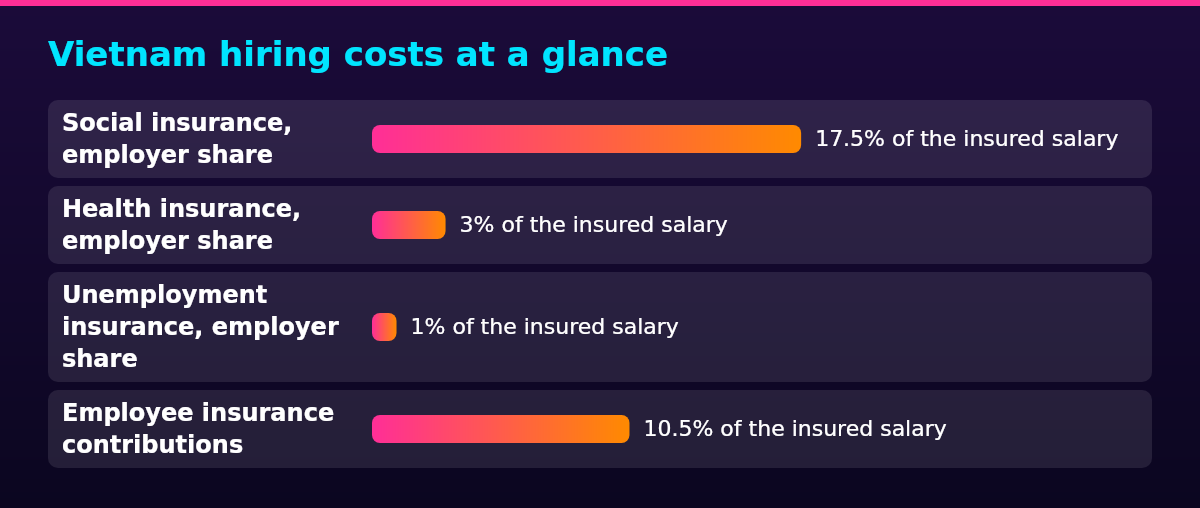
Vietnam hiring costs at a glance
| Cost item | Amount | Who pays | Source |
|---|---|---|---|
| Employer of record (EOR) fee | $599 per worker a month | You, to the provider | Deel and Remote pricing pages, November 2026 |
| Social insurance, employer share | 17.5% of the insured salary | You, via the EOR | PwC statutory contributions summary, 2026 |
| Health insurance, employer share | 3% of the insured salary | You, via the EOR | Decree 188/2025, from 1 July 2025 |
| Unemployment insurance, employer share | 1% of the insured salary | You, via the EOR | Decree 374/2025, from 1 January 2026 |
| Trade union contribution | 2% of the salary fund subject to social insurance | You | Law 50/2024 |
| Employee insurance contributions | 10.5% of the insured salary | The worker, withheld | Laws 41/2024 and 51/2024, Decree 374/2025 |
| Personal income tax | 5% to 35% by bracket, after a VND 15.5 million monthly deduction | The worker, withheld by the employer | Law 109/2025, 2026 tax period |
| Regional minimum wage | VND 3,700,000 to 5,310,000 a month by region | You, as salary | Decree 293/2025, from 1 January 2026 |
| Insurance contribution ceiling | VND 46,800,000 a month of insured salary | Caps the insured base | Law 41/2024, Decree 73/2024 |
| Annual leave | 12 working days, plus 1 day per 5 years of service | You, as paid leave | Labour Code |
| Notice period | 3 working days to 45 days by contract type | Either side | Labour Code |
| Severance | Half a month’s wage per working year | You, on an agreed ending | Labour Code |
| Entity route instead | Enterprise, tax and social insurance registrations, then in-house payroll | You | Vietnamese registration law |
VND figures are Vietnamese dong. The amounts are statutory floors and current list prices, not a quote: salaries move by role and region.
No statutory bonus exists in Vietnam: the 13th-month or Tet payment many Vietnamese employers pay is a widespread custom, because the Labour Code sets salary by the labor contract and any collective agreement, so budget it as a market expectation.
How an EOR works in Vietnam
A Vietnamese EOR becomes the legal employer of your hire while your company directs the work, the same employer of record model that applies in any country. The provider signs the Vietnamese labor contract, registers the worker for social, health and unemployment insurance, runs payroll, withholds PIT and applies the 2019 Labour Code’s floors on hours, leave, probation and notice.
The structure matters legally, because Vietnamese law draws a line between employing and dispatching. Labor leasing under Articles 52 to 54 of the Labour Code is a licensed conditional business capped at 12 months per placement, and a hiring company may not use an unlicensed lessor. The EOR structure that works in Vietnam is direct employment: the provider is the true employer on its own contract and registrations, not a dispatch firm. Ask a provider to confirm in writing that your hire is its own employee.
It is also the fastest way to hire employees in Vietnam without a local entity: onboarding typically runs from a few business days to a few weeks, depending on the provider’s entity and the worker’s documentation. An EOR is the legal employer and holds the statutory obligations; a payroll provider only runs payments on payroll you already operate.
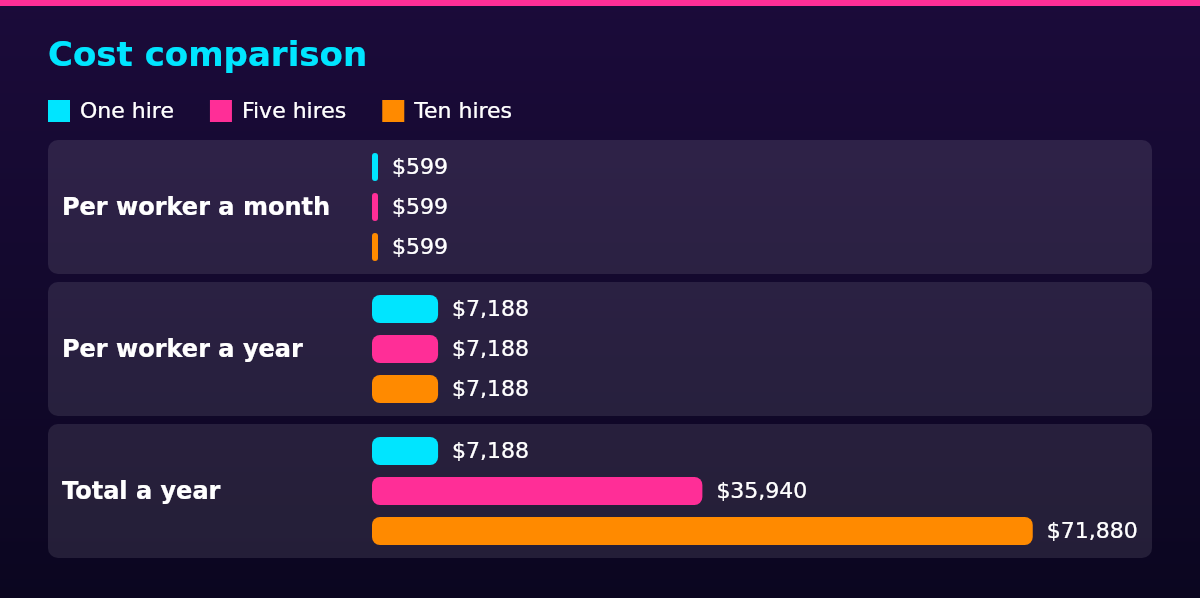
Cost comparison
| EOR fee | One hire | Five hires | Ten hires |
|---|---|---|---|
| Per worker a month | $599 | $599 | $599 |
| Per worker a year | $7,188 | $7,188 | $7,188 |
| Total a year | $7,188 | $35,940 | $71,880 |
An EOR versus a Vietnamese entity comes down to one cost line against several: the EOR fee against the entity’s registrations and in-house payroll setup. The fee is currently a $599 starting rate per worker a month at Remote, which lists it on annual contracts, and at Deel. Five workers cost $35,940 a year and ten cost $71,880, before any volume discount. The fee is also the one cost line you can negotiate: how much employer of record services cost varies by provider, country and contract length.
EOR fees are not the whole cost of employing someone in Vietnam. The 21.5% employer insurance share, 17.5% of it social insurance per the PwC statutory contributions summary, plus the 2% union contribution, apply identically whether the legal employer is your provider or your own subsidiary: they are Vietnamese employment costs, not EOR costs, and so is the PIT withheld from the worker’s gross salary.
The entity side is a different cost shape: a Vietnamese subsidiary starts with enterprise registration, then tax and social insurance registration, and from then needs in-house payroll capacity and its own work-permit sponsorship. The crossover arrives when the total EOR fees pass the annual fixed cost of running Vietnamese payroll in-house.
Legal compliance in Vietnam
Vietnamese employment law applies to your hire whoever employs them, foreign employer or local, and its core statute, the 2019 Labour Code, caps working time at 8 hours a day and 48 hours a week. Overtime needs the worker’s consent and is capped at 40 hours a month and 200 hours a year, or 300 hours a year in listed sectors, under Article 107 of the Labour Code, and is paid from 1.5 times the normal rate under Article 98. For a foreign employer, the EOR carries these duties as the legal employer.
Leave runs to a statutory floor: 12 working days of annual leave, plus one extra day for every five years worked, alongside the public holidays, sick leave and maternity provisions the Code sets, per the Labour Code’s leave provisions.
The contract must be in writing: probation runs 180 days for management positions, 60 days for positions requiring college-level or higher qualifications, 30 days for intermediate or technical-worker positions and 6 working days otherwise, once per job, at no less than 85% of the job’s wage, under Articles 25 to 27 of the Labour Code.
A contractor engagement carries no Labour Code floor: no notice ladder, no severance, no insurance registration, so it costs less until the work is really employment: the gap is the misclassification risk. Employing through an employer of record rather than a contractor settles the question: the EOR hires the worker as an employee from day one.
Foreign employees are covered unevenly: social insurance applies to foreign workers holding a work permit under a Vietnamese labor contract of a year or more, health insurance applies from a contract of one month, and unemployment insurance covers Vietnamese citizens only, per the PwC summary of Vietnam’s statutory contributions.
Hiring a foreigner into Vietnam runs through the work-permit regime of Decree 219/2025, in force since 7 August 2025: permits and exemption certificates run up to 2 years, issued by provincial-level People’s Committees within 10 working days of a valid application filed on the National Public Service Portal. The expert route needs a university degree plus documented experience, and intra-corporate transferees in listed service sectors with 12 months employed abroad are on the exemption track. Because permits are applied against the employing entity, whether a provider can sponsor the permit is the country-specific question to settle before you shortlist a foreign candidate.
Tax exposure turns on the same structure: the EOR’s Vietnamese contract, not your company’s presence, is the local employer, which is the structural reason the arrangement lowers permanent establishment (PE) risk, the tax-law name for a taxable local presence, for the hiring company. A worker who concludes contracts in your company’s own name can still create a taxable presence, so keep signing authority with the head office.
Payroll taxes in Vietnam
Social insurance is Vietnam’s mandatory scheme for pensions, survivorship, sickness and maternity, and for occupational accidents and diseases, and it is the biggest employer line: 17.5% of the insured salary from the employer, alongside 8% from the worker, the 2026 rates per the PwC statutory contributions summary.
Law 41/2024, in force from 1 July 2025, sets the fund rates: 14% from the employer for retirement and survivorship, 3% for sickness and maternity, and 8% from the worker.
Health insurance adds 3% from the employer and 1.5% from the worker of the insured salary, the employer’s two-thirds of the total rate that Decree 188/2025 applies at 4.5% from 1 July 2025.
Unemployment insurance is 1% from each side from 1 January 2026, under Decree 374/2025. The worker’s combined share across the three schemes is 10.5%.
The trade union contribution is 2% of the salary fund subject to social insurance, paid by the employer under the 2024 Law on Trade Unions, which takes the employer’s statutory total to 23.5%.
The insured salary is capped through the reference level: the base salary is VND 2,340,000 a month from 1 July 2024 under Decree 73/2024.
Law 41/2024 caps the insured salary at 20 times the reference level, and Decree 158/2025 holds the reference level equal to the base salary, so 20 x 2,340,000 puts the 2026 social and health insurance ceiling at VND 46,800,000 a month.
Unemployment insurance runs on a different base and cap: its insured salary is capped at 20 times the regional minimum wage, and the unemployment allowance at five times the regional minimum, per the PwC tax summary.
Personal income tax is employee-side withholding, not an employer cost on top of salary. For the 2026 tax period the brackets under Law 109/2025 start at 5% on the first VND 10 million of taxable monthly income and rise to 35% above VND 100 million, after a VND 15.5 million monthly deduction for the taxpayer, and the employer withholds and remits PIT with the payroll.
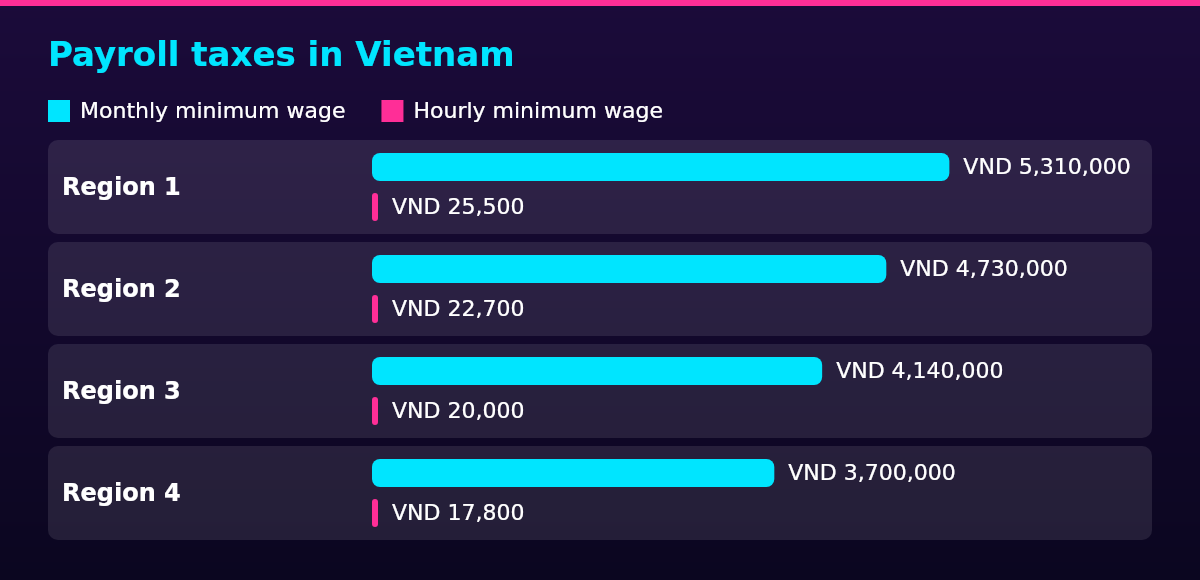
Regional minimum wages from 2026
| Region | Monthly minimum wage | Hourly minimum wage |
|---|---|---|
| Region 1 | VND 5,310,000 | VND 25,500 |
| Region 2 | VND 4,730,000 | VND 22,700 |
| Region 3 | VND 4,140,000 | VND 20,000 |
| Region 4 | VND 3,700,000 | VND 17,800 |
The regions are set by Decree 293/2025, effective 1 January 2026: Region 1 covers the urban cores of Hanoi and Ho Chi Minh City and their environs, and the floor falls to VND 3,700,000 in Region 4. The wages adjust by decree, most recently for 2026.
EOR versus a local entity
The choice is an EOR, a Vietnamese subsidiary, or a representative office. The EOR fits a first hire, a short commitment or a test market; the subsidiary fits a team you expect to keep growing and manage directly; the representative office is the lightest legal presence, but its scope is liaison and market research, not revenue-generating activity, so it is not a hiring vehicle; a company that wants staff in Vietnam starts with an EOR.
Both routes still owe the same statutory costs: the insurance stack, the union contribution and PIT withholding apply to the legal employer whichever one it is. What differs is control: your own subsidiary gives you the contract, the bank account and direct work-permit sponsorship, while the EOR holds the employment relationship for you. Work-permit sponsorship attaches to the local employer, which is one reason a contractor arrangement stops fitting once a foreign hire needs a permit.
A Vietnamese EOR is not a professional employer organization (PEO) arrangement, either: the difference between a PEO and an EOR is that a PEO co-employs staff your own entity already employs, while an EOR employs them for you where you have no entity at all. It is also not labor dispatch: the provider is the true employer on its own contract, which keeps the arrangement on the right side of the Labour Code’s licensing line.
The crossover point is arithmetic: once the per-worker fees pass the annual fixed cost of your own registrations plus in-house payroll, the subsidiary wins from there on. Because that fixed cost depends on the payroll capacity you already run, work it from your own numbers with the fee table above.
Scaling framework
| Stage | Headcount | Model | Trigger to move on |
|---|---|---|---|
| First hire | 1 | EOR | A second hire in Vietnam is planned |
| Building | 2 to 5 | EOR, provider’s own entity | Monthly fees start to compound |
| Growing | 6 to 10 | EOR or subsidiary | In-house payroll or work-permit sponsorship needed |
| Established | More than 10 | Subsidiary, in-house payroll | Monthly fees pass the entity’s fixed annual cost |
Each stage turns on a trigger, not a headcount alone. In the building stage, confirm the provider employs through its own Vietnamese entity rather than a local partner’s. The growing stage is where the fee total and the entity’s fixed cost come close, and where work-permit needs start to matter. The 2% trade union contribution is owed whether or not the workforce unionizes, so it sits in the budget at every stage.
When you do move workers from an EOR to your own subsidiary, the contracts move with them. Agree the transfer terms with the provider before the original service agreement is signed, so notice, leave accrual and final-pay items are settled in writing.
Termination rules in Vietnam
| Contract type | Notice period |
|---|---|
| Indefinite-term contract | 45 days |
| Contract of 12 to 36 months | 30 days |
| Contract under 12 months | 3 working days |
Termination in Vietnam is not at-will: the notice ladder, severance and statutory grounds below set what an exit costs. The same ladder runs both ways under Articles 35 and 36 of the Labour Code: the worker’s resignation and the employer’s dismissal use the same notice periods.
An employer’s unilateral termination needs one of the statutory grounds Article 36 lists plus the stated notice, under the Labour Code’s termination provisions. A termination outside those grounds does not stand.
Severance depends on how the employment ends: a contract that ends on agreed terms owes the worker half a month’s wage per working year under Article 46, and a unilateral termination on structural grounds owes the job-loss allowance of one month’s wage per working year with a two-month minimum under Article 47, per the Labour Code.
Probation can end without cause, on the notice the probation contract states, without Article 46’s severance, under the Labour Code’s probation rules.
FAQ
About $599 per worker a month at the major global providers, the starting fee Deel and Remote currently charge for employer of record services. On top of the fee you fund the 17.5% social, 3% health and 1% unemployment employer contributions plus the 2% trade union contribution.
Yes. The 2019 Labour Code lets one employer hold the Vietnamese labor contract, and Articles 52 to 54 draw the line that matters: labor leasing is a licensed business capped at 12 months per placement, so the structure that works is direct employment, the provider as the true employer rather than a dispatch firm.
Yes: a US company can hire employees in Vietnam by putting them on an EOR’s local payroll, which makes the provider the legal employer while the US company directs the work. A contractor engagement also avoids the entity, but it leaves the worker outside the Labour Code’s notice, severance and insurance floors, a misclassification risk if the work is really employment.
Put the hire on an EOR’s Vietnamese payroll: agree the role and salary, the provider issues the labor contract under the 2019 Labour Code, registers the insurances and withholds personal income tax, and onboarding typically runs a few business days to a few weeks.
VND 3,700,000 to 5,310,000 a month from 1 January 2026, by region: Region 1, the urban cores of Hanoi and Ho Chi Minh City and their environs, sits at VND 5,310,000, falling through Regions 2 and 3 to VND 3,700,000 in Region 4, under Decree 293/2025. The regions are redrawn by decree, most recently for 2026.
Vietnam’s mandatory scheme covering pensions, survivorship, sickness and maternity, and occupational accidents and diseases, funded in 2026 at 17.5% of the insured salary by the employer and 8% by the worker, per the PwC tax summary.
No. Vietnam’s Labour Code sets salary by the labor contract and any collective agreement, and no article requires a 13th-month payment. The Tet bonus many Vietnamese employers pay is a widespread custom, so budget it as a market expectation, not a statutory cost.