

On this page
An employer of record UAE arrangement makes a provider’s licensed UAE entity the legal employer of your hire for about $599 a month per worker, the current starting fee on the Deel and Remote pricing pages for employer of record (EOR) services, so you can employ someone in the UAE without registering a UAE company. On top of the fee you fund an end-of-service gratuity that accrues from the first completed year of service, and the health insurance every private sector employer has had to buy since 1 January 2025. The employer of record also sponsors the work permit and residence visa through the authority that licenses its entity, and the worker pays no personal income tax on their salary.
The provider’s entity, not your company, is the employer on the UAE contract: on the mainland it registers the contract with the Ministry of Human Resources and Emiratisation (MOHRE), pays salaries through the Wage Protection System (WPS), and applies Federal Decree-Law No. 33 of 2021, the UAE Labour Law, while you direct the work day to day. Whether that entity is licensed on the mainland or in a free zone decides which authority’s employment rules apply to your UAE hire, so it is the first thing to confirm with a provider. The employer of record fee scales per worker, while a UAE company’s trade license, MOHRE registration and in-house payroll are fixed costs, which is why an EOR usually wins for a first hire and an entity tends to win as the team grows.
UAE hiring costs at a glance
| Cost item | Amount | Who pays | Source |
|---|---|---|---|
| Employer of record fee | $599 per worker a month | You, to the provider | Deel and Remote pricing pages, November 2026 |
| Health insurance | AED 320 a year for the basic package, from 1 January 2025 | You | MOHRE basic scheme |
| End-of-service gratuity | 21 days of basic pay a year for the first five years, 30 days beyond | You | UAE Labour Law, Article 51 |
| GPSSA pension, UAE nationals | 20% of salary: you 12.5%, the worker 5%, the government 2.5% | Split | GPSSA scheme rates |
| Social insurance, GCC nationals | The home country’s scheme rates, registered by the employer | Split | Cabinet Resolution No. 18 of 2007 |
| Unemployment insurance | AED 5 or AED 10 a month | The worker | Involuntary Loss of Employment scheme |
| Work permit and residence visa | MOHRE work permit valid two years, applied for by the employer | You, to the authority | MOHRE work permit rules |
| WPS salary rule | The previous month’s salaries due on day one of the month | You | Ministerial Resolution No. 340 of 2026 |
| Emiratisation | 2% of skilled jobs a year once you have 50 employees | You | MOHRE Emiratisation rules |
AED figures are UAE dirhams. These are statutory floors and current list prices, not a quote: salaries move by role and providers discount for volume.
Health insurance became a nationwide employer obligation on 1 January 2025, when a Cabinet decision made employer-purchased cover a precondition for issuing or renewing a residency permit, and MOHRE’s basic package costs AED 320 a year, with the financial obligation on the employer.
How an EOR works
A UAE EOR puts your hire on the payroll of an entity the provider runs in the Emirates, while your company directs the work, the same employer of record model that applies in any country. On the mainland the provider signs the employment contract, registers it with MOHRE, pays through WPS, and applies the UAE Labour Law’s floor on hours, leave and notice.
To hire an employee in the UAE, the provider applies for the two-year MOHRE work permit and the residence visa, and the Emirates ID is issued in the same process: the Work Bundle consolidated the mainland permit steps from 15 to 5, with in-person visits cut from 7 to 2. Gulf Cooperation Council (GCC) nationals need a MOHRE permit but no residence visa.
Visa sponsorship sits with the provider’s entity, which is why whether an EOR can sponsor visas is the capability question in any country. Onboarding typically runs from a few days to a few weeks, set by the provider’s own entity and the worker’s documentation.
Mainland versus free zone
The first split in UAE employment rules is mainland versus free zone: free zone workers are generally not governed by the UAE Labour Law, each free zone authority has its own employment law, and free zone employees are sponsored by the zone authority, not their employer, per the official guidance on working in free zones. Mainland private sector employment runs under Federal Decree-Law No. 33 of 2021, with MOHRE registering the contracts and work permits. Contract provisions in a free zone must still be in accordance with the Labour Law.
For an EOR buyer the split is practical: the notice periods, gratuity, working hours, visa route and payroll rules that apply to your hire follow the authority that licenses the provider’s UAE entity. Ask which authority licenses the entity and which employment law its contracts follow before you sign. Every mainland rule quoted in this post is a MOHRE rule unless a section says otherwise; free zone rules vary zone by zone.
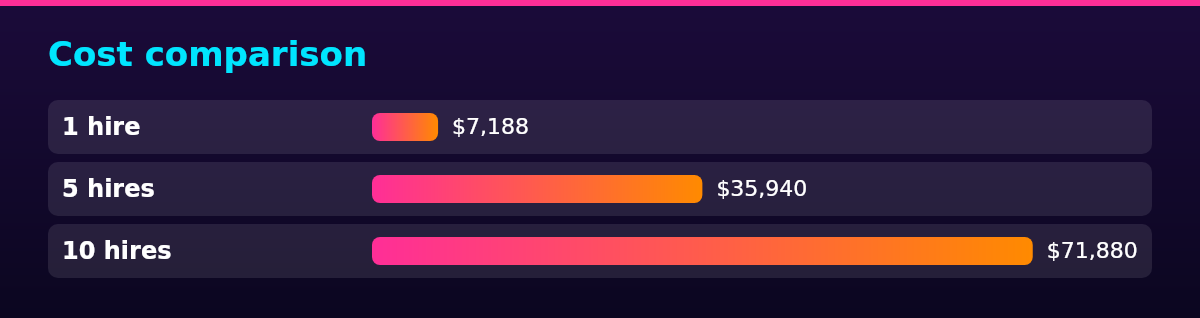
Cost comparison
| Hires | EOR cost a year |
|---|---|
| 1 hire | $7,188 |
| 5 hires | $35,940 |
| 10 hires | $71,880 |
At the $599 a month starting fee, an EOR costs $7,188 a year for one hire, $35,940 for five and $71,880 for ten, before any volume discount; Remote lists the fee on annual contracts. How much employer of record services cost varies by provider and country, so treat the fee as the line you can negotiate.
The entity side is a different cost shape: a UAE company needs a trade license, MOHRE registration, WPS setup, in-house payroll and its own visa sponsorship capacity, and its profits carry the federal corporate tax of 9% on taxable income above AED 375,000, in force since the first financial year starting on or after 1 June 2023 under Federal Decree-Law No. 47 of 2022. Qualifying free zone businesses keep the zone’s tax incentives where they comply and stay out of the mainland. No license fee is quoted here, since published figures vary by emirate and zone; the entity’s real cost is its fixed stack of license, registrations and payroll capacity.
Gratuity, health insurance, WPS and leave obligations are identical on both routes: they are UAE employment costs, not EOR costs, and they follow the worker. The comparison is between the flat per-worker fee and the fixed cost of running a UAE entity; the crossover arrives when the total fees pass that fixed cost, which the scaling framework below works through.
Legal compliance in the UAE
Mainland employment runs on Federal Decree-Law No. 33 of 2021, in force since 2 February 2022, which governs private sector employment, with MOHRE as its authority. A worker is hired on a fixed-term contract that can be extended or renewed for a similar or shorter duration, and if neither side renews it but both keep performing, it renews on the same terms. Probation must not exceed six months, cannot be extended, and carries 14 days’ prior written notice when a mainland employer ends the contract during it. The government portal sets out the contract duration and probation rules.
Notice runs from 30 to 90 days as set by the contract, at full wage, under Article 43. A for-cause dismissal without notice under Article 44 needs a written investigation first, and a dismissal that follows a valid MOHRE complaint is unlawful under Article 47, with compensation capped at three months’ wage, per the government portal’s termination guidance.
Working time is capped at 8 hours a day and 48 hours a week under Article 17, reduced by 2 hours every day during Ramadan; overtime pays basic wage plus 25%, plus 50% between 10 pm and 4 am, and rest-day work pays 50% more or gives a substitute rest day, under the working hours rules.
Annual leave is 30 fully paid days after one completed year of service, and a worker with between six months and a year of service accrues 2 days a month, under the leave rules.
A contractor engagement sits outside the UAE Labour Law, so it carries no gratuity, notice or leave entitlement, and that saving reverses if the worker is really an employee. Employing through an employer of record rather than a contractor settles the classification question by making the worker an employee from day one.
Emiratisation, the UAE’s quota program for employing Emirati nationals, requires private sector establishments with 50 or more employees to fill 2% of skilled jobs a year, rising to 10% by 2026, with AED 6,000 a month per citizen not employed for non-compliance. Companies with 20 to 49 employees in 14 designated sectors must hire at least one Emirati by the end of 2024 and one more by the end of 2025, or pay AED 96,000 from January 2025 and AED 108,000 from January 2026. The quota sits with the legal employer, so ask how the provider’s headcount and yours interact. The government portal publishes the Emiratisation rules.
Tax exposure turns on the same structure: the EOR’s UAE contract, not your company’s own presence, is the local employer, which is the structural reason the arrangement usually avoids creating a permanent establishment for the hiring company. A worker who concludes contracts in your company’s own name can still create a taxable presence, so keep signing authority with the head office.
Payroll in the UAE
Salaries run through the Wage Protection System, paid via Central Bank authorized banks and exchange houses and monitored by MOHRE. Under Ministerial Resolution No. 340 of 2026, the previous month’s salaries are due on the first day of each Gregorian month, and an employer must transfer at least 85% of wages due on time. The late ladder is steep: alerts from day 2, new work permits suspended from day 5, fines and Category 3 reclassification from day 11, labor dispute registration from day 16 with 25 or more workers, and from day 21, executive instruments, asset attachment and travel bans, with Public Prosecution referral for employers with 50 or more workers who repeat the violation. The government portal sets out the payment of wages rules.
The end-of-service gratuity is a payroll obligation: it accrues at 21 days of basic wage a year for the first five years and 30 days a year beyond them, on the last basic salary with allowances excluded, and is capped at two years’ wage. All termination dues, including the gratuity, are payable within 14 days of the contract ending. Article 51 and the end-of-service benefit rules govern the accrual.
UAE nationals are outside the gratuity because their end-of-service follows the pension legislation: the General Pension and Social Security Authority (GPSSA) scheme runs on 20% of salary, split 5% employee, 12.5% employer and 2.5% government, and the minimum monthly wage for Emiratis is AED 6,000 effective 1 January 2026, per the pension rules for Emiratis.
GCC nationals are treated as UAE nationals in employment procedures but stay on their home countries’ schemes: the employer registers them and contributes to the home social insurance system under Cabinet Resolution No. 18 of 2007, and they work on a MOHRE permit without a residence visa under Cabinet Resolution No. 292 of 2015, per the GCC nationals rules.
Unemployment insurance is the one deduction the worker pays: private sector employees subscribe to the Involuntary Loss of Employment (ILOE) scheme at AED 5 a month on a basic salary under AED 16,000, or AED 10 above it, paying 60% of the subscription salary for up to three months, with an AED 400 fine for not subscribing, per the unemployment insurance rules.
The UAE does not levy income tax on individuals, so there is no withholding on salaries, per the government taxation page, and no statutory minimum salary in the private sector, though wages must be sufficient to meet basic needs.
EOR versus a local entity
The choice is an EOR, a UAE entity, or a contractor: the EOR fits a first hire, a short commitment or a market test; the entity fits a team you expect to keep growing and want to manage directly; the contractor fits only work that is genuinely independent.
A UAE EOR is not a professional employer organization (PEO) arrangement either: the difference between a PEO and an EOR is that a PEO co-employs staff your own entity already employs, while an EOR employs them for you where you have no entity at all, which matters in the UAE because a PEO needs the license and MOHRE registration you have not set up.
The crossover is arithmetic: once the total EOR fees pass the annual fixed cost of your own license, registrations and in-house payroll, the entity wins from there on, and its profits then carry the 9% federal corporate tax above the AED 375,000 threshold. Work it from your own numbers with the fee table above, since the fixed cost depends on the emirate, the zone and the payroll capacity you already run.
Scaling framework
| Stage | Headcount | Model | Trigger to move on |
|---|---|---|---|
| First hire | 1 | EOR | A second UAE hire is planned |
| Building | 2 to 5 | EOR, confirm the entity’s licensing | Monthly fees start to compound |
| Growing | 6 to 10 | EOR or UAE entity | Payroll capacity or sponsorship volume needed |
| Established | More than 10 | UAE entity, in-house payroll | Fees pass the entity’s fixed annual cost |
In the building stage, confirm which authority licenses the provider’s UAE entity, mainland or free zone, because the notice, gratuity and visa rules that apply to your hires follow it.
Emiratisation thresholds change the budget for growing teams: the 20 to 49 employee rule bites in 14 designated sectors, and the 50 employee threshold starts the 2% skilled jobs ladder, so a headcount plan that crosses either line needs the quota in it, per the Emiratisation rules.
Termination rules in the UAE
| Length of service | Gratuity |
|---|---|
| One to five years | 21 days of basic wage a year |
| Beyond five years | 30 days of wage a year |
An exit in the UAE costs the accrued gratuity plus notice, and the entitlement starts after one year of continuous service. The gratuity is capped at two years’ total wage, is calculated on the last basic salary with allowances excluded, and unpaid leave does not count toward service. The 21 and 30 day rates are Article 51’s, set out with the end-of-service benefit rules.
Notice runs 30 to 90 days as the contract sets, at full wage, and an employer ending the contract during probation gives 14 days’ prior written notice instead. A for-cause dismissal without notice needs a written investigation first under Article 44, whose grounds include absence for more than 20 non-consecutive days in a year or more than 7 consecutive days. A worker dismissed after a valid MOHRE complaint can claim arbitrary dismissal under Article 47, where compensation is capped at three months’ wage, per the government portal’s termination guidance. UAE nationals are outside the gratuity table, since their end-of-service follows the pension legislation.
FAQ
About $599 a month per worker, the current starting fee on the Deel and Remote pricing pages. On top of the fee you fund the gratuity accrual, the health insurance and the work permit, with no income tax withholding on the salary.
Yes, through the standard structure: the provider’s licensed UAE entity is the employer and the visa sponsor, and even free zone contract provisions must accord with the Labour Law. Verify which authority licenses its entity and which employment law its contracts follow.
Yes: an EOR’s UAE entity employs the worker for you, which puts the contract, the MOHRE registration, the WPS payments and the visa sponsorship on the provider. A contractor engagement also avoids the entity but leaves the worker outside the Labour Law’s floor, a misclassification risk if the work is really employment.
On the mainland, permit applications come from a representative of a MOHRE-registered establishment, and the Work Bundle consolidated the permit, residency and Emirates ID steps from 15 to 5. The permit is valid two years, and with an EOR the provider’s entity runs the steps as employer and sponsor.
Private sector establishments with 50 or more employees must fill 2% of skilled jobs a year with Emiratis, rising to 10% by 2026, with AED 6,000 a month per citizen not employed. Companies with 20 to 49 employees in 14 designated sectors must hire at least one Emirati by the end of 2024 and one more by the end of 2025, or pay AED 96,000 from January 2025 and AED 108,000 from January 2026, per the Emiratisation rules.
21 days of basic wage for each of the first five years, then 30 days of wage for each year beyond, capped at two years’ total wage, with entitlement after one year of continuous service. The calculation uses the last basic salary and excludes allowances and unpaid leave, under Article 51’s end-of-service benefit rules.
Yes, once the worker has completed at least one year of continuous service, and all termination dues, including the gratuity, are payable within 14 days of the contract ending. UAE nationals are the exception: their end-of-service follows the pension legislation instead.
The General Pension and Social Security Authority, the federal body that runs the pension scheme for UAE nationals employed in the private sector. Its contributions total 20% of salary, split 5% employee, 12.5% employer and 2.5% government, with a minimum monthly wage for Emiratis of AED 6,000 effective 1 January 2026, per the pension rules for Emiratis.