
On this page
Six states still enforce a convenience of employer rule as of October 2026: New York, Delaware, Nebraska and Pennsylvania tax a remote employee’s home-state workdays directly, and Connecticut and New Jersey apply the rule back at the states that use it on their residents. New Jersey’s version has applied since January 1, 2023, and Nebraska added a more-than-seven-days presence condition effective January 1, 2025, so any state list drafted before 2023 may already be stale. Under the rule, the employer’s state treats a nonresident employee’s home-state workdays as its own income unless the employer’s necessity, rather than the employee’s convenience, required the work to happen there. The consequence lands in your payroll: you withhold the employer state’s income tax on the covered employee’s compensation, and the employee claims a credit on their home-state return, capped at what that state would have taxed the same income.
The states that apply it
| State | How the rule runs | What the employer withholds | Latest change (year) |
|---|---|---|---|
| New York | A nonresident’s days outside the state stay New York work days unless the employer’s necessity required the duties there, under 20 NYCRR 132.18. | New York income tax on the covered employee’s compensation, as New York source wages. | A 2024 administrative law judge ruling applied the rule to pandemic work-from-home days. |
| Delaware | Wages stay Delaware source unless the work was “not required to be performed elsewhere”, 30 Del. C. § 1124(b)(1). | Delaware income tax for nonresident employees of a Delaware employer. | Unchanged; the COVID-19 telework relief expired in 2021. |
| Nebraska | Out-of-state days stay Nebraska source when the employee is in the state more than seven days during the taxable year, Neb. Rev. Stat. § 77-2733(8)(c). | Nebraska income tax on covered nonresident wages; residents are taxed on all wages. | LB1023 added the seven-day condition, effective January 1, 2025. |
| Pennsylvania | A Department of Revenue doctrine applied through guidance, not a statute. | Pennsylvania income tax for nonresident employees from states without a reciprocal agreement. | The telework guidance is current for 2026. |
| Connecticut | Reciprocal: Connecticut applies a convenience state’s own test to that state’s residents (CT DRS). | Connecticut income tax for covered nonresident employees. | In force for tax years since January 1, 2019. |
| New Jersey | Reciprocal: New Jersey withholds for residents of states that also impose a similar test, such as Delaware, Nebraska, and New York, under P.L.2023, c.125. | New Jersey Gross Income Tax for covered nonresident employees. | Enacted in 2023, retroactive to January 1, 2023. |
Alabama is the state that left. An Alabama Department of Revenue notice posted August 25, 2026 states that an employer withholds Alabama tax from a nonresident employee’s wages only to the extent those wages are attributable to services physically performed in Alabama, and that no Alabama withholding is required merely because the employer is located in the state. The notice disavows the Tax Tribunal’s Bollinger ruling to the extent that ruling is inconsistent with it, and that 2023 ruling was the convenience-style position that put Alabama on older lists.
How the rule works
The rule turns on one question: did the employer’s necessity require the work outside its state, or did the employee choose the location for their own convenience? New York’s regulation, 20 NYCRR 132.18, is the clearest statement of the test: a nonresident’s days worked outside New York still count as New York work days unless, in the regulation’s words, the duties are performed elsewhere “of necessity, as distinguished from convenience”, obligating the employee to out-of-state duties in the service of the employer. Days worked from home on a normal schedule fail that test, so they stay New York days.
New York also defines the one exception an employer can actually engineer, in the tax department’s memo on the bona fide employer office test, issued in 2006 and still the operative guidance. Home-office days count as days worked outside New York only when the home is a bona fide employer office, which takes either the primary factor, specialized facilities at or near the home, or at least four of the memo’s secondary factors plus three of the other factors. An employee whose assigned office is outside New York and who works from home is working outside New York on those days, so where you assign the office is what changes the sourcing.
Pennsylvania reaches the same result by doctrine rather than statute: no statute carries the rule, and the Department of Revenue applies it through its telework guidance, treating days worked outside the state as Pennsylvania days when the employee worked there for their own convenience. The CPA firm RKL describes the doctrine as applying when the days worked outside Pennsylvania are not based on the necessity of the company.
Say a New Jersey resident works for a New York employer and spends two days a week at home in New Jersey at their own request. New York counts the home days as New York work days under the necessity test, so the employer withholds New York income tax on the full salary. New Jersey taxes the resident as well and credits the New York tax on the resident return, up to the New Jersey tax on the same income, which is where a gap can open when New York’s rate is higher.
The retaliatory states
Connecticut and New Jersey do not tax anyone’s remote days on their own initiative: each applies another state’s convenience rule back at that state’s residents, so the covered employee is taxed the way their home state taxes a remote worker. Connecticut has done this for tax years beginning on or after January 1, 2019, so a New York resident who telecommutes for a Connecticut employer has New York’s own test applied to those days, and Connecticut keeps the tax that New York would otherwise take. Where the employer does not withhold for the home state, the affected employee makes estimated payments there.
New Jersey enacted its version as P.L.2023, c.125, signed July 21, 2023 and retroactive to January 1, 2023, and it withholds New Jersey Gross Income Tax when a covered nonresident works remotely for a New Jersey employer unless the employer’s necessity, not the employee’s convenience, put the work outside the state. The covered states are currently Delaware, Nebraska, and New York, a list the New Jersey Division of Taxation says may change as states adopt or drop similar tests. Pennsylvania residents are outside the rule because of the reciprocal agreement between the two states, and Connecticut residents are outside it because Connecticut’s own law is reciprocal in the same way.
New Jersey’s rule carries the same shape of exceptions as the direct states. The employer-necessity exception covers work that can only be fulfilled outside New Jersey, and an employee who performs no services in New Jersey at all has no wages allocated to the state. The rule also reaches third-state days: a covered employee working from a Maine vacation home for a New Jersey employer still triggers New Jersey withholding, because the convenience test looks at where the work could have been done.
What changed recently
The list has moved three times since 2023, and each change pushed toward presence thresholds and reciprocity rather than expansion. As recently as May 2025, the Connecticut General Assembly’s research office counted at least seven states with a convenience rule, including Alabama. Alabama’s revenue department then took its own state off the list with the notice posted August 25, 2026.
Nebraska tightened its rule with LB1023, approved April 2024 and effective January 1, 2025. The amendment keeps out-of-state days Nebraska-source only when the employee is present in Nebraska for more than seven days during the taxable year, where no presence threshold applied before, and the same law added an employer penalty safe harbor for relying on time-and-attendance systems, business records, or a written employee statement of days worked in the state.
Alabama followed its notice with a statute. House Bill 379, signed May 15, 2025 and effective January 1, 2026, gives nonresidents present 30 or fewer days in Alabama a safe harbor, with conditions: the employee worked in more than one state, is not an athlete, entertainer or public figure, and their home state offers a substantially similar exclusion or no income tax. Above 30 days, all compensation paid to the employee for the calendar year is subject to Alabama state and local income tax, and disaster and emergency deployments are fully exempt.
The other recent fight ended without changing the map. Massachusetts taxed remote employees based at a Massachusetts office during the pandemic under 830 CMR 62.5A.3, a temporary rule since allowed to expire, and the Supreme Court declined to hear New Hampshire’s challenge to it, as the Connecticut research office’s summary records. The direct convenience states kept their rules, which is why the six-state list above is the operating map for payroll.
What the employer withholds
For remote work taxes under this rule, you withhold the employer state’s income tax on the covered employee’s full compensation for as long as the rule applies, rather than only the wages for office days. The default everywhere else is that state income tax follows where the employee physically works. The convenience of employer rule overrides that default for covered employees of New York, Delaware, Nebraska and Pennsylvania employers, and for covered residents working for Connecticut and New Jersey employers.
Withholding in the employer state also means registering there if your company has no location in it. That is the same registration step any multi-state payroll setup needs, and it comes with the deposit schedules, wage bases and reconciliation dates that processing payroll across states involves. A convenience-rule employee does not change those mechanics; the rule changes which state’s wage base you run them for.
Do not withhold both states on the same wages. You withhold the employer state’s tax, and the employee resolves the home state on their own return through the credit. Delaware shows the pattern in its Division of Revenue employer guide: a Delaware employer withholds for nonresident employees for services performed in the state, Delaware has no reciprocal agreements with any state, and the nonresident handles the rest through the credit.
Day-level records are what make the rule workable. Nebraska’s income tax withholding chapter has employers withhold on all wages for services performed in Nebraska for nonresidents, with Form 9N allocating multi-state days, and the Nebraska and Alabama safe harbors accept time-and-attendance systems, business records, or a written employee statement as proof. A written remote work policy that records each employee’s approved work location, and who asked for it, is what turns those records into something you can show a state.
Unemployment insurance sits outside all of this: state unemployment insurance (SUI) tax follows the work location under each state’s rules, not the convenience test, so a covered remote employee’s SUI wages stay in the work state. Income tax withholding and SUI are separate systems with separate registrations, and the convenience rule changes only the income side.
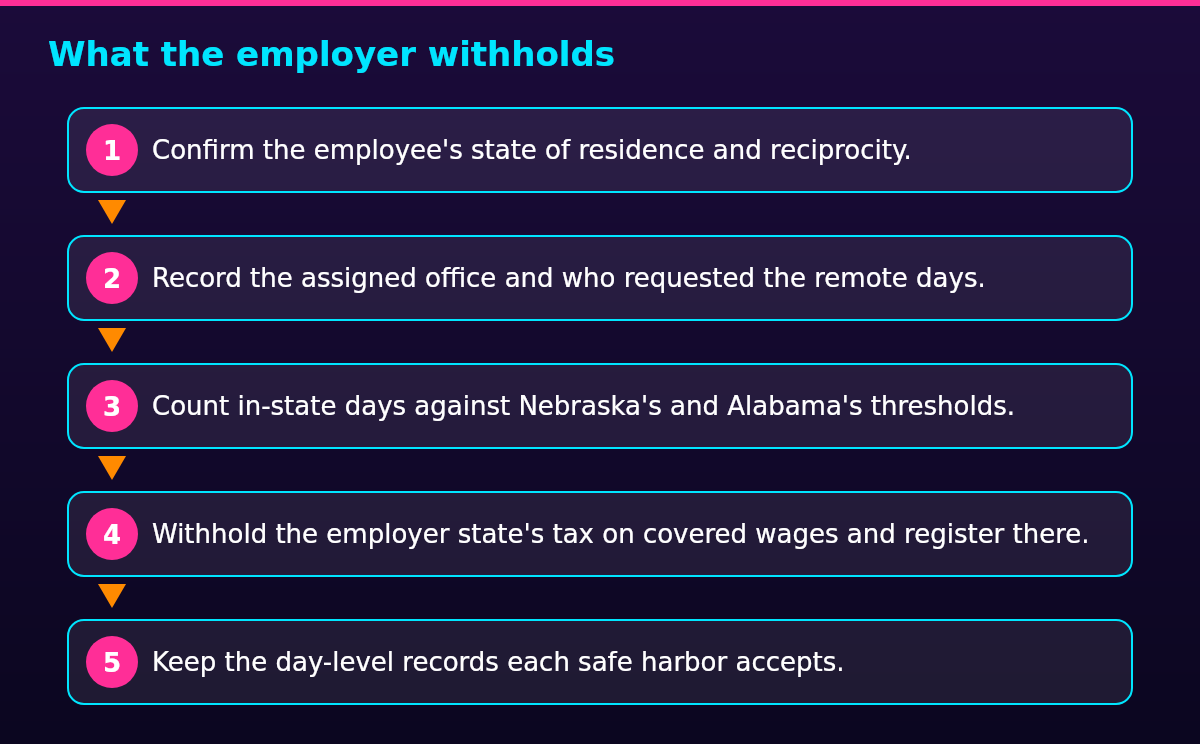
The whole loop fits five steps:
- Confirm the employee’s state of residence and reciprocity.
- Record the assigned office and who requested the remote days.
- Count in-state days against Nebraska’s and Alabama’s thresholds.
- Withhold the employer state’s tax on covered wages and register there.
- Keep the day-level records each safe harbor accepts.
The employee’s credit
An employee caught by the rule generally credits the employer state’s income tax on their home-state return, and the credit is capped at the tax the home state would have charged on the same income. Most states allow that resident credit, but the details are each home state’s own, so the outcome depends on where the employee lives. When the employer state’s rate is higher, the cap leaves a residual double tax the employee keeps paying, which is the complaint behind every lawsuit and legislative answer the rule has produced.
New Jersey turned that gap into a payment. Its refundable credit, worth 50% of the tax owed to New Jersey for residents denied refunds by another state for remote work between 2020 and 2023, is the clearest case of a state paying part of the double tax back, as the Connecticut General Assembly’s research office records. The employer’s exposure is the decisions that follow: whether to gross up salaries so a covered employee is not paid less for the same job, and how to hold pay equity between office-based and remote staff in the same role.
When an employer of record (EOR) employs your remote hire, the EOR runs the withholding and the day tracking as the legal employer, and the state’s rule is what applies either way. What moves to the EOR is the registration, the deposits and the records, not the tax outcome for the employee.
FAQ
Six as of October 2026: New York, Delaware, Nebraska and Pennsylvania apply it directly, and Connecticut and New Jersey apply it back at the states that use it on their residents. Nebraska’s version has carried its seven-day presence condition since January 1, 2025, and Alabama left the list with an August 25, 2026 revenue department notice.
For remote work taxes, you usually pay state income tax to the state where you physically work. If your employer is in New York, Delaware, Nebraska or Pennsylvania, the convenience of employer rule can make the employer’s state tax your home-office days too, and your home state credits that tax up to its own tax on the same wages. Local income taxes, where they exist, follow the locality’s own rules.
You generally owe income tax to the state where the work is physically done, and your home state credits tax paid there when it also taxes the same wages. Remote work from a different state is what the convenience of employer rule tests: in the covered states, your employer’s state can treat your home days as its own unless the employer’s necessity required the work outside it. Reciprocal agreements, where they exist between the two states, send the tax to your home state instead.
You file a resident return in the state you live in and a nonresident return in any state that taxes your wages, when the two are different. An employee covered by a convenience rule files a nonresident return in the employer’s state and claims the credit on the resident return at home. If your work and home states have a reciprocal agreement, you file only in your home state.
Yes, and the convenience of employer rule is what decides which state’s income tax the employer withholds. Nothing stops you from working for a company in another state; the tax question is whether your home days get taxed by the employer’s state, which happens for employees of New York, Delaware, Nebraska and Pennsylvania employers, and for covered residents of Connecticut and New Jersey employers. Your employer’s payroll setup, not your job, is what changes.