
On this page
Workers compensation insurance for remote employees is mandatory in almost every US state, and the state that sets the requirement is where each employee actually works, not where your company is based. Insuring remote employees costs a median of $1.09 per $100 of payroll, from $0.50 in North Dakota to $2.52 in Hawaii, per Oregon’s 2024 rate ranking study, and office work is the cheapest part of the workers’ compensation system. Remote employees who work from home in another state need workers’ compensation insurance under that work state’s rule: California requires it from one employee, most of Florida from four, Texas is the only state where it is optional for most private employers, and in four states only the state fund sells it. The rest of the rule for remote employees is which state’s law applies to the home office, whether home office injuries are covered, and who sells workers’ compensation insurance in each work state.
Which state’s rules apply
The workers’ compensation law that applies to a remote employee is the law of the state where the work is performed, even when that is a home office in a state where you have no office, no registration and no payroll. An employee who lives in one state and works from home in another counts as working in the home state, so that state’s threshold and claim system apply. What differs by state is how much contact triggers a full policy, and the boards spell those triggers out precisely.
New York draws its line in policy terms. An out-of-state employer needs a full New York statutory policy, with New York listed in Item 3A of the policy’s information page, when an employee’s primary work location is New York, or when the employer had employees working there for at least 25 individual days or 40 hours a week for longer than two consecutive weeks in the prior year, per the New York Workers’ Compensation Board. The board’s other triggers include a permanent physical location in the state, a New York permit or contract, and construction work performed there.
Limited exposure can ride on the employer’s home-state policy instead. New York accepts Item 3C coverage, where the employer’s own state’s law governs and New York is listed in Item 3C, for employees who only attend meetings, seminars or conferences in the state no more than one per month, or travel through without stopping for work, as the board’s out-of-state employer rules set out.
California sets a low bar. The California Division of Workers’ Compensation requires employers to carry coverage even if they have only one employee, and tells out-of-state employers they may need coverage if they have any employees regularly working in California.
Florida handles out-of-state employers through the policy itself: the employer either notifies its carrier or buys a Florida-approved policy that lists Florida in Section 3A, as the Florida Division of Workers’ Compensation requires. Its thresholds run from one employee in construction to four in most other industries and six regular employees in agriculture.
North Dakota uses a contacts test. Coverage is required when an employee is expected to earn at least 25% of their gross annual wages from work in the state, or when work performed there makes up at least 25% of the employer’s payroll for the state, per North Dakota Workforce Safety and Insurance.
The wrinkle runs the other way too. An employee who lives in New York but works entirely in another state needs no New York policy, as long as they do no work in New York for your business and receive no direction and control from you at their home, per the New York Workers’ Compensation Board. Every address change deserves a re-check, because a move changes the work state, and the work state sets the requirement.
Who must carry coverage
Employers need workers’ compensation for remote employees in every state but Texas, once the number of employees working in a state crosses that state’s threshold. What counts is the number of employees working in each state, not your company-wide headcount: a company with ninety employees in Texas and one working from home in Sacramento has crossed California’s one-employee line, whether or not it has any office in California. The threshold that matters for remote employees is the work state’s own.
| State | Who must carry coverage | Where the rule is set |
|---|---|---|
| California | Every employer with one or more employees, including out-of-state employers with employees regularly working in the state | Division of Workers’ Compensation |
| New York | Virtually all employers, once an employee’s primary work location is in the state or exposure meets the board’s days-and-hours test | Workers’ Compensation Board |
| Florida | Construction employers with one or more employees, most other employers with four or more, agriculture with six regular or twelve seasonal workers | Division of Workers’ Compensation |
| Washington | All employment in the state, except the exclusions listed in state law | Revised Code of Washington 51.12 |
| North Dakota | All employers must insure all employees, including part-time, seasonal and occasional workers, before work begins | Workforce Safety and Insurance |
| Ohio | Every person, firm or private corporation with one or more employees | Ohio Revised Code 4123.01 |
| Texas | Optional for most private employers; those without coverage must notify the state and report lost-time injuries, illnesses and deaths | Department of Insurance |
Independent contractors are not employees, so genuine contractors do not put you over a state’s employee threshold. The label is not what protects you, though. A contractor who should have been an employee, a misclassified hire, can leave the claim uninsured exactly when it arrives, because the state applies its rule to the real working relationship, not the contract. Coverage is also one item on a longer list of your responsibilities as a remote employer, from payroll tax to equipment, and the same work-state logic runs through every one of them.
Home office injuries
A home office injury is a workers’ compensation claim when it happens doing the job, and state laws describe the test as whether the injury arose out of and in the course of employment. The same statute that covers a fall in the office kitchen covers a fall at the kitchen table, if the employee was working at the time. In New York, the Workers’ Compensation Board says it plainly: whether a worker is covered is “always a factual determination by the Board.”
The claims are ordinary office claims. In the office and clerical industry group, slips and falls are the predominant cause of injury, accounting for almost 40% of lost-time claims, and a typical carpal tunnel claim costs about 30% less than an average claim, per a National Council on Compensation Insurance (NCCI) telecommuting analysis. The same analysis flags home offices as a source of work-related slips, falls and repetitive-motion claims, from exposed cords, distractions and makeshift desk arrangements.
In most states, an injury during purely personal activities on personal time is not compensable, so making lunch, exercising or walking the dog between meetings sits outside the course of employment. The borderline cases, like reaching for a work file while lunch cooks, are where boards judge on the facts. What an employer controls is the record: what the employee was doing, where and when, decides the claim faster than any policy wording.
The frequency trend runs in the employer’s favor. Combined office workers in special classes saw a 40% decline in claim frequency between 2019 and 2022, per NCCI’s remote work analysis. A remote employee carries the office claim mix, at office rates.
Cost per $100 of payroll
Workers’ compensation insurance costs a rate per $100 of payroll for the employee’s job classification, and the median rate across US states is $1.09 per $100 of payroll, in the Oregon Department of Consumer and Business Services study of rates effective March 1, 2023. The spread between states is wide: the same payroll costs about five times as much to insure in Hawaii as in North Dakota. Where your remote employees work decides where you sit in that range, which is why the work state matters to the bill as well as the obligation.
| State | Rate per $100 of payroll |
|---|---|
| North Dakota | $0.50 |
| Oregon | $0.89 |
| Georgia | $1.09 |
| Hawaii | $2.52 |
Georgia sits exactly at the study median, Oregon runs at 82% of it, North Dakota at 45%, and Hawaii at 231%, per the 2024 Oregon rate study.
Remote office work lands at the cheap end of even that range: office and clerical work accounts for about 60% of workers’ compensation payroll but only 11% of premium, per NCCI’s telecommuting analysis, and the rating system has a dedicated class code for it. Clerical office employees are class code 8810, while clerical telecommuting employees are class code 8871. Payroll coded to the telecommuting class was about 0.5% of countrywide payroll in 2020, so how a remote employee is classified moves the bill.
Say you pay one fully remote employee $70,000 a year. At the Oregon rate study median of $1.09 per $100 of payroll, the premium comes to about $763 a year, roughly $64 a month, before any credit or debit your claims history applies.

Monopolistic state funds
In four states, workers’ compensation comes only from the state fund, and most employers with employees there must buy it from the state fund: Ohio, North Dakota, Washington and Wyoming. A remote hire in one of them means a stop at that state’s fund, not a call to your broker. Your policy’s other states endorsement cannot reach them either, as the Indiana Compensation Rating Bureau notes that monopolistic fund states cannot be included.
North Dakota is the clearest case. Workforce Safety and Insurance is “the sole provider and administrator of workers’ compensation in North Dakota,” and state law does not allow private insurers to underwrite coverage there.
Wyoming is the same shape. Its own Department of Insurance calls Wyoming “a monopolistic state, where the state fund is the primary provider of this insurance,” with coverage bought through the Department of Workforce Services.
Ohio defines employer to include every person, firm and private corporation with one or more employees, and all such employers are subject to the state’s workers’ compensation chapter, per Ohio Revised Code 4123.01.
Washington covers all employment in the state except a short statutory list of exclusions, and its Department of Labor and Industries runs the no-fault state fund that sells the coverage.
Ohio’s employers pay their premiums straight to the state insurance fund, as Ohio Revised Code 4123.29 provides. That is the whole practical difference for a remote hire: the rate comes from the fund, the premium goes to the fund, and no carrier can endorse your way out of it.
The other states endorsement
The other states insurance endorsement extends a standard workers’ compensation policy to states where you did not expect to have workers, and it stops working the moment you actually hire there. On the policy’s information page, Item 3.A lists the states where operations are known or expected. Part Three, the other states endorsement at Item 3.C, is built to give temporary and automatic coverage for new operations in other states and for incidental exposures like interstate travel, with new operations covered as long as they are reported within 30 days, per the Indiana Compensation Rating Bureau.
Policies written in the assigned risk market, where employers the standard market declines go, get less. The Residual Market Limited Other States Insurance Endorsement, form WC 00 03 26 A, covers only “temporary, incidental or casual exposure” and does not provide automatic coverage for actual operations in other states, per the Indiana Compensation Rating Bureau. The endorsement itself warns that it “does not satisfy the requirements of that state’s workers compensation law” once the employer hires employees or begins operations in the state. A steady remote hire in a new state is an operation in that state, not an incidental exposure, and that is the practical line.
How to fix your coverage
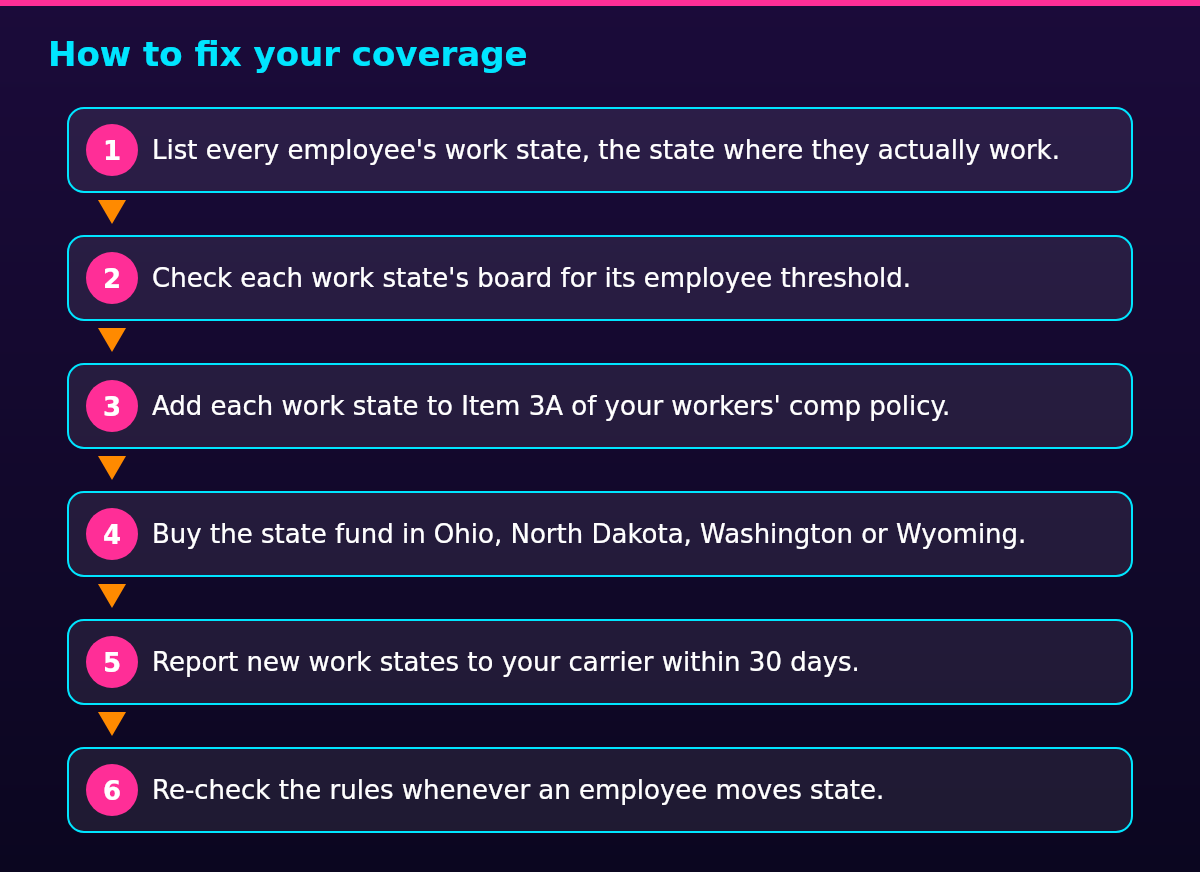
Getting workers’ compensation coverage for remote employees right is a state-by-state audit of where each employee actually works, not a bigger umbrella policy. An umbrella policy added on top of coverage written for the wrong states satisfies no work state’s board. Six steps, repeated whenever someone moves, keep the coverage matched to the team:
- List every employee’s work state, the state where they actually work.
- Check each work state’s board for its employee threshold.
- Add each work state to Item 3A of your workers’ comp policy.
- Buy the state fund in Ohio, North Dakota, Washington or Wyoming.
- Report new work states to your carrier within 30 days.
- Re-check the rules whenever an employee moves state.
The requirement and the 30-day reporting rule belong in your HR policy for remote workers, and every new hire’s work state gets captured when you onboard remote employees, so the audit stays current without a separate project. Where you would rather not run multi-state compliance yourself, the PEO vs EOR comparison sets out the two ways a professional employer organization (PEO) or an employer of record (EOR) can carry the employment relationship, and what each costs.
FAQ
Yes, in almost every case. The requirement is set by the state where the employee works, and every state except Texas makes coverage mandatory once you cross its employee threshold. New York requires a full policy once an employee’s primary work location is the state, California requires coverage from one employee, and North Dakota applies its contacts test, so a home office in another state puts that state’s rule in charge.
Yes. What counts is where the work is performed: New York’s days-and-hours tests, California’s regular-work test, Florida’s Section 3A notice and North Dakota’s contacts test all turn on the employee working in the state, not the company’s address or payroll location. An employee who lives in one state and does their job from a home office in another is working in the state the home office is in.
No. Workers’ compensation is mandatory in every state except Texas, where private employers can choose to carry coverage in most cases, per the Texas Department of Insurance. Every state that requires it does so by its own employee threshold, so the more useful question is whether you have crossed the line in the states where your employees work.
Yes. Employees are covered wherever they perform their work, including at home, when the injury arises out of and in the course of employment. In New York the board decides covered status on the facts of each case, and the same test that covers a fall in the office covers a fall at the kitchen table during work.
The claim is handled by the workers’ compensation system of the state where the employee works, the same as an office injury. The employee reports it to you, you report it to your carrier or the state fund, and medical and wage benefits follow that state’s own schedule. Home office claims are office claims: slips, falls and repetitive strain, judged on the facts of what the employee was doing.
No, in most states you do not: independent contractors are not employees, so genuine contractors do not trigger a coverage requirement. The risk is misclassification: if the state recharacterizes a contractor as an employee, the claim can land on an employer with no policy in place, which costs far more than the premium would have.