

On this page
The short answer to how to pay international contractors is a cost-plus-compliance trade: five methods move the money, and on a $4,000 monthly invoice the transfer itself currently costs anywhere from under $10 with a foreign-exchange specialist to $45 with a Bank of America USD wire, or a flat $29 to $49 a month on a contractor platform. The five are a bank wire, a foreign-exchange provider such as Wise, a receiving-account provider such as Payoneer, PayPal, and a contractor platform such as Deel, Remote or Oyster.
Paying a contractor in another country is really two decisions: which method moves the money, and who carries the paperwork and the risk. Every method leaves worker classification and the tax forms with you unless you pay a platform, or one of its paid indemnity tiers, to take more of the work on. Every fee and exchange-rate markup below was read from the provider’s own pricing page in October 2026, because these numbers move.
International contractor payments compared
| Method | Cost today | Exchange rate | Who pays the fees | Who carries compliance |
|---|---|---|---|---|
| Bank wire (SWIFT) | $45 outgoing in USD (Bank of America) | Bank’s markup; it may profit on the conversion | You, plus correspondent-bank deductions | You |
| Wise | From 0.23% per transfer, varies by currency | Mid-market rate, no markup | You | You |
| Payoneer | Free to receive in local currency, 1% non-local, 1% by ACH debit | Not stated on its pricing page | Split: you pay sending, the contractor pays withdrawal | You |
| PayPal | About 4.99% plus $0.49 recipient-side | 4.00% conversion fee above the base rate | Mostly the contractor | You |
| Contractor platforms | $29 to $49 per contractor a month | Contract currency; fees outside it | You, a flat monthly fee | Shared; indemnity tiers move it |
The traditional route for international contractor payments is the bank wire: Bank of America wire transfers currently cost $45 outgoing in US dollars, and nothing for a wire sent in a foreign currency, though the bank’s exchange-rate markup applies and it states it may make money on the conversion. Inbound wires may incur a $15 fee per wire. International wires sent by the bank’s 5 p.m. ET cutoff typically arrive in 1 to 5 business days, and correspondent banks along the route can deduct their own charges from the amount.
Wise currently charges from 0.23% per transfer, varying by currency, and converts at the mid-market rate with no markup. The pricing page mentions volume discounts on large conversions and states no transfer timing, so there is no published speed figure to set against the wire’s 1 to 5 days.
Payoneer currently charges the contractor nothing to receive into a local-currency account, and 1% into a non-local one. You pay 1% by ACH bank debit from a US account, or up to 3.99% plus $0.49 by credit card. The contractor’s own withdrawal runs 1.2% to 4% to a bank in local currency, and an annual account fee of $29.95 applies only when less than 6,000 USD is received in 12 months.
PayPal currently deducts about 4.99% plus $0.49 on the recipient’s side of a cross-border business payment: its 3.49% commercial rate plus a $0.49 fixed fee, with 1.50% added for international transactions. When you pay in a currency other than the one the invoice is listed in, the 4.00% conversion spread applies to the transaction exchange rate; PayPal’s fee page prices other conversions at 3.00%. The contractor is the merchant in that setup, so the processing fee lands on them unless your agreement says you reimburse it.
Among the platforms, Deel currently starts at $49 per contractor a month, covering payments in 120+ currencies, automated invoicing and document collection.
Remote currently charges $29 per contractor a month for Contractor Management, covering 190+ countries, localized contracts, invoice approval and compliance screening.
Oyster currently charges $29 per contractor a month for Global Contractors after a 30-day free trial, generating contracts in 180+ countries, and applies a fee when you pay in a currency different from the contract currency.
Across all five methods, the compliance column changes only at the platforms: a wire, an FX transfer and a PayPal payment leave classification, the contract and the tax forms entirely with you.
How to choose a method
The best way to pay overseas contractors depends on two things, the invoice size and who you want carrying the compliance, not on brand. On a single monthly invoice, a flat platform fee costs about the same as one bank wire and takes the paperwork with it. PayPal’s percentage is the one that scales with the invoice, which makes it the most expensive way to pay overseas as invoices grow.
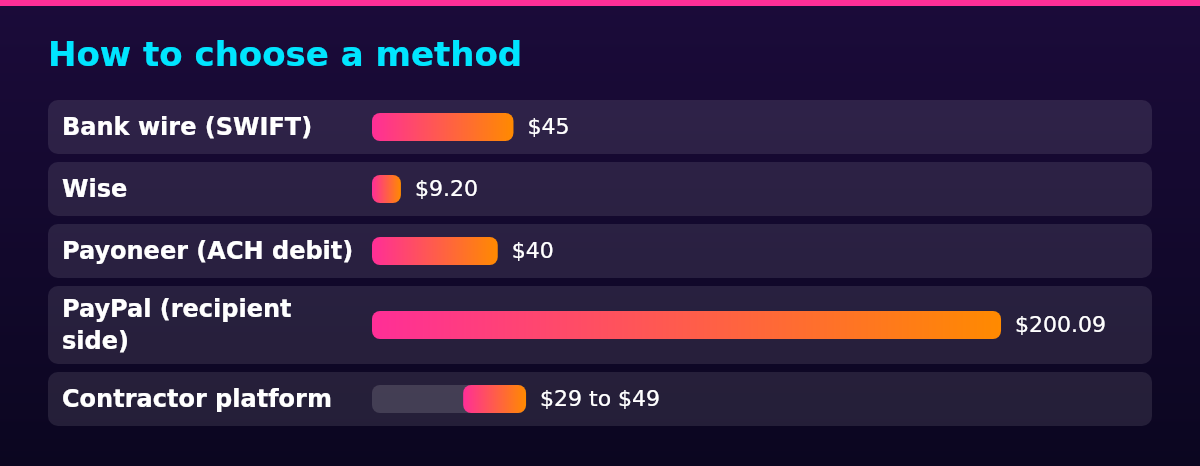
Say you pay one overseas contractor a $4,000 monthly invoice. Each method currently takes a different cut of it, at the published rates above:
| Method | Cost on a $4,000 monthly invoice |
|---|---|
| Bank wire (SWIFT) | $45 |
| Wise | $9.20 |
| Payoneer (ACH debit) | $40 |
| PayPal (recipient side) | $200.09 |
| Contractor platform | $29 to $49 |
A few qualifiers sit under those numbers. The Wise figure is its published floor, 0.23% of the invoice, and varies by currency, with the exact fee shown before you confirm the transfer on Wise’s pricing page. The Payoneer figure is your sending side only; the contractor’s own withdrawal adds 1.2% to 4% on theirs, and PayPal’s cut also lands on the contractor unless you reimburse it. The percentages cross over at size, too: at the 0.23% floor, a transfer costs more than the $45 wire once the invoice passes about $19,600, and the exact floor varies by currency.
Add contractors and the fee shapes diverge further: the platform bill scales per head, one flat fee each a month, while the wire scales per transfer and the percentage transfer scales with the invoice. Remote’s base plan currently undercuts a monthly wire per contractor, Deel’s list price sits just above one, and the percentage transfer stays the cheapest of the three at any headcount, while carrying none of the paperwork. A second currency conversion, outside the contract currency, is the platform fee most teams forget to check. That trade, cost against paperwork against risk, is the whole decision.
Steps to pay a contractor abroad
1. Sign a written contractor agreement
Sign it before the first invoice: every later decision, from fee disputes to classification questions, refers back to it. What it needs to cover is in the contractor agreement section. Both sides hold a countersigned copy before the first hour of work, not a chat thread confirmation.
2. Collect the tax forms
For US companies, collect the contractor’s Form W-8BEN before the first payment to document their foreign status, and whether a 1099-NEC follows at year end depends on where the work happens, not where you pay from.
3. Choose the method and the fee split
Match the method to the invoice size, and write the fee split into the agreement: the five methods price the two sides of the payment differently, so an unwritten split is where the first dispute starts.
4. Set the currency and invoice cadence
Fix the invoice currency, the cadence and a payment window before the first invoice lands. Monthly invoicing with net 15 or net 30 terms is the common pattern for long-running engagements. A fixed cadence also keeps the payment records clean enough to reconcile at year end without digging through email.
5. Send the payment and record it
Send the payment and record the method, the amount in both currencies, the exchange rate and the date. The record is what year-end reporting and any later audit work from, whatever the method.
6. Close the year-end reporting
Close the year by reporting what the records show in each jurisdiction you owe. For US companies that means a Form 1099-NEC for a US-person contractor, while a contractor who performed the work entirely abroad generally does not receive one.
The contractor agreement
An international contractor agreement is what decides the arguments a payment method can only make worse: it is the document both sides point at when a fee, a date or the classification itself is in dispute, and it needs to exist before the first invoice. Before the first payment, it should fix:
- The currency the invoice is issued in, which can differ from the currency you pay in
- Who bears the transfer and conversion fees, with both sides named
- The invoice cadence and the payment window
- IP assignment and what happens to work product
- The termination notice each side owes
- The worker’s status as an independent contractor, and who controls how the work gets done
Two more lines matter in an international agreement that a domestic one skips: which country’s law governs the contract, and where a dispute is heard. Both belong in the document before money moves, because a cross-border fee argument with no agreed forum resolves at the speed of two legal systems. None of the payment methods records the last bullet either: no wire or transfer tells an authority the worker is a contractor, so the agreement, and how the engagement actually runs, are the evidence.
Misclassification risk before you pay
Every payment method except a platform’s paid indemnity tiers leaves international contractor misclassification risk with you: the worker’s country applies its own tests to whether a contractor is really an employee, and paying through a bank, Wise or PayPal changes none of them. The cost of international contractor misclassification runs from back taxes and social-insurance contributions to a reclassification order, jurisdiction by jurisdiction. The tests and the penalties vary by country, and independent contractor misclassification covers them jurisdiction by jurisdiction.
Platforms screen engagements, but screening is not a transfer of risk. On Remote’s pricing page, the Plus tier currently costs $99 per contractor a month and adds up to $100,000 of indemnity for misclassification risk, while the Contractor of Record service at $325 a month carries uncapped indemnity.
Deel’s Contractor of Record currently starts at $325 per contractor a month and moves classification liability to Deel’s own local entity. Those paid tiers, not the base plans, are what actually move the risk.
When a contractor becomes an employee
Hiring international contractors stops being the right setup when the engagement starts looking like employment: fixed hours, your tools, your direction of the work, or you simply wanting the person full time. At that point the payment method stops being the question, and the routes become an employer of record for independent contractors or your own entity with global payroll behind it.
The jump from hiring international contractors to employing them is a fresh hire in everything but the interview: it needs the same documents, a local-law employment contract and a new payroll setup as any round of hiring foreign remote workers. The worker’s notice, severance and registration rules flip from the contract to the local employment regime on the day it happens, so the sequence is worth running before the offer, not after.
FAQ
By invoice size and who carries the compliance: a foreign-exchange provider such as Wise currently costs the least per transfer, a flat platform fee costs about the same as one bank wire while carrying the contracts and screening, and PayPal’s percentage makes it the most expensive route as invoices grow. For one contractor on a monthly invoice, the platform decision is really about paperwork, not price.
Yes, and most do it through one of the methods above, with a written agreement and the contractor’s Form W-8BEN on file before the first payment. Generally, no Form 1099-NEC is issued when the work is performed entirely outside the United States; the exceptions, such as US-person contractors, are what the year-end reporting step turns on.
Through the same five routes: an international bank transfer into their local account, a foreign-exchange provider, a receiving account with a withdrawal, PayPal, or a platform that pays them in their own currency. Long-running engagements usually settle on a monthly invoice paid by bank or foreign-exchange transfer, with the platform route becoming common once a company has several contractors.
By invoice: the contractor bills on a set cadence, usually monthly, and you pay within the window the agreement names, with net 15 and net 30 the common terms. The method, the currency and who eats the fees are set in the agreement before the first invoice, not negotiated per payment.