

On this page
An employer of record India arrangement puts a provider’s own Indian entity on record as your hire’s legal employer for about $599 a month, the fee Deel currently charges per worker, so you can hire someone in India without registering a private limited company. On top of that fee, the provider funds the employer’s 12% EPF contribution and 3.25% ESI contribution on the worker’s wages, the same payroll taxes a private limited company of your own would carry. An employer of record (EOR) is the company that legally employs your worker in the country where they work: it signs the local contract, runs payroll, and carries the statutory contributions, while you direct the day to day work. The crossover comes down to headcount: once your EOR fees across your Indian hires pass the fixed annual cost of running your own private limited company, the entity usually starts to win on cost.
India hiring costs at a glance
| Cost item | Who pays | Amount | Source |
|---|---|---|---|
| EOR monthly fee | You, the client company | $599 per employee per month (USD), the current Deel and Remote rate | Deel pricing |
| EPF employer contribution | Employer | 12% of EPF wages (8.33% to the Employees’ Pension Scheme, 3.67% to the Provident Fund itself), mandatory up to a ₹25,000 a month wage ceiling since 17 September 2026 | EPFO |
| ESI employer contribution | Employer | 3.25% of wages, only on wages up to a ₹21,000 a month ceiling (₹25,000 for employees with disabilities), in force since 1 July 2019 | ESIC |
| Gratuity accrual | Employer | About 4.81% of annual wages set aside each year, payable after 5 years of continuous service (1 year for fixed term employees under the 2025 labour codes) | Payment of Gratuity Act, 1972 |
| Karnataka professional tax | Employee, deducted and remitted by the employer | Nil below ₹25,000 a month gross salary; ₹200 a month at or above that (₹300 in February), capped at ₹2,500 a year | Karnataka professional tax |
| Private limited company instead | You | No statutory minimum paid up capital; 2 directors and 2 shareholders; registration with the Registrar of Companies | Companies Act, 2013 |
The EOR fee is the flat part of the monthly cost. The statutory contributions on top scale with the worker’s wages up to their own ceilings, which is what folds a predictable total into one invoice at low headcount.
How an EOR works in India
An employer of record in India is the legal employer of your worker on an Indian employment contract through its own Indian entity, so you direct the work without becoming the employer yourself. The provider registers the worker with the Employees’ Provident Fund Organisation and, where the wage ceiling applies, the Employees’ State Insurance Corporation, issues the written appointment letter the state’s Shops and Commercial Establishments Act requires, and runs TDS income tax withholding on the salary each month.
Hiring through an EOR in India typically takes a few days to a few weeks once the worker’s documents are in hand, against the months it takes to incorporate and register a private limited company. You keep the hiring decision, the pay you offer, and the day to day direction of the work; the provider carries the contract, the payroll and the statutory filings.
Cost comparison
| Headcount | EOR fee (USD a year) | Private limited company crossover |
|---|---|---|
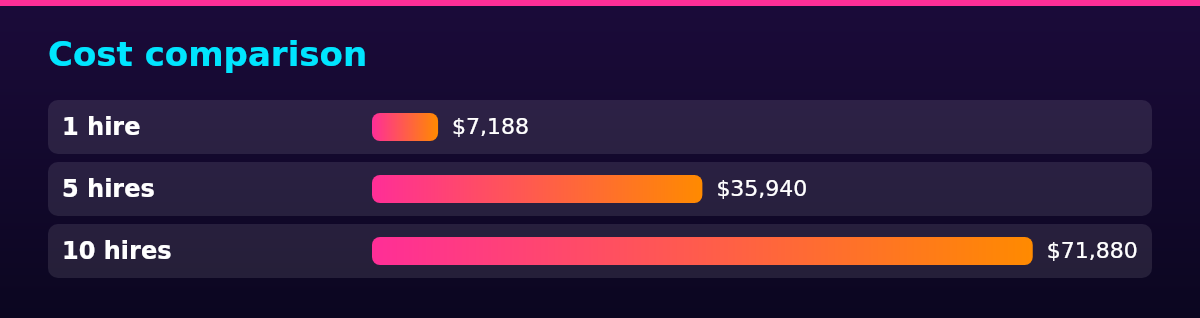
| 1 hire | $7,188 | Its fixed annual cost is under $7,188 a year |
| 5 hires | $35,940 | Its fixed annual cost is under $35,940 a year |
| 10 hires | $71,880 | Its fixed annual cost is under $71,880 a year |
The EOR side scales in a straight line: the $599 a month fee on the Remote pricing page works out to $7,188 a year per worker, $35,940 for five people and $71,880 for ten. Both routes carry the same EPF, ESI and gratuity obligations on the same salary, so the real comparison is the flat EOR fee against the mostly fixed cost of running a private limited company.
A private limited company’s costs barely rise with headcount: no statutory minimum paid up capital applies since the Companies (Amendment) Act, 2015 removed the earlier ₹1,00,000 floor, though founders typically still set a ₹1,00,000 authorized capital as a formality, plus a registered office, Registrar of Companies filings and ongoing compliance costs. Those fixed costs are what make the crossover work: multiply your EOR fees by your Indian headcount and compare the total to what registering and running your own entity would cost each year.
On a ₹7,20,000 a year salary (₹60,000 a month), above both statutory ceilings, the employer’s EPF share stays capped at 12% of the ₹25,000 wage ceiling, or ₹36,000 a year, however much higher the actual salary runs. The ESI scheme excludes wages above its own ₹21,000 a month ceiling entirely, so there’s no employer ESI contribution at that salary. Gratuity accrues at about 4.81% of the annual wage, or roughly ₹34,632 a year, payable once the worker reaches five years of service (one year for a fixed term hire under the 2025 labour codes). That puts the statutory employer add on at around ₹70,632 a year on top of salary and the EOR or entity’s own running cost, a figure that falls as a share of pay as salary rises past the ceilings rather than scaling with it.
The cost of employer of record services guide breaks down how the monthly fee itself varies by country and provider.
Legal compliance in Karnataka
India employment law for a foreign employer hiring in Karnataka starts with the state’s own Shops and Commercial Establishments Act: working hours are capped at 9 hours a day and 48 hours a week, extendable with overtime pay to a maximum of 10 hours a day, under Section 7 of the Karnataka Shops and Commercial Establishments Act, 1961.pdf). Employees get one weekly holiday and earn one day of leave for every 20 days worked, under the same Act.
Gratuity applies to any establishment with 10 or more employees and is payable after 5 years of continuous service, under the Payment of Gratuity Act, 1972, a central law that applies the same way nationwide regardless of state. The 5-year rule is waived on the employee’s death or disablement, and the 2025 labour codes cut it to 1 year of service for fixed term employees.
Hiring a contractor instead of an employee shifts the payroll but keeps the status question: Indian courts weigh control over how the work gets done, how integrated the person is into day to day operations, and economic dependency on the one employer to decide whether a contractor is really an employee. The Employees’ Provident Fund Organisation can open a Section 7A inquiry into a misclassified arrangement and assess the back contributions due; the independent contractor misclassification guide covers the test in more depth.
A foreign company can also trigger Indian tax exposure through its workers: a dependent agent who habitually concludes contracts, holds stock for delivery, or secures orders in India for a non-resident company creates a taxable business connection under Section 9(1)(i) of the Income Tax Act, 1961, and India’s tax treaties layer a narrower, fixed place permanent establishment test on top. The permanent establishment guide covers how that exposure builds and what lowers it.
Every Indian state runs its own Shops and Commercial Establishments Act, so the working hours, leave and notice rules above apply to establishments registered in Karnataka specifically, not nationwide; a hire registered in another state follows that state’s own Act instead.
The 2025 labour codes in India
The Code on Wages, the Industrial Relations Code, the Code on Social Security and the Occupational Safety, Health and Working Conditions Code, the four laws meant to replace 29 existing central labour statutes, took effect on 21 November 2025, according to a Ministry of Labour and Employment press release.
As of the most recent reporting available (September 2026), no state had yet notified rules under all four codes. Because labour sits on India’s Concurrent List, each code needs matching state rules before it is enforceable there, so the older EPF Act, ESI Act, Payment of Gratuity Act and state Shops Act keep applying in the interim where a state’s own rules are still pending. That status is moving: the Labour Ministry launched a 90-day “Shram Samvad” outreach campaign across 316 districts on 28 September 2026 to push states toward notifying their rules.
One change already matters for EOR hiring regardless of state rules: under the new codes, a fixed term employee qualifies for gratuity after 1 year of service instead of 5. The codes also require a written appointment letter for every worker and extend ESIC coverage to any establishment with even one employee in a hazardous process, instead of the earlier 10-employee threshold.
Payroll taxes in India
| Payroll item | Employer share | Employee share | Source |
|---|---|---|---|
| EPF | 12% of EPF wages, capped at a ₹25,000 a month wage ceiling since 17 September 2026 | 12% of EPF wages, same ceiling | EPFO |
| ESI | 3.25% of wages, only up to a ₹21,000 a month ceiling | 0.75% of wages, same ceiling | ESIC |
| Karnataka professional tax | None; the employer administers the deduction | Nil below ₹25,000 a month; ₹200 a month at or above that, ₹2,500 a year cap | Karnataka professional tax |
Payroll also withholds tax deducted at source (TDS) on the salary under India’s progressive income tax slabs, under the Income Tax Act, 1961. The EOR calculates and deposits TDS each month as part of running payroll, and the worker settles their own annual return separately.
EOR versus a private limited company
An EOR fits a first hire or a small India team, when speed matters and you want the EPF, ESI, gratuity and Shops Act obligations handled without registering a local company. Your own private limited company fits scale, or when you need to hold Indian intellectual property, grant equity to local staff, or sponsor long term in house hiring without a per worker fee.
A private limited company needs at least 2 directors and 2 shareholders, a registered office in India, and registration with the Registrar of Companies under the Companies Act, 2013; no statutory minimum paid up capital applies since the 2015 amendment, though founders typically still set a ₹1,00,000 authorized capital as a formality.
Corporate tax runs at a standard 25% rate for domestic companies with turnover up to ₹400 crore (30% above that), or a concessional 22% rate under Section 115BAA of the Income Tax Act, 1961 for companies that forgo specified exemptions, which works out close to 25.17% effective once the surcharge and cess are added.
The crossover is the one in the cost comparison above: once your EOR fees across your India headcount pass the fixed annual cost of running your own entity, the private limited company usually wins on cost. An Indian EOR is also not a professional employer organization (PEO): the EOR is the sole legal employer on its own entity, while a PEO shares employer duties with you under a co-employment arrangement; the PEO vs EOR comparison sets the two models side by side.
Scaling framework
| Stage | Headcount | Model | When to set up an India entity instead of an EOR |
|---|---|---|---|
| First hire | 1 | EOR | EOR fees start to rival a private limited company’s fixed running cost |
| Early team | 2 to 5 | EOR | You need Indian intellectual property ownership or equity grants |
| Growing team | 6 to 10 | EOR or an early private limited company | In house payroll and compliance capacity makes sense at your headcount |
| Scale | 10+ | Private limited company with in house HR and compliance | Enough headcount that in house HR pays for itself |
Most employers start on an EOR because it needs no incorporation and carries the EPF, ESI and Shops Act obligations from day one, then move to their own entity once the flat per worker fees pass the fixed cost of running one.
Termination rules in Karnataka
| Rule | What Karnataka law requires | Source |
|---|---|---|
| Notice, under 6 months’ service | None required | Section 39, Karnataka Shops and Commercial Establishments Act, 1961.pdf) |
| Notice, 6 months’ service or more | 1 month’s notice or pay in lieu | same |
| Misconduct dismissal | No notice required where misconduct is proven at an inquiry; the employee has a right of appeal | same |
| Gratuity trigger | 5 years of continuous service (1 year for a fixed term hire under the 2025 labour codes) | Payment of Gratuity Act, 1972 |
These are the Shops Act rules for commercial and office staff. The separate Industrial Disputes Act sets its own retrenchment compensation rules for the larger “workman” category of industrial employees, a different test from the one above. Karnataka’s Section 39 notice period applies to establishments registered in Karnataka; a worker registered in another state follows that state’s own Shops Act notice rule instead.
FAQ
About $599 a month per employee in fees, the rate Deel currently charges, plus the employer’s EPF, ESI and gratuity contributions on top of salary. At one hire that’s $7,188 a year in fees before salary and statutory contributions.
Either through an employer of record, the fast route with no Indian company of your own, or through your own private limited company once one is registered. Through an EOR the provider becomes the legal employer, registers the worker with the EPFO and, where the wage ceiling applies, the ESIC, issues the appointment letter the state’s Shops Act requires, and runs TDS payroll, while you pick the person, set the pay and manage the work.
Yes, hiring through an EOR is legal in India: the provider employs the worker on its own Indian entity and carries the EPF, ESI, gratuity and Shops Act obligations that come with being the employer. There is no licensing regime specific to EOR arrangements the way some countries require.
Not as a standard shift in Karnataka: the Karnataka Shops and Commercial Establishments Act, 1961 caps the working day at 9 hours, extendable with overtime pay to a maximum of 10 hours. The 2025 labour codes don’t raise that ceiling; they mainly settle which older laws keep applying where state rules haven’t been notified yet.
The company that legally employs your worker in the country where they work: it signs the local employment contract, runs payroll, withholds tax and pays the employer’s statutory contributions on its own local entity, while you direct the day to day work. In India, that employer is the provider’s own Indian entity.
The EOR’s Indian entity pays 12% of EPF wages to the Employees’ Provident Fund, split 8.33% to the pension scheme and 3.67% to the fund itself, up to a ₹25,000 a month wage ceiling, plus 3.25% of wages to ESI for workers earning up to ₹21,000 a month. The worker’s own 12% EPF and 0.75% ESI shares come out of their pay, the same as they would under a private limited company.
Yes, through an employer of record: the provider’s own Indian entity is the legal employer, so your company never needs to register in India to have someone working there. The tradeoff is the per worker monthly fee against the fixed cost of running your own entity, which is what the cost comparison above works out.