

On this page
The Deel employer of record (EOR) plan makes Deel the legal employer of your international hires, so you can employ people in other countries without registering a company there. Deel’s pricing page currently lists full legal employment in 130+ countries for the EOR plan, starting at $599 per employee a month, as of October 2026.
Deel holds the local employment contract, runs payroll on its own payroll engine and carries the statutory employment obligations in each country, while your hire keeps working for you day to day. Around the EOR plan sit four other Deel plans for engaging and paying workers, from $49 contractor management to a $125 US PEO on Deel’s pricing page, and the boundary between them decides who carries which liability. Those boundaries, the real invoice above the list price and the risks an employer of record does not remove are what to check before signing.
What Deel EOR covers
What Deel EOR includes is the legal employment of your hire in their country: Deel issues the compliant local employment contract, runs payroll on its own payroll engine and covers the statutory obligations of employment, per Deel’s employer of record page. The scope Deel lists runs from contracts, minimum wage and terminations to the local labor laws in every country it employs in.
Your hire signs with Deel’s local entity, is paid through it and receives statutory benefits through it, while reporting to your managers and working on your roadmap. The legal employment relationship sits between your hire and Deel’s entity in the country; the working relationship sits between your hire and you. On your side there is no local entity to register and no local payroll to run, because the employment filings sit with Deel’s entity.
Benefits administration sits inside the plan, per Deel’s list of what the service covers: statutory health coverage, unemployment insurance and social security in each country that requires them, plus optional employer-provided benefits you choose to add. Onboarding is automated, with a dedicated onboarding manager assigned, and Deel also manages the end of employment: notice periods, severance payouts and accrued benefits when you end a role.
Deel makes two wider claims about the service that are worth reading as claims. One is that any and all intellectual property created by your hire passes through to you under its contract clauses. The other is that in-house legal, HR and equity help is available from 2,000+ experts when local rules get complex. Both are Deel’s own statements, not third-party findings.
What stays with you is everything that is not legal employment: the role, the work, the management and the budget for salary and fees. Deel is the employer on paper; you keep the working relationship and every business decision.
Where Deel employs people
| Figure | What it measures | Where Deel states it |
|---|---|---|
| 130+ countries | Countries the EOR plan covers, full legal employment | Deel’s pricing page |
| 150+ countries | Platform-wide compliance copy | Deel’s employer of record page |
| 130+ countries | Entity and payroll engine ownership claim | Deel’s employer of record page |
| 120+ currencies | Contractor payments | Deel’s pricing page |
| 40,000+ customers | Customer count | Deel’s pricing page |
The EOR plan currently lists full legal employment in 130+ countries globally on Deel’s pricing page, as of October 2026. The same page counts contractor payments in 120+ currencies, which is a different plan measuring a different thing.
Deel’s product copy runs higher than the plan list: its employer of record page says Deel handles contracts, minimum wage, terminations and local laws in 150+ countries, and that Deel owns its entities and payroll engine in 130+ countries. Deel’s own pages carry both employment counts, so treat any single country-count claim with care and check the plan-level list for the service you are buying.
Full legal employment means your hire is an employee under local law on Deel’s entity, not a contractor: they get the country’s statutory benefits, notice and severance protections. What Deel does not publish is a per-country breakdown of where it employs through its own entity and where it uses a local partner. That matters because the entity model affects who handles a severance dispute and how a termination runs in practice. Before hiring in a specific country, ask Deel directly whether it employs there through an owned entity or a partner, and what the contract says about each.
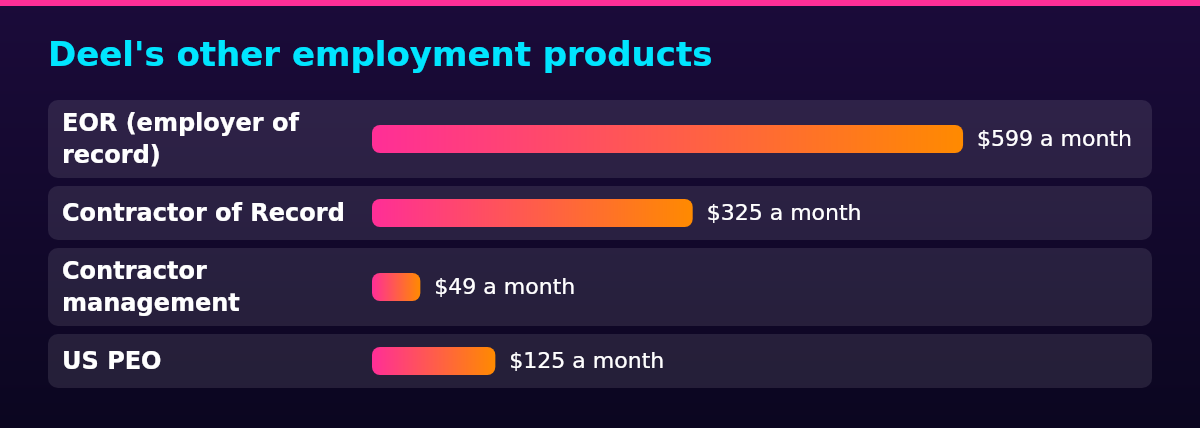
Deel’s other employment products
| Plan | Who it covers | Starting price per worker |
|---|---|---|
| EOR (employer of record) | Employees in other countries, with Deel as legal employer | $599 a month |
| Contractor of Record | Contractors whose misclassification risk Deel carries | $325 a month |
| Contractor management | Contractors you pay through Deel but manage and classify yourself | $49 a month |
| US PEO | US employees, co-employed across all 50 US states | $125 a month |
| Global payroll | Employees on your own entities, paid through Deel’s payroll engine | Not published, quote |
Deel publishes all four starting prices on its pricing page, read on October 22, 2026; the global payroll plan is the exception, with costs bundled into a quote rather than listed. Deel’s own pitch for Contractor of Record is “Classify them yourself, or shift liability to Deel with Contractor of Record.”
The boundary that matters is who carries the misclassification risk, meaning the risk that a worker paid as a contractor is treated by local rules as an employee. The $49 contractor management plan leaves classification with you: Deel handles contracts and payments, but if the working relationship looks like employment, the liability is yours. The $325 Contractor of Record moves that risk to Deel, which classifies the worker and carries it, per Deel’s pricing page. The $599 EOR plan is the full employment slice: Deel is the legal employer, holding the contract, payroll, benefits and termination obligations.
What it costs
Deel EOR currently starts at $599 per employee a month, per Deel’s pricing page, read on October 22, 2026. How much the invoice moves above that list price depends on the country: add-ons for benefits upgrades, equipment and currency conversion are priced per country, so two hires at the same salary can cost different amounts.
Two costs sit outside the fee itself: the salary you pay your hire, and the employer contributions and statutory benefits each country you hire in requires on top of it. The $599 covers Deel’s service, so a realistic monthly line for one employee is salary, plus statutory costs, plus the fee. Budgeting from the fee alone understates the real cost of a hire.
Ten EOR employees run $5,990 a month at the list price, before any add-on. The plans are month-to-month with no long-term commitments required, per Deel’s pricing FAQ, so the cost scales up or down as your team changes.
The plan-by-plan Deel price breakdown runs what every other Deel plan costs and includes, line by line. Deel’s $599 is one point in the wider employer of record cost range across providers, and where any provider’s price sits depends on the countries and worker types in your team.
How onboarding works
How long Deel EOR onboarding takes can be as little as one day, by Deel’s own claim: the new employee is invited by email to create a Deel account, with a dedicated onboarding manager on the process, per Deel’s employer of record page. That one-day figure is Deel’s claim for the fastest case, not a typical timeline across countries.
The mechanics behind the claim are the standard EOR flow. Deel issues the local employment agreement, enrolls your hire in the statutory and optional benefits you have chosen, and sets up payroll on its own engine. You provide the role, the salary and the start date; your hire provides identity documents, tax details and a bank account. Once payroll runs, you fund the amounts and Deel pays your hire and remits the withholdings in the country.
What stretches the timeline is country paperwork: work authorization where the country requires it, local registrations, and document turnaround from your hire. Deel publishes no per-country onboarding timeline, so ask for a current estimate for your specific country before you set a start date.
Legal compliance
Under the EOR plan, Deel handles the local employment obligations of the legal employer in each country it employs in: the compliant contract, minimum wage compliance and the termination rules that apply there. Three exposures stay with you.
Permanent establishment (PE) risk, meaning the chance your company itself becomes taxable in the country where your hire works, does not move to Deel with the employment contract. What your employee does and from where they do it can still create permanent establishment risk for your company, and whether it does depends on the activities, the country and any tax treaty, not on who runs the payroll.
Contractor misclassification is the second exposure, and it turns on which plan a worker is on. Hires made through the EOR plan or Contractor of Record sit with Deel; contractors you keep paying directly, on the $49 plan, are still judged by your local worker-classification tests. In the US, the IRS applies a common-law test: a worker is an independent contractor if you control only the result of the work and not the means and methods, per the IRS independent contractor definition.
Entity verification is the third. Deel says it owns its entities and payroll engine in 130+ countries, but publishes no per-country breakdown of owned entities versus local partners, and the liability chain between you and the employing entity depends on where you hire. Ask for the owned-entity list for your countries before you hire where termination or severance rules are strict, because that is where the entity model shows up first.
Scaling framework
Moving from Deel EOR to your own entity becomes worth it when headcount in one country pushes the $599 per-employee fee past the cost of registering a local company. The EOR plan earns its fee on your first hires in a country; the entity becomes cheaper per head later on. Where that crossover lands depends on the country and your salary base: entity setup costs are largely fixed, while the EOR fee scales with every head.
The comparison at the crossover is fixed entity costs, such as incorporation, accounting and local administration, against the per-head EOR fee. At low headcounts the EOR wins because you pay per person instead of paying for infrastructure; past the crossover, the entity wins on cost per head. A trigger worth checking is a country reaching double-digit headcount with a permanent outlook, because that is when the fixed costs start to win.
Deel’s month-to-month pricing makes the exit contractual rather than structural: you end the service rather than unwind an entity. Because the price is per employee with no long-term commitment, per Deel’s pricing FAQ, moving a team to your own entity when the crossover arrives is a planning decision, not a lock-in.
If Deel’s breadth is not the fit for your countries or worker mix, the Deel alternatives comparison prices nine competitors against Deel’s rates.
FAQ
Yes, where a published price, a wide country list and both employees and contractors on one platform matter most. The limits to weigh are real: add-ons priced per country move the invoice above Deel’s $599 list price, and Deel publishes no per-country owned-versus-partner entity list, so coverage depth in a specific country has to be confirmed with Deel directly. Whether it is the right EOR depends on the countries you hire in and your worker mix.
The EOR plan starts at $599 per employee a month, currently, on Deel’s pricing page, plus per-country add-ons for benefits upgrades, equipment and currency conversion. Ten employees run $5,990 a month at the list price before add-ons. The pricing is month-to-month with no long-term commitment required.
An EOR payroll is the payroll run by the employer of record as the legal employer: your hire is on Deel’s payroll in their country, paid under the local contract, tax withholding and statutory benefits, while you fund the salary and the service fee. You see the cost and the data; Deel files and remits in the country. It is the mechanism that lets your international hire be paid as a local employee without your company appearing on any local register.
Yes, by the signals a buyer can check: Deel publishes its scale (40,000+ customers, its own figure on its pricing page, as of October 2026) and its prices and coverage in plain terms. What sets your actual exposure is the paperwork, not the marketing: who employs your hire, who carries which liability and how terminations run in your countries under the service agreement you sign.
There is no single best employer of record: the right provider depends on the countries you hire in, the worker types you need and your budget. The best employer of record services comparison ranks the leading providers on those criteria, with prices and coverage side by side.