

On this page
An employer of record South Africa arrangement makes a provider the legal employer of your South African hire for about $599 a month, which is the starting fee Deel and Remote currently charge for employer of record (EOR) services, so you can employ someone there without registering a local company. On top of the fee you fund South Africa’s employer levies: 1% of the worker’s pay to the Unemployment Insurance Fund (UIF), matched by a 1% employee deduction, and 1% to the Skills Development Levy (SDL) once total salaries pass R500,000 over 12 months. PAYE, the income tax the South African Revenue Service (SARS) withholds, comes out of the worker’s gross salary rather than on top of it.
The EOR, not your company, is the employer on the South African contract: it registers with SARS, files the monthly payroll return, and applies the Basic Conditions of Employment Act (BCEA) while you run the work day to day. The wage floor is the national minimum wage, which rises to R30.23 an hour from 1 March 2026, per the SAnews report of the ministerial announcement. EOR fees scale per worker while a local company’s registration and payroll costs are fixed, so an EOR usually wins for a first hire and a Pty Ltd, South Africa’s private company form, tends to win as the team grows.
South Africa costs at a glance
| Cost item | Amount | Who pays | Source |
|---|---|---|---|
| Employer of record (EOR) fee | $599 per worker a month | You, to the provider | Deel and Remote pricing pages, November 2026 |
| UIF | 1% of pay from each side, up to the R17,712 monthly ceiling | Split: you 1%, the worker 1% | SARS, in force since June 2021 |
| SDL | 1% of total salaries above R500,000 in 12 months | You | SARS |
| PAYE | 18% on the first R245,100 a year, rising to 45% above R1,878,600 | The worker, withheld by the employer | SARS, 2027 tax year |
| National minimum wage | R30.23 an hour from 1 March 2026 | You, as salary | Ministerial determination, February 2026 |
| Annual leave | 21 consecutive days a leave cycle | You, as paid leave | BCEA |
| Notice period | 1 to 4 weeks by length of service | You, as notice or pay instead | BCEA |
| Severance | 1 week’s pay per completed year of service | You, on an operational-requirements dismissal | BCEA |
| Entity route instead | CIPC registration, then SARS, UIF and Compensation Fund registration | You | Department of Home Affairs |
R figures are South African rand. The amounts are statutory floors and current list prices, not a quote: salaries move by role, and providers discount for volume, so treat the table as a budgeting start.
The UIF ceiling means the levy stops growing above R17,712 of monthly pay, where the most each side contributes is R177.12 a month, and workers on fewer than 24 hours a month are excluded, under the SARS UIF levy page.
SDL is paid by the employer, not the worker, on the full salary bill, including wages, overtime, leave pay, bonuses, commissions and lump sums, and the employer becomes liable once it expects total salaries to exceed R500,000 over the next 12 months, per the SARS skills development levy page.
How a South African EOR works
A South African EOR becomes the legal employer of your hire while your company directs the work, the same employer of record model that applies in any country. The provider signs the employment contract, registers the worker with SARS for PAYE, UIF and SDL, runs monthly payroll, and applies the BCEA’s floor on hours, leave and notice.
South African law already recognizes a third party as an employer: section 198 of the Labour Relations Act (LRA) makes a temporary employment service that procures workers for a client their employer, while excluding independent contractors. An EOR sits on the right side of that line when it is the true employer on a South African contract, employing under its own payroll, rather than a labour broker placing temporary staff. Ask a provider to confirm in writing that your hire is its own employee, not a placed temp.
It is also the fastest way to hire employees in South Africa without a local entity: onboarding typically runs from a few business days to a few weeks, depending on the provider’s own entity, the contract sign-off and the worker’s documentation. The fee covers the local employment relationship; the work plan, tools, goals and performance management stay with your team.
Cost comparison
| EOR fee | One hire | Five hires | Ten hires |
|---|---|---|---|
| Per worker a month | $599 | $599 | $599 |
| Per worker a year | $7,188 | $7,188 | $7,188 |
| Total a year | $7,188 | $35,940 | $71,880 |
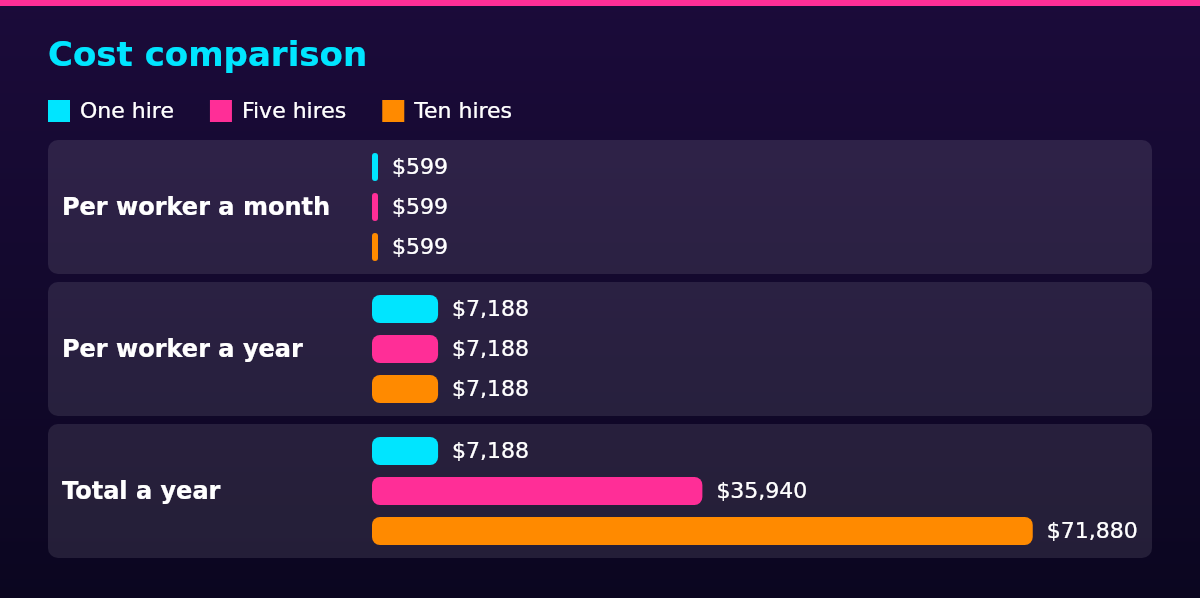
An EOR versus a South African Pty Ltd comes down to one cost line against several: the EOR fee, currently a $599 starting rate per worker a month at Remote, which lists it on annual contracts, and Deel, against the Pty Ltd’s registration and in-house payroll setup. Five workers cost $35,940 a year and ten cost $71,880, before any volume discount a provider offers. The fee is also the one cost line you can negotiate: how much employer of record services cost varies by provider, country and contract length.
EOR fees are not the whole cost of employing someone in South Africa. UIF, SDL, PAYE withholding and the BCEA’s leave and notice floor apply identically whether the legal employer is your provider or your own Pty Ltd: they are South African employment costs, not EOR costs. The comparison is between the provider’s flat fee and the fixed cost of running payroll yourself.
The entity side is a different cost shape: a Pty Ltd registers with the Companies and Intellectual Property Commission (CIPC), then registers with SARS for PAYE, the UIF and the Compensation Fund, and from then needs in-house payroll and accounting capacity. The crossover arrives when the total EOR fees pass the annual fixed cost of running South African payroll in-house, which is worked through in the scaling framework below.
Legal compliance in South Africa
Employment law in South Africa applies to your hire whoever employs them, foreign employer or local, and its core statute, the BCEA, caps ordinary working time at 45 hours a week, nine hours a day on a five-day week. Overtime is by agreement only, at 1.5 times the wage, capped at three hours a day and ten hours a week, under the Basic Conditions of Employment Act. For foreign employers, the EOR carries these duties as the legal employer.
Leave entitlements run on statutory cycles: 21 consecutive days of annual leave a leave cycle, sick leave on a 36-month cycle equal to the days the worker would normally work in six weeks, three days of family responsibility leave a year after four months’ service, and four consecutive months of maternity leave, all set by the BCEA’s leave provisions.
The contract itself is regulated too: the employer must give the worker written particulars at the start of employment, covering the parties, the job, the place of work, the start date, ordinary hours, the wage, the overtime rate, deductions, leave and the notice period, under BCEA section 29. The EOR issues this contract, so ask for a copy before the start date to check the terms match what you agreed.
A contractor engagement carries no BCEA floor and no unfair-dismissal protection, so it costs less until the worker is really an employee: a misclassified contractor can claim the LRA’s section 185 right not to be unfairly dismissed, plus the BCEA minimums. Employing through an employer of record rather than a contractor settles the classification question, because the EOR hires the worker as an employee from day one.
The Employment Equity Act (EEA) applies to designated employers: those with 50 or more employees, or fewer than 50 once annual turnover reaches the Schedule 4 small-business threshold, plus municipalities and organs of state, per the EEA’s designated-employer definition. The reporting and affirmative-action duties attach to the legal employer, which for your hire is the EOR while it employs them.
B-BBEE scores matter where your customers care: selling to organs of state or large South African corporates, under the B-BBEE Act. B-BBEE is South Africa’s statutory scorecard for black ownership and participation in a business. EOR-based staff sit on the provider’s payroll, so check with a B-BBEE verification agency how they are treated on your scorecard before assuming points.
Tax exposure turns on the same structure: the EOR’s South African contract, not your company’s presence, is the local employer, which is the structural reason the arrangement lowers permanent establishment risk for the hiring company. A worker who concludes contracts in your company’s own name can still create a taxable presence, so keep signing authority with the head office.
Payroll taxes in South Africa
The employer’s levy stack is small and capped: UIF is 1% of the worker’s pay matched by a 1% employee deduction, both stopping at the R17,712 monthly earnings ceiling, for a maximum of R177.12 a month from each side, under the SARS UIF page.
SDL is 1% of the total salary bill, paid by the employer alone, and it starts once total salaries are expected to exceed R500,000 over 12 months, per the SARS skills development levy page.
PAYE is employee-side withholding, not an employer cost. For the 2027 tax year, running 1 March 2026 to 28 February 2027, it starts at 18% on the first R245,100 of taxable income and rises through the brackets to 45% above R1,878,600, with a primary rebate of R17,820 and a tax threshold of R99,000, below which a worker under 65 pays no income tax, under the SARS rates of tax for individuals.
PAYE, UIF and SDL all reach SARS on one monthly declaration, the EMP201, due within seven days after the end of the month. A South African employer also registers with the Compensation Fund, which administers workplace-injury cover under the Compensation for Occupational Injuries and Diseases Act (COIDA), one of the registrations the Department of Home Affairs work-visa requirements list for employers.
EOR versus a local entity
The choice is an EOR, a South African Pty Ltd, or a contractor: the EOR fits a first hire, a short commitment or a test market; the Pty Ltd fits a team you expect to keep growing and want to manage directly; the contractor fits only work that is genuinely independent. The entity route means CIPC incorporation, then SARS, UIF and Compensation Fund registrations, the registration set the Department of Home Affairs visa requirements evidence; the EOR route means one fee per worker and none of the setup.
Both routes still owe the same statutory costs: UIF, SDL, PAYE withholding and the BCEA’s floor apply to the legal employer whichever one it is. What differs is control: your own entity gives you the contract, the bank account and direct visa sponsorship, while the EOR holds the employment relationship for you.
A South African EOR is not a professional employer organization (PEO) arrangement, either: the difference between a PEO and an EOR is that a PEO co-employs staff your own entity already employs, while an EOR employs them for you where you have no entity at all.
The crossover point is arithmetic: once the per-worker fees pass the annual fixed cost of your own registrations plus in-house payroll, the entity wins from there on. Because that fixed cost depends on the accounting and payroll capacity you already run, work it from your own numbers with the fee table above rather than a rule of thumb.
Scaling framework
| Stage | Headcount | Model | Trigger to move on |
|---|---|---|---|
| First hire | 1 | EOR | A second hire in South Africa is planned |
| Building | 2 to 5 | EOR, provider’s own entity | Monthly fees start to compound |
| Growing | 6 to 10 | EOR or Pty Ltd | In-house EMP201 capacity or critical-skills visas needed |
| Established | More than 10 | Pty Ltd, in-house payroll | Monthly fees pass the entity’s fixed annual cost |
Each stage turns on a trigger, not a headcount alone. In the building stage, confirm the provider employs through its own South African entity rather than a partner’s, because a partner adds a second company to every payroll cycle. The growing stage is where the fee total and the entity’s fixed cost come close, and where visa needs start to matter, since work permits are applied against the employing entity’s registrations.
When you do move workers from an EOR to your own Pty Ltd, the contracts move with them. Agree the transfer terms with the provider before the original service agreement is signed, so notice, leave accrual and final-pay items are settled in writing.
Termination rules in South Africa
| Length of service | Notice period |
|---|---|
| Four weeks or less | 1 week |
| More than four weeks, up to a year | 2 weeks |
| One year or more | 4 weeks |
Dismissal in South Africa is not at-will: the notice period, severance and CCMA referral rules in this section set what an exit costs. The employer must prove a fair reason and a fair procedure under section 188 of the Labour Relations Act, and the act’s Code of Good Practice names the three fair grounds as the worker’s conduct, the worker’s capacity, and the operational requirements of the employer’s business. Once a dismissal is established, the employer carries the onus of proving it fair under section 192.
The notice ladder is a floor, and no agreement may make the worker’s notice longer than the employer’s, under the BCEA’s notice rules. Instead of working notice, the employer may pay the worker what they would have earned for the notice period, which BCEA section 38 calls payment instead of notice. Farm and domestic workers with more than four weeks’ service are owed four weeks’ notice.
Severance is owed on one statutory ground: a worker dismissed for the employer’s operational requirements, such as a restructuring, is entitled to at least one week’s remuneration for each completed year of continuous service under BCEA section 41.
A worker who believes a dismissal was unfair refers the dispute to the CCMA, the Commission for Conciliation, Mediation and Arbitration, in writing within 30 days of the dismissal, under LRA section 191. Compensation for an unfair dismissal is capped at the equivalent of 12 months’ remuneration, per LRA section 194. The 30-day window is why documentation matters from the first written warning onward.
FAQ
About $599 per worker a month at the major global providers, which is the starting fee Deel and Remote currently charge for employer of record services. On top of the fee you fund the UIF levy at 1% matched by the worker’s 1%, and SDL at 1% once total salaries pass R500,000 over 12 months, plus the worker’s gross salary.
Yes. South African law recognizes a third-party employer in section 198 of the Labour Relations Act, which makes a temporary employment service that procures workers for a client their employer. An EOR that employs your hire on its own payroll as its own employee fits that structure as a true employer, not a labour broker.
Yes: a US company can hire employees in South Africa by putting them on an EOR’s local payroll, which makes the provider the legal employer while the US company directs the work. A contractor engagement also avoids the entity, but it leaves the worker outside the BCEA floor and the LRA’s dismissal protection, which is a misclassification risk if the work is really employment.
The conduct of the employee, the capacity of the employee, and the operational requirements of the employer’s business. The LRA’s Code of Good Practice names those three, and a dismissal is only fair if one of them holds and the employer followed a fair procedure and can prove both under section 188.
Designated employers under the Employment Equity Act: any employer with 50 or more employees, and employers with fewer than 50 once annual turnover reaches the Schedule 4 small-business threshold, plus municipalities and organs of state. The reporting and affirmative-action duties attach to the legal employer, which for an EOR-based hire is the provider.
The worker needs a work visa unless they are a South African citizen or permanent resident, and the application runs against the employing entity, including its SARS, UIF, Compensation Fund and CIPC registrations and the employer’s undertakings. The Department of Home Affairs work visa routes run up to five years for a general work visa where no suitably qualified local candidate exists, up to five years for an occupation on the Critical Skills List, up to four years for an intra-company transfer, and an employer-level corporate visa for a set number of foreign workers. Because the EOR is the legal employer, visa applications run on the provider’s registrations, and whether a provider sponsors visas in South Africa is the country-specific question to settle before you shortlist a foreign candidate.