

On this page
A remote hiring platform is the software or service an employer uses for remote hiring: finding candidates, tracking applications, or employing and paying the worker outright. Employing platforms of this kind currently cost $199 to $699 per employee a month, an applicant tracking system $299 to $719 a month for the company, and a remote job post $299.
Eight remote hiring platforms cover the three legs of remote hiring: Deel, Remote, Oyster and RemoFirst employ your remote hires as an employer of record (EOR), the local legal employer that puts each worker on its own entity and payroll. Workable and Greenhouse track applicants through every hiring stage. We Work Remotely and RemoteOK are remote job boards where employers post roles.
Which remote hiring platform fits depends on what the employer needs: employing workers abroad, tracking applicants, or filling the candidate pipeline.
Platforms compared
| Platform | Best for | Starting price (USD) | What stands out |
|---|---|---|---|
| Deel | Employees and contractors in one platform | $599 per EOR employee a month | Closest to a full remote hiring platform: own entities plus a sourcing add-on |
| Remote | Payroll and PEO in the same platform | $599 per employee a month, annual contracts | EOR in 90+ countries; contractor management from $29 a month |
| Oyster | Purchasable misclassification coverage for contractors | $699 per employee a month | Oyster Shell reimburses misclassification claims up to $500,000 aggregate |
| RemoFirst | The lowest published EOR price | $199 per employee a month | Free contractor management tier; RemoHealth add-on |
| Workable | A flat monthly price for the company | $299 to $719 a month for the company | Standard published at the 1 to 20 employee tier; paid add-ons |
| Greenhouse | A quote matched to your process | Doesn’t publish standard pricing | Core, Plus and Pro tiers, priced after a demo |
| We Work Remotely | A remote-only audience for one post | $299 per 30-day post | Multi-post plans for volume hiring |
| RemoteOK | Single posts with bundle discounts | $299 per job post | Bundles at 50% off per post; talent marketplace |
Those starting prices are not on one basis: the first four are per employee a month, Workable’s range is per company a month, Greenhouse publishes no figure, and the two boards charge per post. Every price in this remote hiring platform comparison was read from the vendor’s own pricing page in November 2026, and each entry states its basis.
Platforms that hire for you
The four platforms in this group are employer of record services: they become the legal employer of your remote hire, put the worker on their own local entity and payroll, and charge per employee a month. Employers pick an employer of record platform for remote hiring where the company has no entity of its own. Three of the four also pay contractors, which carries its own classification rules in the US. The interviews and screening decisions involved in recruiting remote workers stay with your team whichever platform you pick.
Deel
Best for: companies running employees and contractors in many countries on one platform
Deel employs workers through its own entities in many of the countries it covers, and runs employees, contractors and contractor-of-record hires from one platform. Its Find talent add-on sources candidates too, making Deel the closest thing on this list to a full remote hiring platform.
Deel’s employer of record plans currently start at $599 per EOR employee a month, with contractor management at $49 per contractor a month, contractor of record at $325 per contractor a month, a US professional employer organization (PEO) plan from $125 per employee a month, and the Find talent add-on from $14 per worker a month, on the Deel pricing page.
Pros
- Employees, contractors and contractor-of-record hires in one platform
- Own entities in many of its EOR countries
- A sourcing add-on alongside the employing plans
Cons
- The $49 per contractor a month rate is the highest of the four
- At $599 per EOR employee a month, three times RemoFirst’s published rate
Remote
Best for: employers who want payroll and PEO options alongside the EOR
Remote employs workers in more than 90 countries, and sells global payroll and a US PEO alongside its employer of record service, so a company can keep US staff in a PEO and employ people abroad with the same platform. Its base contractor tier is $20 a month cheaper than Deel’s.
Remote’s employer of record service currently starts at $599 per employee a month on annual contracts, with contractor management from $29 per contractor a month, Contractor Management Plus from $99 per contractor a month, contractor of record from $325 per contractor a month, global payroll from $19 per employee a month, and the US PEO from $99 per employee a month, on the Remote pricing page.
Pros
- Published coverage of more than 90 EOR countries
- Contractor management from $29 per contractor a month
- Global payroll and US PEO plans in the same lineup
Cons
- The $599 per employee a month EOR price assumes annual contracts
- Payroll, PEO and EOR are separate plans that stack fees
Oyster
Best for: teams hiring contractors that want purchasable misclassification coverage
Oyster employs workers through its employer of record service, pays contractors alongside them, and sells Oyster Shell, misclassification coverage that attaches to contractor engagements. For a contractor hire whose status is genuinely borderline, purchasable coverage is Oyster’s clearest published difference.
Oyster’s employer of record plan currently costs $699 per employee a month with annual discounts available, and contractor management is free for the first 30 days and $29 per contractor a month after that, with the Oyster Shell misclassification add-on stacking on the $29 rate, on the Oyster pricing page.
Oyster Shell is a paid add-on for contractor engagements only: $49 per contractor a month, reimbursing misclassification claims up to $50,000 per claim and $500,000 aggregate per customer, subject to eligibility conditions including Oyster’s standard contract unmodified, a low or moderate risk check, and the engagement outside the company’s home country, per Oyster’s Shell coverage overview.
Pros
- Oyster Shell add-on reimbursing misclassification claims up to $500,000 aggregate per customer
- A 30-day free period on contractor management
- Annual discounts on the EOR rate
Cons
- $699 per employee a month is the highest EOR list price of the four
- The contractor free period lasts 30 days, then billing starts
- Shell covers contractor engagements only and depends on eligibility conditions
RemoFirst
Best for: the lowest published EOR price on the list
RemoFirst charges one published employer of record rate regardless of company size, and includes a free tier for organizing contractor documents and agreements before any payments run. For a first hire abroad on a tight budget, it is the cheapest way to employ someone properly.
RemoFirst’s employer of record service currently starts at $199 per employee a month, with contractor payments at $25 per contractor a month and the RemoHealth benefits add-on from $55 per person a month, on the RemoFirst pricing page.
Pros
- $199 per employee a month with no company-size minimum
- A free tier for managing contractors before payments run
- Health benefits available as a priced add-on
Cons
- Benefits cost extra: RemoHealth starts at $55 per person a month
- The published lineup covers EOR, contractor payments and RemoHealth, with no PEO or sourcing option listed
Platforms for applicant tracking
An applicant tracking system (ATS) is the software leg of remote hiring: it posts the role, collects applications, moves candidates through pipeline stages and schedules interviews for employers, but it never employs or pays anyone. Both systems below bill the company rather than the worker, which keeps their cost predictable for an employer hiring continuously, and separates them cleanly from the employing platforms.
Workable
Best for: a flat monthly price for the whole company
Workable prices by company rather than by job post or seat: the published Standard price covers the 1 to 20 employee tier, and texting, video interviews and assessments come as paid add-ons. That suits a small team hiring continuously against one predictable line item.
Workable currently costs $299 a month on Standard (1 to 20 employees), $599 on Premier and $719 a month on Enterprise, with annual billing about 20% less than monthly. The add-ons are Texting+ at $89 a month, Video interviews+ at $109 a month and Assessments+ at $59 a month, on the Workable pricing page.
Pros
- One flat published company price: $299 a month at the 1 to 20 employee tier
- Published prices, with no demo or quote needed
- Add-ons for texting, video interviews and assessments
Cons
- The published $299 Standard price applies to the 1 to 20 employee tier; Workable publishes no prices for larger tiers
- The three add-ons together add $257 a month to the bill
Greenhouse
Best for: teams that want pricing matched to their process
Greenhouse is an applicant tracking system sold in three tiers, Core, Plus and Pro, with each company’s price set after a demo. Employers who want a tailored quote get one; employers who want a number to compare against Workable don’t.
Greenhouse doesn’t publish standard pricing: the Greenhouse pricing page shows the Core, Plus and Pro plans and a demo form with no dollar figures, as of November 2026.
Pros
- Three tiers (Core, Plus and Pro) that can scale with a growing process
- A quote built around the company’s own hiring volume
Cons
- No published price to compare before a demo
- The pricing page carries no dollar figures
Platforms for finding candidates
Remote job boards for employers are a flat-fee sourcing channel: the post goes live for a set period, and remote candidates apply directly. Neither board employs anyone or runs payroll; the employing platforms above cover that part. Both job boards here charge employers $299 a post.
We Work Remotely
Best for: one post that reaches an audience already committed to remote work
We Work Remotely is a job board built for remote roles only, so a post reaches people browsing for remote work instead of a general board’s mixed audience. For an employer filling a single role, one post is the whole spend.
A job post on We Work Remotely currently costs $299 for 30 days on the We Work Remotely posting page, and the board lists multi-post plans on a separate plans page for volume hiring.
Bulk job posts start at $179 a job, advertised at up to 40% off, and an annual plan runs from $49.99 per 30 days, on the We Work Remotely plans page.
Pros
- A remote-only audience, no filtering for remote-ready candidates
- A flat $299 per 30-day post
- Multi-post plans for volume hiring
Cons
- The board lists the role and nothing else: no employing, payroll or tracking
- Every role needs its own post fee; bulk rates bring the price down but never to zero
RemoteOK
Best for: single posts with published bundle discounts
RemoteOK is a remote job board that charges a flat fee per post, sells bundles at half price, and adds a talent marketplace for searching candidate profiles directly. Between the boards, RemoteOK discounts bundles to 50% off per post and We Work Remotely publishes bulk rates from $179 a job.
A job post on RemoteOK currently costs $299, bundles drop the per-post price by 50%, and the talent marketplace costs $249 a year, on the RemoteOK posting page.
Pros
- Flat $299 posts with 50% bundle discounts for volume
- A talent marketplace ($249 a year) for direct sourcing on top of posts
Cons
- Per-post pricing, the same limit as any board: no employing, payroll or tracking
- The marketplace is a separate annual fee on top of posts
Cost comparison
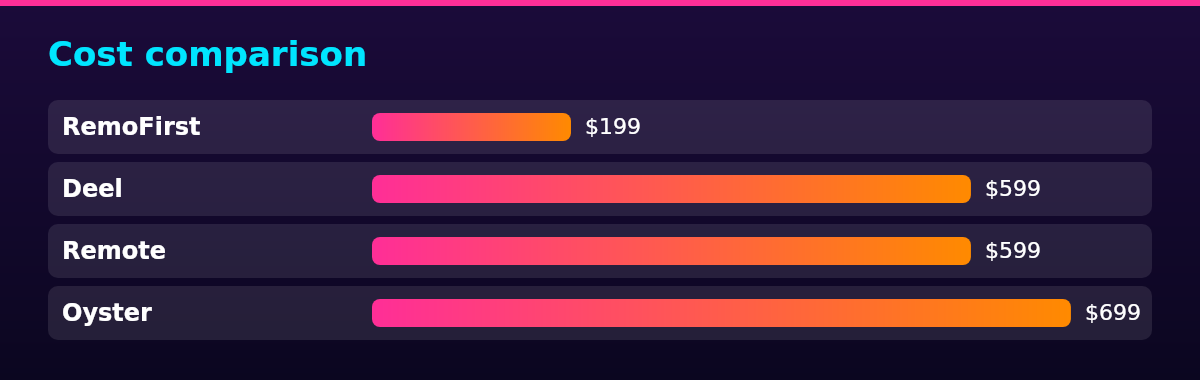
A remote hiring platform costs $199 to $699 per employee a month when it employs the hire, $25 to $49 per contractor a month when it only pays contractors, $299 to $719 a month for the company on an applicant tracking system, or $299 for a single job post. The boards are one-off spends and the other two groups are subscriptions, so the three bases don’t add up into one number.
| Platform | EOR price per employee a month (USD) |
|---|---|
| RemoFirst | $199 |
| Deel | $599 |
| Remote | $599 |
| Oyster | $699 |
Contractor management is cheaper than employment everywhere, but the spread is wide for the same work:
| Platform | Contractor rate per contractor a month (USD) |
|---|---|
| RemoFirst | $25 |
| Remote | $29 |
| Oyster | $29 |
| Deel | $49 |
On a ten-contractor team, the RemoFirst to Deel gap is $240 a month, or $2,880 a year, before any salary. The two trackers bill the company: Workable runs $299 to $719 a month by tier plus $59 to $109 a month per add-on, and Greenhouse quotes after a demo. The two boards both list a role for $299, with RemoteOK’s bundles at half price per post.
Say you employ three people abroad and pay two contractors through RemoFirst: the platform bill is $647 a month ($199 x 3 + $25 x 2) before salaries and employer contributions. The same five workers on Deel’s published rates cost $1,895 a month ($599 x 3 + $49 x 2), close to three times as much for the same service.
The platform fee is not the whole cost of an employee abroad: what employer of record services cost all-in depends on employer contributions, statutory benefits and onboarding in each country, on top of the monthly fee.
Legal compliance
Misclassification rules for remote hiring are what decide which platform fits: in the US, whether a worker counts as an employee or a contractor determines whether a contractor tier is enough or an employing platform is the safer buy.
The misclassification rules that set that line for remote hires in the US are the IRS’s employee-versus-contractor test for federal employment tax, the Department of Labor’s economic reality test for federal wage and hour law, and state tests like California’s ABC test.
In the US, the IRS decides employee versus contractor case by case, weighing behavioral control, financial control and the relationship’s permanence under its independent contractor guidance. No single factor settles a case, and a platform’s contractor tier does not move the misclassification exposure off the employer.
For federal wage and hour law, the Department of Labor’s 2024 classification rule set out a six-factor economic reality test under the Fair Labor Standards Act: profit or loss, relative investment, the relationship’s permanence, the degree of control, how integral the work is, and the worker’s skill and initiative. The agency has since paused the rule’s enforcement, so the six factors read as the framework courts apply rather than a live rule, per the rule’s Federal Register text.
States add their own tests, and California’s is the strictest commonly cited: under Labor Code 2775, a worker is presumed to be an employee unless the hiring party proves all three parts of the ABC test, including that the work falls outside the hiring entity’s usual course of business. The burden of proof sits on the employer, pushing borderline hires toward an employing platform rather than a contractor tier.
The three platform groups carry very different exposure. A job board sells advertising and nothing else; an applicant tracking system organizes a process the employer runs anyway; only the employing platforms take on employment obligations. Contractor tiers sit in between: the platform moves the money, but the classification question stays with the employer. Hiring abroad raises one more question, whether the worker’s presence creates a permanent establishment (PE) for the company, and an EOR hire usually keeps that question off the client.
Scaling framework
Which remote hiring platform fits depends on team size: a first contractor hire needs a job post and a payments tool, first employees abroad need an employer of record, and a team hiring at volume needs an applicant tracking system, with an own entity as the eventual crossover.
First hire, single contractor: a $299 post on We Work Remotely or RemoteOK plus contractor payments at $25 to $49 a month covers the whole spend for the smallest team, and the screening work runs on the same discipline as any small business recruiting effort.
First employees abroad: an employer of record at $199 to $699 per employee a month is the standard route. RemoFirst suits a first hire where price leads; Deel and Remote suit teams adding contractors and employees together; Oyster suits teams that want purchasable misclassification coverage.
Ten or more hires a year: at that team size the pipeline becomes the bottleneck, and an applicant tracking system (Workable at $299 a month, Greenhouse on a quote) is the hiring platform that earns its fee at that volume, running the same stages a documented remote hiring process covers.
The entity crossover is the one decision to time: platform fees scale per employee, while a local entity carries a fixed cost that stops mattering per head. Once a handful of employees sit in one country, price the entity against the EOR bill.
FAQ
A hiring platform is any software or service an employer uses for one step of hiring: job boards list the role, applicant tracking systems manage applications and interviews, and employer of record platforms employ and pay the hire.
The top hiring platforms are Deel, Remote, Oyster and RemoFirst for employing workers abroad, Workable and Greenhouse for tracking applicants, and We Work Remotely and RemoteOK for posting remote roles. Published price and country coverage separate the employing four; published versus quoted pricing separates the trackers.
A remote hiring platform costs $199 to $699 per employee a month for the employing kind, $25 to $49 per contractor a month for contractor payments, $299 to $719 a month for an applicant tracking system for the company, or $299 for a single job post. Those are list prices read from the vendors’ own pages in November 2026.
Yes: an employer of record platform (Deel, Remote, Oyster or RemoFirst) employs the worker on its own local entity in the worker’s country, runs payroll and statutory benefits under that country’s rules, and bills a per-employee monthly fee. The legal employment relationship sits with the platform.