

On this page
A remote work agreement is the document each remote employee signs that records where they work, when, on whose equipment, at what reimbursement, and under what security and relocation rules. In 2025, 35% of employed people in the United States did some or all of their work at home on the days they worked, according to the BLS American Time Use Survey, so the one-employee arrangement is now normal enough to need paper. The wording matters because the rules behind it vary by place: federal wage rules reach telework hours, California and Illinois set expense reimbursement rules, EU member states require written place-of-work terms, and some states tax a relocating worker differently from day one.
The agreement sits next to your company-wide policy, not on top of it: the policy sets the rules for everyone, and the agreement records the arrangement for one employee. Ten clauses cover most remote roles. The clauses that carry legal weight, reimbursement, hours and relocation, are the ones where the jurisdiction behind the rule is named below, because that is where a copyable template alone leaves you guessing.
What the agreement covers
| Clause | What it locks down |
|---|---|
| Work location | The employee’s designated work address and how a move gets approved |
| Schedule and hours | Working hours, the timekeeping method and response expectations |
| Overtime approval | Who approves extra hours and on what timeline |
| Equipment | Who provides, maintains and owns the laptop, phone and peripherals |
| Expense reimbursement | What you pay for, how the employee claims it and what stays out of pocket |
| Data security | Which devices hold company data, the network rules and loss reporting |
| Pay and benefits | Confirmation that salary, benefits and tax treatment are unchanged by the remote arrangement |
| Working from another state | Written approval and notice before a cross-state move |
| Working from another country | Prior approval, an allowlist and time-zone overlap requirements |
| Ending or changing the arrangement | Notice periods, the reversion to contract terms and equipment return |
Most small employers need six or seven of these. The work location, working hours, equipment, reimbursement, security and state-relocation clauses carry the rules that actually bite, and the country clause matters only if you allow travel or relocation abroad. Cut the clauses that do not apply to the role rather than keeping a template long: a hybrid employee three days in the office needs fewer conditions than a fully remote hire in another state.
Salary, equity, notice periods and termination terms belong in the employment contract, not here. The agreement should say it changes none of them, and should name which document prevails where the two could be read differently; most employers name the employment contract as the senior document.
Work location clause
A work location clause names the employee’s designated work address and makes any move a decision you approve in writing. Example: “The employee’s designated work location is [full street address]. The employee will perform work only from this location unless the employer approves a different location in writing, requested at least 30 days in advance.”
The address is the fact your payroll registration, workers’ compensation coverage and home-office safety checks all key off, so a move you learn about after the fact arrives as three problems at once. The 30-day window exists to give you time to register, adjust payroll and confirm insurance before the employee changes desks. Revisit the clause whenever the employee renews a lease or buys a home somewhere new.
Working hours clause
A working hours clause sets a remote employee’s work hours, the timekeeping method, and the overtime approval rule. Example: “The employee’s working hours are [9:00 a.m. to 5:00 p.m.] in the [employer’s] time zone, recorded in [the employer’s timekeeping system]. Hours beyond 40 in a workweek require the employer’s prior written approval.”
The approval requirement does not remove the pay requirement. Under the federal Fair Labor Standards Act, covered employers must pay nonexempt employees for all hours worked, and the Department of Labor’s Field Assistance Bulletin 2023-1, issued February 9, 2023, states that when an employer knows or has reason to believe work is being performed, that time counts as hours worked whether the employee is on the employer’s premises or teleworking from another location. So the clause pairs approval with timekeeping: unapproved overtime still gets paid, and the response for it is discipline, not a withheld check.
Name the response expectations as well. If the team runs core hours with a shared overlap window, write the window into the clause so the employee’s schedule matches the team’s norm instead of a private guess.
Equipment provisions
An equipment clause states who provides the laptop, phone and other equipment for remote work, who maintains them, and what happens to them when the arrangement ends. Example: “The employer provides the employee with a laptop, monitor and phone, which remain the employer’s property. The employee maintains the equipment in working order and returns it within 14 days of the end of the remote arrangement or of employment. The employee may purchase the equipment at fair market value on written request.”
The buy-out line earns its place even when nobody uses it: a returned laptop with a cracked screen is worth less than the fair market value the employee would happily pay, and the clause gives you the choice. The company devices versus BYOD decision, that is, whether employees work on your hardware or bring their own device (BYOD), decides who runs the security updates, so make it once at the policy level rather than per hire.
Expense reimbursement rules
Whether an employer is required to reimburse remote work expenses depends on the state: Illinois and California require it by statute, and elsewhere the clause sets the rule, listing what you pay for, how the employee claims it and what stays out of pocket. Example: “The employer reimburses the employee’s home internet costs at [amount] per month on receipt, or pays a flat monthly stipend of [amount] without receipts. The employer does not reimburse office furniture, personal electricity above the stipend, or costs covered by another benefit.”
Two states make this clause non-optional. Illinois sets the floor: under the Wage Payment and Collection Act, 820 ILCS 115/9.5, an employer must reimburse an employee for all necessary expenditures or losses incurred within the employee’s scope of employment and directly related to services performed for the employer, and the same act lets the employer set the method in a written expense reimbursement policy.
California requires reimbursement of necessary remote work expenses under Labor Code § 2802. Elsewhere the reimbursement floor is mostly whatever the contract says, which makes the clause the whole rule: name the categories, the amounts and the claim method. A flat stipend saves receipt-chasing; a receipts-based line pays only what the role actually uses. Revisit the amount when internet or phone prices move.
Data security clauses
A data security clause confines company data to approved devices and states the rules for passwords, networks and loss reporting. Example: “The employee accesses company systems only from devices the employer manages or has approved in writing. The employee keeps devices screen-locked, does not use public Wi-Fi for company work except through the employer’s virtual private network (VPN), and reports loss or theft of any device within 24 hours. The employee’s confidentiality obligations under the employment contract survive the end of this agreement.”
The clause is only as strong as the tools behind it. A device the employer manages can be wiped remotely, so the 24-hour reporting window is what bounds the damage; a VPN nobody uses makes the public Wi-Fi line decorative. Tie the clause to the controls you actually run, the password manager, the mobile device management profile and the screen-lock policy on the laptop you issued, and drop any rule you cannot enforce.
Working from another state
Yes, a remote employee can work from a different state, and the relocation clause makes the move a decision you approve in writing before it happens. Example: “The employee will not perform work from any US state other than [state] without the employer’s prior written approval, requested in writing at least 60 days before the change. Approval may depend on payroll registration, tax treatment or insurance availability in the new state.”
The 60-day window exists because a move across state lines changes your payroll and insurance obligations, and those changes take weeks to set up. Some states tax the same wages by where the employee sits, others by where the employer sits: New Jersey’s Division of Taxation explains its convenience-of-the-employer rule, effective for tax years beginning on and after January 1, 2023, under which nonresidents of certain states, including New York, keep owing New Jersey Gross Income Tax on wages from a New Jersey employer even when they work from their home state for convenience rather than employer necessity.
Running multi-state payroll already means registering wherever an employee works, so a move approved in June still lands on the July payroll run. The clause’s job is to make sure you hear about the move in April, with enough time to price the new state before you approve it.
Working from another country
Yes, a remote employee can work from another country once you approve it in writing, and the cross-border clause names the countries you allow. Example: “The employee will not perform work from outside [country] without the employer’s prior written approval. Approval is limited to countries on the employer’s current allowlist, for no more than [number] weeks in a calendar year, and requires at least [number] hours of daily overlap with the team.”
The paperwork rights are statutory in much of Europe. Under Directive 2019/1152, EU member states must ensure each worker receives the essential aspects of the employment relationship in writing, including the place of work or the principle that the worker is employed at various places; the core items come within seven calendar days of the first working day and the rest within a month.
The tax risk is the other reason for the allowlist. An employee who works abroad can create a permanent establishment for your company, exposing profit to corporate tax in the host country, so the allowlist is the list of countries where someone has already checked that risk.
Health and safety
The employer’s responsibility for a remote employee’s home office runs through the workspace clause: a space the employee certifies as safe, injuries reported within 24 hours, and your workers’ compensation carrier’s details in writing. Example: “The employee confirms that the designated work location has a workspace with adequate lighting, safe cable placement and a working smoke detector. The employee reports any work-related injury to the employer within 24 hours, whatever the location. Workers’ compensation coverage is provided by [carrier name and policy number].”
Naming your workers’ compensation carrier in writing saves the employee from hunting for a policy number at a bad moment, and a short checklist does more than a general promise of a safe workspace. A self-certification list the employee ticks once a year, covering chair, lighting, cables and heat, turns the employer responsibilities for remote employees you already carry into one document.
Changing or ending the agreement
A change clause lets either side end the remote arrangement with written notice, reverting the role to the employment contract’s terms. Example: “Either party may end the remote work arrangement with [number] days’ written notice, after which the employee works at the employer’s premises under the terms of the employment contract. The parties review this agreement every [12] months. Equipment must be returned within 14 days of the arrangement ending.”
US employers typically write the clause so it does not touch at-will status: ending the remote arrangement moves the employee back to the contract’s terms, and ending employment is a separate decision with its own rules. Outside the United States, notice periods are usually set by statute, so the clause defers to the employment contract’s termination terms rather than trying to shorten them.
How to write it
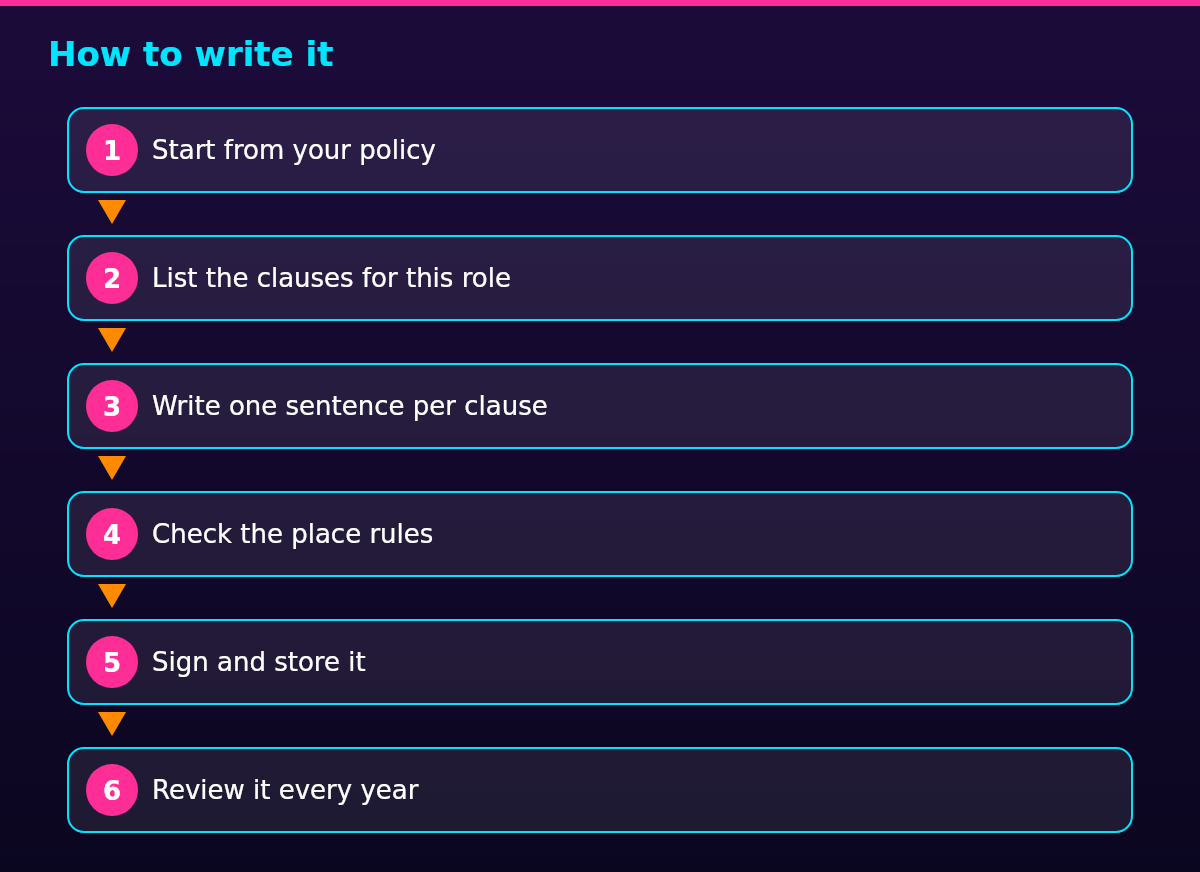
A first draft takes about an hour if you start from the policy and work clause by clause.
- Start from your policy. Pull each clause from your remote work policy so the documents agree.
- List the clauses for this role. A fully remote hire needs all ten; a hybrid hire needs fewer.
- Write one sentence per clause. Each clause states its rule in a single sentence.
- Check the place rules. Match reimbursement, tax and written-terms rules to this employee’s state and country.
- Sign and store it. File the signed addendum with the employment contract.
- Review it every year. Update the stipend, address and allowlist at the annual review.
FAQ
It should include ten clauses: the work location, the schedule and hours, overtime approval, equipment, expense reimbursement, data security, a pay and benefits confirmation, the rules for working from another state, the rules for working from another country, and how the arrangement changes or ends. Most of the disagreements a remote arrangement creates, from unpaid internet bills to unannounced relocations, land on one of those ten.
The guidelines for employees working remotely live in the company-wide policy the employer publishes, while the remote work agreement records the arrangement for one employee: where they work, when, on whose equipment and at what reimbursement. A signed agreement sits under the policy, never in place of it.
Yes, a signed remote work agreement is a binding document: it is a contract or a contract addendum, enforceable by both sides, and it stays inside the employment contract’s terms. It records the arrangement and its rules; it does not replace the contract it attaches to.
Yes. A complete example is a one-page addendum to the employment contract that names the work location, the working hours and overtime approval, the equipment, the stipend, the security rules, the state and country rules, and the notice period for ending the arrangement. Employers call it a remote work addendum, a work-from-home agreement or a telecommuting agreement, and the three names describe the same document.