

On this page
Deel vs Oyster is a choice between two employer of record (EOR) platforms, and the answer turns on what you are hiring: Deel charges $599 per employee a month against Oyster’s $699, while Oyster charges $29 per contractor a month against Deel’s $49, as of October 2026.
An EOR legally employs your worker in their country on its own local payroll, so you can hire abroad without registering your own entity there. Deel and Oyster both publish their prices, which makes this one of the few EOR comparisons you can run on real list prices rather than demo-call quotes.
Employee-heavy and contractor-heavy companies get opposite answers from the same price list. Price plus support, rather than price alone, decides most Deel vs Oyster calls: Oyster sells hands-on HR help and Deel sells platform breadth.
Deel vs Oyster at a glance
| Deel | Oyster | |
|---|---|---|
| EOR price a month | $599 per employee | $699 per employee |
| Contractor price a month | $49 per contractor | Free for the first 30 days, then $29 |
| Contractor liability add-on | Contractor of Record at $325 a month | Oyster Shell, protection up to $500,000, price not published |
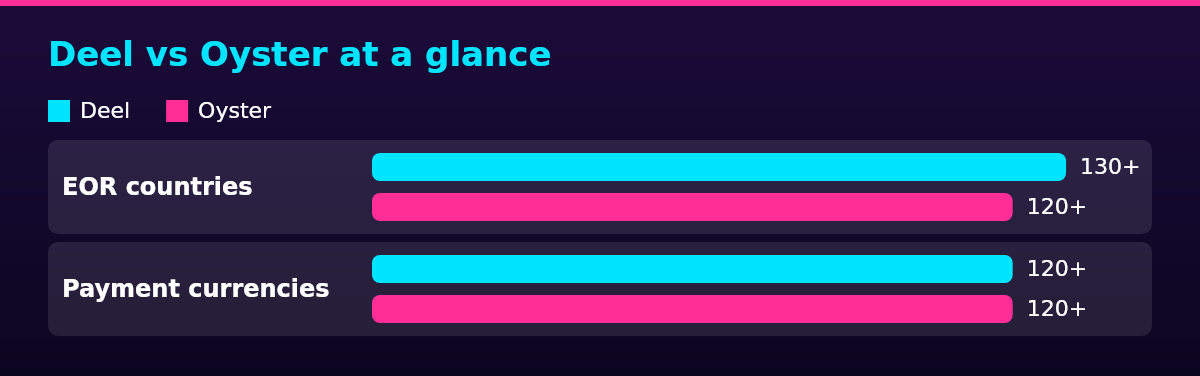
| EOR countries | 130+ | 120+ |
| Contractor countries | 150+ across the platform | 180+ |
| Payment currencies | 120+ | 120+ |
| Annual discounts | Not published | Available, not quantified |
| HR help | Global payroll with HRIS integrations | People Partner Services at $300 an hour |
Every figure above comes from the two vendors’ own pricing pages, read in October 2026, in USD. The two price rows decide most comparisons because employees and contractors price in opposite directions on the two platforms: there is no single cheaper vendor.
EOR country coverage
On country coverage, Deel employs through its EOR in 130+ countries and Oyster in 120+, and the ten-country gap matters less than whether the country you need is served by an owned entity or a local partner.
Entity ownership is one of the criteria worth weighing when you choose the right EOR for your business, and neither vendor publishes it per country.
The counts also measure different things: Deel’s 130+ is its EOR country list and its 150+ platform figure covers hiring and paying employees and contractors, while Oyster’s 120+ is its EOR list and its 180+ covers its wider platform. Where the lists overlap, service depth matters more than the count, and neither pricing page publishes response times or benefits depth by country.
Coverage changes as vendors add countries, so confirm the country you need is on the current list and ask who the employing entity is there. The count you see here is each vendor’s own published figure as of October 2026, and a country that matters to your roadmap is worth confirming in the same week you decide, not months before.
Contractor payments
Oyster is the cheaper contractor platform: its contractor plan is free for the first 30 days, then $29 per contractor a month, and its platform covers hiring, paying and managing teams in 180+ countries, per Oyster’s pricing page.
Deel charges a flat $49 per contractor a month and sells the only priced liability upgrade between the two, Contractor of Record at $325 per contractor a month, per Deel’s pricing page. Under Contractor of Record, Deel takes over the legal employer relationship for the contractor and, with it, the misclassification exposure a plain contractor plan leaves with you.
That exposure is real: misclassification risk stays with your company on a plain contractor plan, and if a worker looks like an employee under your country’s tests, the contractor label does not protect you. Oyster’s Shell add-on assesses misclassification risk and carries aggregate protection up to USD $500,000, per Oyster’s pricing page, but its subscription price is not published.
In plain numbers, $29 against $49 saves $240 per contractor a year: a 20-contractor team pays $980 a month on Deel and $580 on Oyster once the free month ends, a $4,800 difference over a year. Contractor of Record at $325 costs more per contractor than either platform’s contractor fee, so cheap contractor payments and paid liability protection are different purchases, and only Deel publishes a price for the second.
Support models
Oyster sells hands-on people support and Deel sells platform breadth, so which one fits depends on whether your company has an HR function at all.
Oyster’s EOR plans include end-to-end support by local experts, so employment questions in the worker’s country route to someone on the vendor’s side. Its People Partner Services sell project-based HR advisory from Oyster’s senior experts at $300 an hour, covering global HR guidance and people strategy for teams without an HR lead, per Oyster’s pricing page.
Deel’s strength is scope: its platform covers 150+ countries with 24/7 support listed among its plan features, per Deel’s pricing page.
Its global payroll product connects to HRIS systems including Workday, SAP, Oracle, Okta and BambooHR, per the Deel global payroll page. For a company that already runs one of those systems, that integration is the difference between a second HR record and one connected source. Deel publishes no priced HR advisory, so hands-on help beyond platform support is not part of its list price. For teams that already employ HR people, the support difference matters less than the fee gap; for teams without any, Oyster’s hourly advisory is the only priced option between the two.
Cost comparison
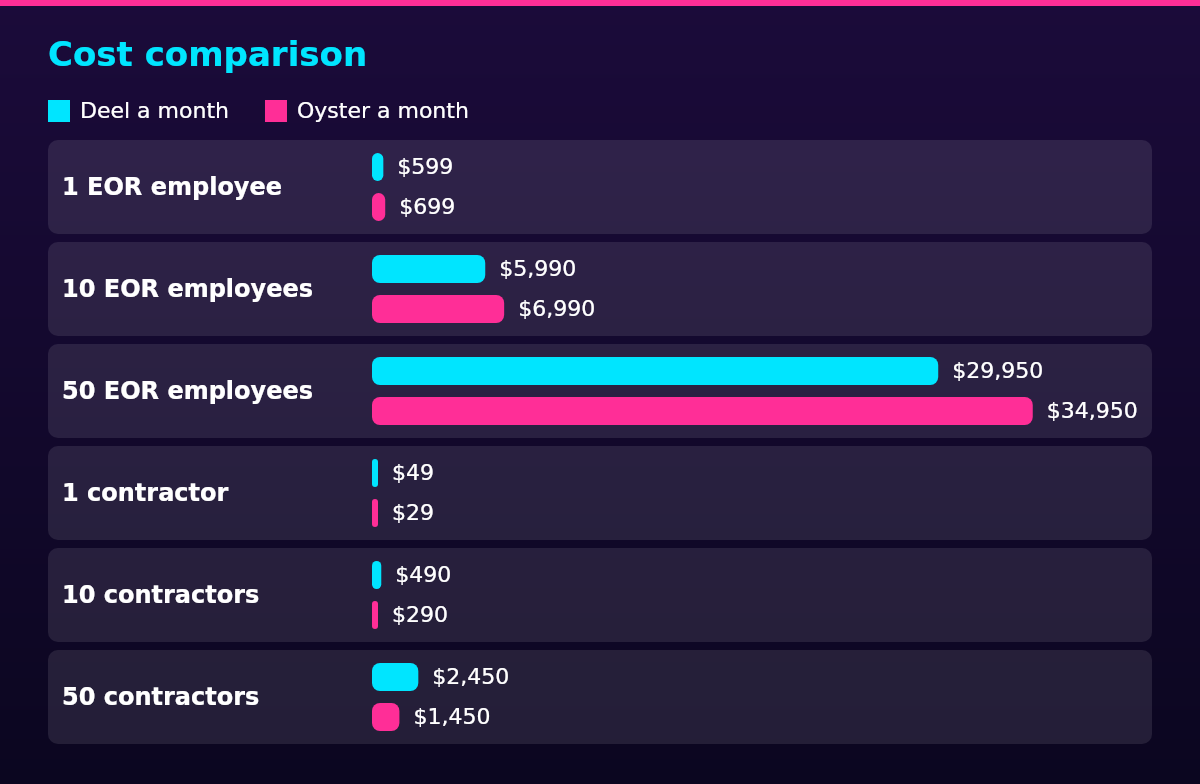
| Team | Deel a month | Oyster a month |
|---|---|---|
| 1 EOR employee | $599 | $699 |
| 10 EOR employees | $5,990 | $6,990 |
| 50 EOR employees | $29,950 | $34,950 |
| 1 contractor | $49 | $29 |
| 10 contractors | $490 | $290 |
| 50 contractors | $2,450 | $1,450 |
The employee gap is $100 per employee a month, $1,200 per employee a year, and $6,000 a month at 50 employees before Oyster’s unquantified annual discounts. The contractor gap runs the other way at $20 per contractor a month, which is $1,000 a month on a 50-contractor team, $12,000 a year.
These cells are the published platform fees only, in USD a month, computed as each vendor’s list price times headcount. List prices are not the whole bill: benefits, equipment and currency conversion add on by country, and the hidden fees and employer burden by country can move a real monthly quote by hundreds per employee.
The add-ons move the math too: ten contractors on Deel with Contractor of Record add $3,250 a month on top of $490 in contractor fees, while Oyster’s Shell price is not published, so the liability line cannot be compared on list prices alone. Ten EOR employees cost $5,990 a month on Deel against $6,990 on Oyster, a $12,000 difference over a year.
Legal compliance
On either platform the vendor, not your company, is the legal employer of record in the worker’s country, and neither platform removes every hiring risk you carry.
Entity ownership differs by country: Deel and Oyster each employ through a mix of their own entities and local partners, and neither publishes which countries are which, so the liability chain between you, the vendor and the employing entity depends on where you hire. Ask each vendor for its current country list marked owned entity versus partner before you sign. A partner-entity country can change who runs the payroll filings and who your worker’s actual employer is in a dispute, which is why the question is worth asking in writing.
Contractor misclassification stays your risk on a plain contractor plan unless you buy Deel’s Contractor of Record or Oyster Shell, and the tests differ by country. In the US, the IRS applies a common-law test that turns on whether the payer controls only the result of the work or also the details of how it is done, per the IRS independent contractor guidance.
Permanent establishment risk survives the EOR: where your employee works and what they do there can still create a taxable presence for your company under that country’s tax rules and treaties. That makes an EOR a hiring tool, not a tax shield, and the exposure depends on the country and the worker’s role.
Deel also sells a US professional employer organization (PEO) at $125 per US employee a month, per Deel’s pricing page, which is co-employment: a PEO shares employer duties with your company rather than replacing them the way an EOR does. It is a different legal model and sits outside an EOR comparison.
Scaling framework
One or two hires in one or two countries run on either platform, and the Deel vs Oyster choice starts to cost real money as headcount grows.
At around ten employees across several countries, Deel’s $100 an employee gap becomes $1,200 per employee a year in platform fees, and its global payroll and HRIS integrations start to matter. A contractor-heavy team of the same size leans Oyster instead, because $20 a contractor compounds across the payroll faster than Deel’s employee saving when most workers are on contractor plans.
US-heavy teams get a Deel-only option: its US PEO at $125 per employee a month, per Deel’s pricing page, runs alongside its EOR under one vendor, and the plan lists co-employment across all 50 US states with benefits, while Oyster publishes no US PEO plan. One vendor for both models is an operational difference, not a price difference.
At 50 or more people in a single country, your own entity starts to compete with EOR fees: 50 employees cost $29,950 a month on Deel and $34,950 on Oyster in platform fees alone, $359,400 to $419,400 a year before a single salary, and at some headcount the entity’s fixed annual cost beats that, though where the crossover sits depends on the country and your setup costs. Both Deel and Oyster rank among the best employer of record services for small international teams, but no platform fee beats an entity past the break-even point your country sets.
Which should you pick?
Pick Deel if you are hiring employees: it lists $100 an employee below Oyster, runs payroll and HRIS integrations across 150+ countries, and can put US staff on its $125 PEO alongside EOR under one vendor.
Pick Oyster if your team is contractor-heavy or you want hands-on HR help: its contractor fee is $20 lower per contractor a month, and People Partner Services at $300 an hour suits teams without an HR function.
Two things would change the answer: a quantified Oyster annual discount at your headcount, or a country where only one of the two operates. Ask each vendor for both in writing before you commit, because neither is visible on a pricing page.
FAQ
No, neither vendor is better across the board: Deel fits employee-heavy teams on price and platform breadth, and Oyster fits contractor-heavy teams and companies that want hands-on HR support. The decision follows what you are hiring, not a vendor ranking.
No: Deel is cheaper per employee and Oyster is cheaper per contractor. Deel lists $599 per EOR employee a month against Oyster’s $699, and Oyster lists $29 per contractor a month against Deel’s $49 after a free first 30 days.
Deel’s $599 per employee a month is not an outlier among EORs that publish prices: Oyster lists $699 for the same service, and Remote also starts at $599. The bill that feels expensive usually comes from country add-ons, benefits, equipment and currency conversion, which sit outside the platform fee on every EOR. Only Oyster says it discounts its EOR price on annual commitments, and it does not publish the figure.
Deel’s pricing page says 40,000+ companies use the platform, from startups to enterprise, and it does not name them. The figure is Deel’s own claim, stated as of October 2026.
Yes, either works for employees on price: Remote’s EOR also starts at $599 per employee per month, per Remote’s pricing page, so the decision turns on contractor fees, platform scope and support rather than the headline employee fee. Deel charges $49 a contractor and sells a US PEO alongside its EOR, so check Remote’s published contractor fee against both before deciding for a contractor-heavy team.