

On this page
Deel vs Remote is the choice between the two employer of record (EOR) platforms most employers use to hire and manage an international workforce without opening their own entity, and the Deel vs Remote employee price is currently a tie: both list $599 per EOR employee a month. In the Deel vs Remote matchup, Deel runs local payroll, benefits and compliance for employees in 130+ countries, plus contractors and US PEO on one global platform, while Remote, the hiring platform at remote.com rather than remote work in general, employs people in 90+ countries and pays contractors in 190+. Contractors run $49 a month on Deel against $29 on Remote, so the Deel vs Remote comparison turns on contractor pricing, country coverage, IP and benefits, and who owns the local entities underneath. Ask it as Remote vs Deel and the same things decide.
Deel vs Remote at a glance
| Deel | Remote | |
|---|---|---|
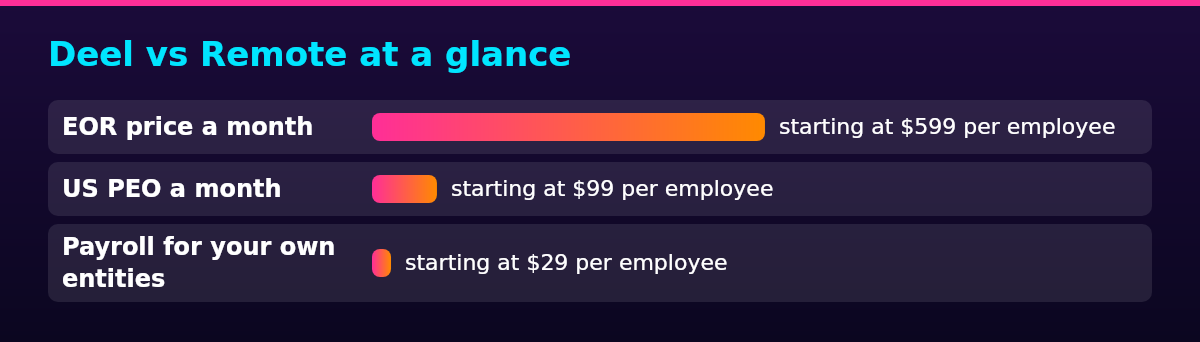
| EOR price a month | $599 per employee | starting at $599 per employee |
| Contractor price a month | $49 per contractor | starting at $29 per contractor |
| Indemnified contractor tier | none published below the contractor of record | Contractor Management Plus from $99, indemnity up to $100,000 per contractor |
| Contractor of record | $325 per contractor | starting at $325 per contractor |
| US PEO a month | $125 per employee | starting at $99 per employee |
| Payroll for your own entities | no standalone price published | starting at $29 per employee |
| EOR countries | 130+ | 90+ |
| Contractor countries | 150+ across the platform | 190+ |
| Entity ownership claim | own entities and payroll engine in 130+ countries | “100% owned entities, no third parties” |
An EOR is the company that becomes the legal employer of your worker in their country: it signs the local contract, runs payroll and handles the statutory filings, so you hire abroad without registering your own company there. All prices are USD list prices from the vendors’ own pages, read in October 2026. The US PEO row is a co-employment product for US teams: a professional employer organization (PEO) shares employer duties with you for US workers, while the EOR rows are for employment abroad.
Where each employs people
For employees, Deel currently covers more countries: Deel’s pricing page lists full legal employment in 130+ countries, as of October 2026. A wider count only matters if it includes the country you are hiring in, so check the list against your actual target before you treat coverage as the deciding factor.
Remote lists 90+ countries for its EOR and 190+ countries for contractor onboarding and payments on its pricing page. The contractor count is the widest coverage claim either vendor makes, and it is a platform figure, not a promise that every country carries the same features.
Deel publishes its contractor coverage differently: its pricing page states contractor payments in 120+ currencies and its platform-level figure is 150+ countries, with no contractor-only country count on the page. For a contractor-heavy team, ask the vendor directly whether your specific countries are served.
A country count is a marketing figure on both sites. What decides your hire is whether your specific country is served at all, and what kind of legal entity serves it, which is the next question.
Who owns the entities
Both vendors claim they own their local entities, and neither publishes the per-country list that would let you check that claim for your countries.
Deel says it owns its entities and its payroll engine in 130+ countries on its employer of record page. The claim covers the network as a whole; there is no published country-by-country breakdown of how each country is served.
Remote’s claim goes further on its employer of record page: “100% owned entities, no third parties”, with a figure of “100+ entities owned and operated by Remote”. That is also the vendor’s own claim, and it is equally unverifiable per country from published pages.
The entity matters because it is the legal employer your worker’s contract sits on: it carries the local employment obligations, and who stands behind it changes the chain you depend on when something goes wrong. Before you sign with either vendor, ask for the per-country entity list in writing for every country you plan to hire in, and treat a country that is not on the owned list as an open question rather than an answer.
Paying contractors
Remote is the cheaper contractor product, and it is the only one of the two that publishes a priced indemnity tier below the contractor-of-record level. Contractor management starts at $29 a contractor a month on Remote against $49 on Deel’s pricing page, read in October 2026.
Remote’s priced tier is Contractor Management Plus, from $99 a contractor a month on Remote’s pricing page, which publishes a misclassification indemnity of up to $100,000 per contractor for penalties and a maximum of $1,000,000 across all your contractors over the term. The same page scopes that indemnity to third-party claims arising from Remote’s breach of its Service Warranty, so read it as a cap on what Remote pays when Remote breaches its own service warranty, not as a transfer of your classification risk.
Both vendors sell a contractor of record, a tier where the vendor, not you, holds the contract and pays the contractor: Deel lists its at $325 per contractor a month, and Remote starts its at the same $325. Deel markets its Contractor of Record as shifting liability to Deel, and Remote describes the indemnity in its version as uncapped; both are the vendors’ descriptions of their own products, and what each covers is set by the service terms you sign.
On the base plans the contract is with you, so misclassification risk stays with you too, and what a wrong call costs depends on the country: back taxes and social contributions, reclassification with severance, or penalties under local tests that differ by jurisdiction. The indemnity tiers above are optional products the vendors sell, each with caps, exclusions and its own service terms; what they cover is a contract question, not a removal of your risk.
IP protection
Both vendors say their contracts pass employee-created intellectual property to you, and they describe the mechanism differently.
Deel says its contracts carry built-in intellectual property protection clauses, so that any and all IP passes through to the customer, on its employer of record page.
Remote describes a two-step mechanism it calls Remote IP Guard on its IP protection page: IP rights assign from the employee to Remote’s local entity under local law, with IP documentation drafted for each country, and then from that entity to you, with the documents visible in the platform.
The chain matters because IP assignment often runs through the legal employer under local law, which is why Remote ties its IP story to its owned entities. Neither vendor publishes the per-country entity list, so the practical check is the same one the entity question raises: ask, in writing, which entity will employ your worker and how IP assigns through it in your country.
Benefits handling
Neither vendor charges a separate benefits administration fee inside its EOR price. Deel includes benefits enrollment and benefits administration, covering healthcare and pensions, in the quoted price on its pricing page.
Remote includes local benefits in every country in its EOR price, and any benefit it offers in a country applies to all your team members in that country, per its pricing page.
What is included is the administration, not the benefits bill: the premiums you choose, statutory employer costs, equipment and currency conversion all sit on top of the platform fee and move with the country. What employer of record services cost in total is set by those add-ons as much as by the platform fee, and they vary by country.
Cost comparison
| Team | Deel a month | Remote a month |
|---|---|---|
| 1 EOR employee | $599 | $599 |
| 10 EOR employees | $5,990 | $5,990 |
| 50 EOR employees | $29,950 | $29,950 |
| 1 contractor | $49 | $29 |
| 10 contractors | $490 | $290 |
| 50 contractors | $2,450 | $1,450 |
| 1 contractor of record | $325 | $325 |
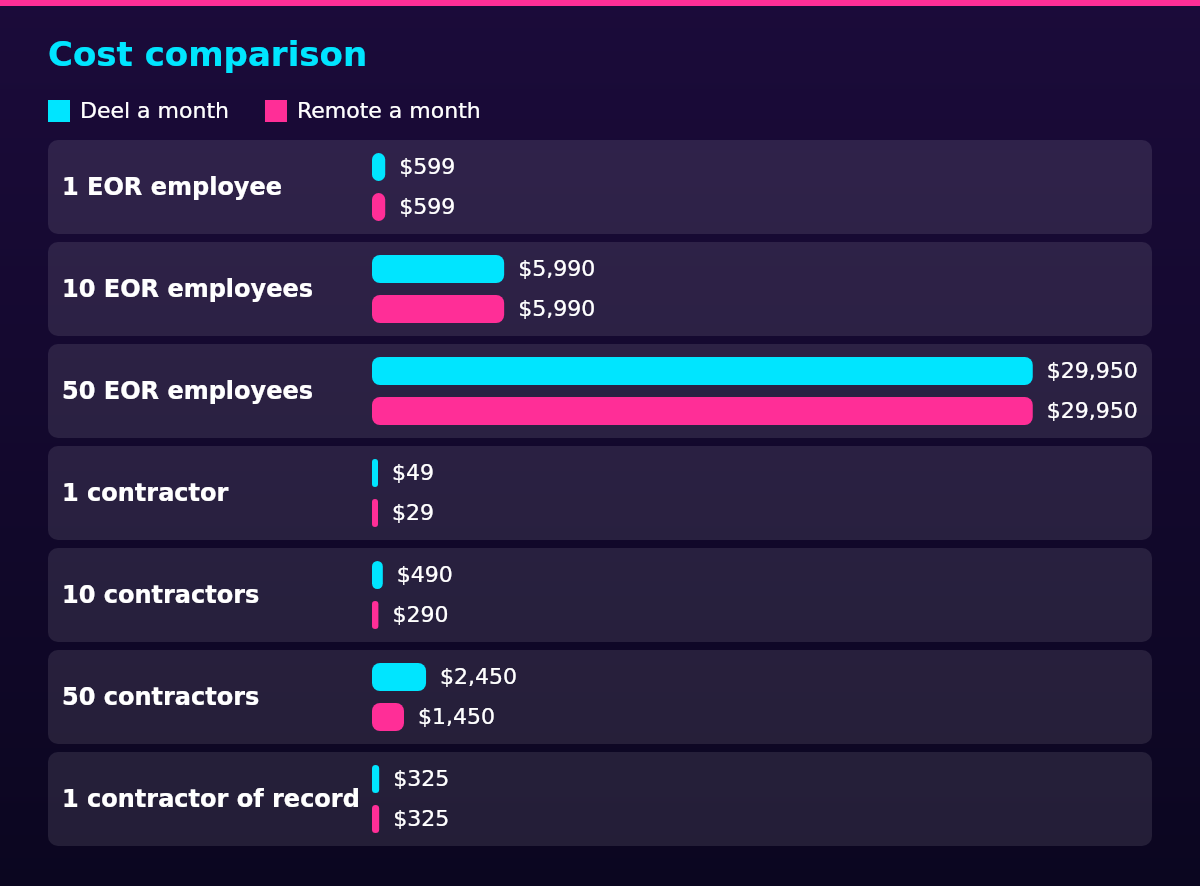
Every cell is the vendor’s published list price multiplied by headcount, in USD a month, read from Deel’s pricing page and Remote’s own in October 2026. The EOR fee is a tie at $599, so at 50 employees the platform fee is $29,950 a month on either vendor, and the employee rows never separate the two bills.
Contractors are where the bills diverge: 50 contractors cost $2,450 a month on Deel’s base tier against $1,450 on Remote’s, per the published contractor prices on Remote’s pricing page and Deel’s own. On top of every platform fee sit the statutory employer costs, benefits premiums, equipment and currency conversion that vary by country, and neither column includes them.
For US-heavy teams, both vendors also sell a US PEO alongside their EOR. Deel lists its US PEO at $125 per employee a month, on the same page as its EOR price.
Remote starts its US PEO at $99 per employee a month, so a US-only team pays a lower management fee on Remote at list price.
Which fees include what is a per-vendor question: the Deel price breakdown covers which costs sit inside Deel’s fees and which bill as an add-on.
Legal compliance
On either platform, the vendor’s local entity, not your company, is the legal employer in your worker’s country, and neither platform removes every risk. What survives an EOR is specific: who stands behind the entity, who carries contractor classification risk, and whether your employee’s work creates a taxable presence for you.
The liability chain runs through the entity that employs your worker, owned or otherwise. Both vendors claim owned entities and neither publishes the per-country list, so the protection you can actually check is contractual: each vendor’s per-country entity list, in writing, before you sign, because the indemnities and obligations in the service terms sit on that entity.
Contractor misclassification stays your risk on the base plans at both vendors, and the tests vary by country. In the United States, the IRS independent contractor guidance applies a common-law test of who controls the work and how it is paid, and misclassifying can mean back employment taxes and penalties; other countries apply their own tests. The priced options vendors sell here are Remote’s $99 Plus tier and either vendor’s $325 contractor of record, and each is a service with its own terms and exclusions, not a removal of the risk.
Where your employee works and what they do can still create a permanent establishment (PE), a taxable presence for your company in the worker’s country even though the EOR is the legal employer. Whether that happens depends on the country, the applicable tax treaty and the facts of the role, and permanent establishment risks are assessed case by case rather than waived by the EOR contract.
Scaling framework
At one or two hires, either platform works, and the employee price is identical at $599 a month; a contractor-heavy start leans Remote on price, at $29 a contractor against Deel’s $49, and on a priced indemnity tier at $99.
At around ten employees across several countries, coverage decides: Deel’s 130+ EOR countries against Remote’s 90+, and which of your countries each vendor serves with an owned entity. Get both entity lists in writing before you commit, because the platform choice at this stage is a country-list choice.
A US-heavy team can run either vendor’s US PEO, at Deel’s $125 or Remote’s starting $99 per employee a month, alongside its EOR for any employment abroad.
At fifty or more people in one country, running your own entity starts to compete with the EOR fee at some headcount, and where the crossover lands depends on the country’s entity costs and employment rules. Remote’s pricing page lists payroll for entities you own at from $29 an employee a month, and Deel publishes no standalone payroll-only price, so price the entity route with the vendor before you assume either one is cheaper.
Which should you pick?
Employee-heavy and contractor-heavy companies get different answers from the same price list, because the employee fee is a tie at both vendors and the contractor fees are not.
Pick Deel if you are hiring employees in the widest set of countries: its 130+ EOR countries against Remote’s 90+ is the wider published employee coverage, and one platform runs employees, contractors and US PEO together.
Pick Remote if your team is contractor-heavy: the $29 base contractor fee, the $99 indemnified tier and 190+ contractor countries on Remote’s pricing page make the contractor economics lean its way, its US PEO starts at $99 against Deel’s $125, and it publishes a price for payroll on entities you own.
If Deel’s breadth is the main draw, the Deel vs Oyster comparison covers Deel against a smaller vendor that sells hands-on HR support alongside its EOR.
What would change this answer is local: a country where only one of the two operates, or a country where one vendor’s entity is owned and the other’s is not disclosed. Neither publishes that list, which is why the written entity question comes before the platform choice.
FAQ
Yes, use Deel for employees across the widest set of countries and Remote for contractor-heavy teams; both employ people in other countries at the same $599 per employee a month on Deel’s pricing page and Remote’s own, so your countries and your contractor ratio decide rather than the employee price. The entity question is the tiebreaker: ask each vendor which of your countries it serves with an owned entity before you sign.
Deel currently lists $599 per EOR employee a month, $49 per contractor a month, $325 per contractor of record a month and $125 per US PEO employee a month on its pricing page, read in October 2026. The same page also carries a $14 per worker a month sourcing add-on, which is a recruiting tool rather than an employment service.
Yes, by its own published scale: Deel’s pricing page says it serves +40,000 customers and has processed $20B+ in global payroll, both vendor claims from October 2026. Those are Deel’s own figures rather than audited numbers, and neither changes what you pay per worker.
Remote, Rippling and Oyster are the closest Deel competitors that publish employer of record prices. Remote overlaps most on employees and contractors, Rippling on US payroll and HR, and Oyster on smaller teams that want hands-on support.
EOR stands for employer of record, the company that becomes the legal employer of your worker in their country so you don’t have to register your own company there. It signs the local contract, runs payroll and handles the statutory filings while you direct the day-to-day work.