

On this page
Video interview software is a hiring platform that screens remote candidates through recorded one-way video, live two-way calls, or both, so a first round can run on candidates’ own time across time zones. A video interviewing platform currently costs from $59 per live role at Willo to $399 a month for Interviewer.AI’s top published edition, with Spark Hire from $249 a month, while HireVue, VidCruiter and interviewstream quote instead of publishing. It replaces phone screens with quick one-way recordings, makes live scheduling across time zones easier, and turns every answer into a structured scorecard the hiring team can compare. The best video interview software for a remote team turns on how many roles you fill a month, how the first round runs, and what each plan costs at your volume.
For employers hiring across time zones, what separates the platforms is scheduling and connectivity: how the video interviewing platform books interviews across zones, and whether it connects to the applicant tracking system (ATS) you already use. Running the interviews themselves is one step of the wider remote hiring process, which spans everything from the job description through onboarding.
Video interview software compared
| Tool | Best for | Starting price (USD) | What stands out |
|---|---|---|---|
| Spark Hire | Flat subscription for both interview types | $249 per month, billed annually | Unlimited live and one-way interviews, jobs and users |
| Willo | Pay-per-role one-way interviews | $59 per live role, pay as you go | More than 50 native ATS integrations, identity verification |
| Interviewer.AI | Artificial intelligence (AI) screening with a human review step | $199 per month, Essential Edition | AI one-way interviews, resume screening, fraud checks on the top tier |
| HireVue | High-volume AI hiring | Not published | On-demand and live interviews, AI interviewer, assessments |
| VidCruiter | Structured hiring in one suite | Not published | Pre-recorded and live interviews, scheduling, references, built-in ATS |
| interviewstream | Institutional hiring bottlenecks | Not published | On-demand and live interviews, scheduling, hiring-event support |
Every price above is the vendor’s own current list price, as of November 2026, and where a vendor quotes instead of publishing, the cell says so. Each platform below also states what it cannot do, because the limits decide a shortlist as often as the features do.
Tools for small teams
The three platforms below suit teams hiring for a steady flow of remote roles rather than a constant volume, the shape of hiring that small business recruiting budgets usually cover.
Spark Hire
Best for: small and mid teams that want one-way and live interviews in one subscription
Spark Hire suits teams that interview steadily and want both interview types in the same plan, without paying per interview, per role or per seat.
Its plans currently start at $249 per month billed annually, which buys unlimited live and one-way interviews, unlimited jobs and unlimited users, or $299 per month month-to-month for 5 jobs at a time and 5 users, on the Spark Hire pricing page. Pricing varies by company size, so the entry price is a floor rather than a quote.
Pros
- Unlimited interviews, jobs and users on the annual plan
- Live and one-way interviews in one subscription
- More than 40 ATS integrations and AI transcriptions in more than 50 languages
Cons
- Month-to-month plans cap at 5 jobs at a time and 5 users
- Company-size pricing means the published price is not always the quoted one
Willo
Best for: teams with occasional roles that would rather pay per role than per seat
Willo fits teams whose hiring comes in bursts: candidates record structured answers on their own time, and you pay for each role you run rather than for a monthly subscription.
Its Lite plan currently costs $59 per live role, pay as you go with no annual contract, and its Enterprise plan is billed annually and tailored by quote, on the Willo pricing page.
Pros
- Pay per live role, so quiet hiring months cost nothing
- More than 50 native ATS integrations
- Digital identity verification for candidates
Cons
- One-way recorded interviews only, with no live interview mode
- Per-role billing adds up once several roles run at once
Interviewer.AI
Best for: teams that want AI screening with a human review step
Interviewer.AI is built for the first-pass screen: candidates answer one-way video questions, recorded or through a conversational AI avatar, and the platform screens responses and resumes before your team reviews the shortlist.
Its Essential Edition currently costs $199 per month for 50 interview credits, 3 job posts and 15 user licenses, and its Professional Edition $399 per month for 120 interview credits, 5 job posts and 25 user licenses, or $1,990 and $3,990 a year billed annually, on the Interviewer.AI pricing page.
Pros
- AI one-way interviews and resume screening in one workflow
- Conversational AI avatar gives candidates a live-feel interview without scheduling
- Fraud checks on the Professional Edition
Cons
- One-way interviews only, with no live rounds for your hiring team
- Job post caps: 3 posts a month on Essential, 5 on Professional
- Interview credits cap how many candidates you can screen a month
Tools for larger teams
The three platforms below fit employers hiring at volume or in regulated, institutional settings, where interviews, scheduling and compliance reporting have to work as one system.
HireVue
Best for: high-volume hiring that needs AI interviews and assessments at scale
HireVue serves employers hiring at volume, with on-demand and live video interviews, a conversational AI interviewer and structured assessments, for hourly, campus and high-volume hiring in particular.
It does not publish standard pricing; its HireVue pricing page describes the editions and prices by quote.
Pros
- On-demand and live video interviews on one platform
- AI interviewer and assessments in the same suite
- Built for hourly, campus and high-volume hiring
Cons
- No published pricing, so budgeting needs a quote
- Aimed at enterprise and mid-market employers
VidCruiter
Best for: structured hiring programs that want interviews, references and scheduling in one suite
VidCruiter assembles a structured hiring suite: pre-recorded and live video interviews, automated scheduling, automated reference checking, skills testing and video proctoring, with its own ATS built in.
It does not publish standard pricing; its VidCruiter pricing page is a request-pricing form.
Pros
- Pre-recorded and live interviews in one suite
- Scheduling, reference checks and skills testing built in
- Its own ATS, so it can run without a separate hiring system
Cons
- No published pricing
- Interviews, references, testing and proctoring come as one suite
interviewstream
Best for: public-sector and institutional employers with interview scheduling bottlenecks
interviewstream serves employers with structured, compliance-heavy hiring: on-demand and live video interviews, interview scheduling, AI interview summaries and hiring-event support, with deployments in K-12, healthcare and local government.
It does not publish standard pricing; its website has no pricing page and prices by demo instead.
Pros
- On-demand and live interviews
- Scheduling built in, including hiring-event support
- Deployed across K-12, healthcare and local government hiring
Cons
- No published pricing or pricing page
- Built around institutional verticals rather than startup hiring
One-way vs live interviews
One-way video interview software records candidates answering set questions on their own time, and a live interview is a scheduled two-way call between the candidate and your team. Of the six platforms above, Willo and Interviewer.AI run one-way interviews only, while Spark Hire, HireVue, VidCruiter and interviewstream run both modes.
One-way interviewing suits the screening round: every candidate answers the same structured questions, reviewers compare like for like, and nobody trades calendar invitations across time zones. Candidates record within a deadline window instead of finding a slot, which is what makes the mode work for distributed teams. Live interviews still carry the rounds that need real-time follow-up: late-stage conversations, senior roles and anything where the questions depend on the answers.
Most teams that hire remotely run a one-way first round and a live final, which is the split Spark Hire, HireVue, VidCruiter and interviewstream support without adding a second tool. A one-way first round also widens the funnel when you are recruiting remote workers across regions: a candidate in Manila or Lisbon can finish the first round the same day they apply, instead of waiting for a slot that suits both calendars.
Scheduling across time zones
When candidates sit in five time zones, remote video interview software has to do the coordinator’s scheduling work for you: self-serve booking, automated reminders, deadline windows for one-way interviews and calendar integrations. VidCruiter and interviewstream build that layer in, including automated reminders and hiring-event logistics, which suits institutional employers with many interview slots. Spark Hire and Willo work alongside your existing calendar rather than replacing it, and Willo’s one-way interviews run against a deadline rather than a booked slot, so the first round needs no coordination at all.
Scheduling friction is one of the remote hiring challenges that grows with every time zone you add: every live round between New York and Manila puts one side outside working hours. Deadline-window screening takes that round off the calendar entirely, which is the strongest argument for a one-way first round at a distributed company.
Cost comparison
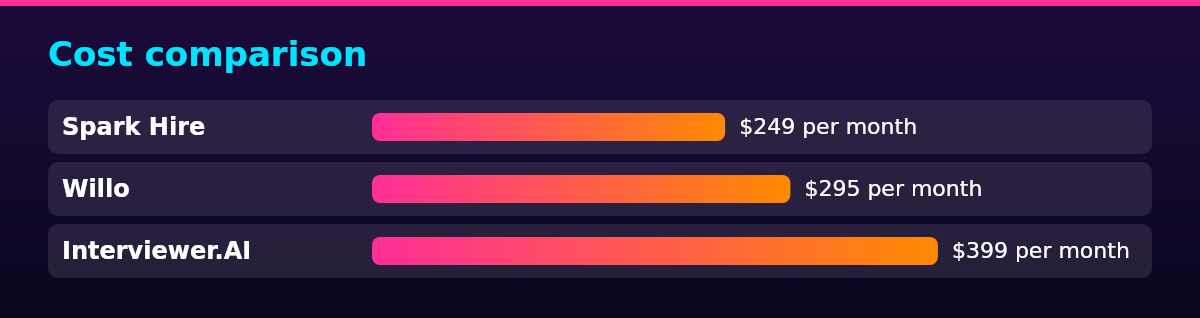
A small team running 5 concurrent roles a month pays $249 to $399 a month at the three platforms that publish prices, and the three demo-gated vendors cannot be costed without a quote. The spread comes from the pricing models rather than the feature sets: a flat subscription at Spark Hire, a bill per live role at Willo, and a credit-based tier at Interviewer.AI. The table below shows the monthly bill for that scenario at each vendor’s current published price.
| Tool | Cost for 5 roles a month (USD) | What the price buys |
|---|---|---|
| Spark Hire | $249 per month | Annual plan: unlimited interviews, jobs and users |
| Willo | $295 per month | 5 live roles at $59 each, pay as you go |
| Interviewer.AI | $399 per month | Professional Edition: 5 job posts, 120 credits, 25 licenses |
| HireVue | Quote required | Priced by volume and modules |
| VidCruiter | Quote required | Priced per module on request |
| interviewstream | Quote required | Priced by demo |
Willo bills $59 per live role, so 5 concurrent roles currently cost $295 a month and 10 roles $590, on the Willo pricing page. A month with no live roles costs nothing.
Interviewer.AI’s Professional Edition currently costs $399 a month for 5 job posts and 120 interview credits, the published tier that covers 5 concurrent roles, on the Interviewer.AI pricing page.
Double the volume to 10 concurrent roles and only two of the six still publish a price that covers it: Spark Hire’s unlimited annual plan, and Willo at 10 live roles. Interviewer.AI’s largest published tier covers 5 job posts, so 10 roles a month goes past its published plans, and HireVue, VidCruiter and interviewstream price only by quote.
Three traps sit in these prices. Interviewer.AI bills in interview credits, so a surge in applicants raises the bill even when the job post count stays flat. Spark Hire’s pricing varies by company size, so the published entry price is a floor rather than a quote. And the demo-gated vendors may well be competitive at volume, but there is no way to compare them on price without entering a sales process.
Legal compliance
AI-scored video interviews are legal across most of the United States, but two jurisdictions regulate them directly: Illinois and New York City. Both rules turn on where the candidate sits, not where your company is headquartered, so an employer in Texas interviewing an Illinois candidate is inside the Illinois rule. Any platform that scores candidates with AI, most directly Interviewer.AI and HireVue, has to clear both bars where they apply.
Illinois is the stricter of the two. Under the Artificial Intelligence Video Interview Act, 820 ILCS 42, an employer using AI analysis of applicant videos for Illinois-based positions must, before the interview, tell each applicant that AI may be used, explain how the technology works and what characteristics it evaluates, and obtain the applicant’s consent.
The same Act limits sharing the videos to people whose expertise or technology is needed, requires deletion within 30 days of an applicant’s request, and requires employers that rely solely on AI analysis to pick in-person interview candidates to report race and ethnicity data to the Illinois Department of Commerce and Economic Opportunity every year.
New York City regulates the tool rather than the video. Since July 5, 2023, the Department of Consumer and Worker Protection has enforced Local Law 144 of 2021, which prohibits using an automated employment decision tool unless it had a bias audit in the year before use, the audit summary is publicly available, and candidates get notice 10 business days before use, under the department’s guidance.
These are the two named US rules, not a national law, and requirements elsewhere differ by jurisdiction, so scope any AI scoring to the places you actually hire. As buying criteria, consent capture, notice templates, deletion workflows and bias-audit documentation belong on your requirements list, not on a nice-to-have list: a platform that cannot timestamp candidate consent or delete a video on request makes both rules harder to follow.
How to choose as you scale
Choosing video interview software by team size keeps the bill and the feature set in line with how you actually hire, because the platform that fits a first remote role is usually the wrong one for fifty hires a quarter. The steps below work through the decision in the order that matters: volume, interview mode, price, integration and compliance.
1. Count your monthly roles
Your monthly role count picks the pricing model before any feature does. One or two roles a month points to Willo’s pay-per-role billing, 3 to 5 roles fits either a flat subscription or Interviewer.AI’s Professional tier, and steady double-digit hiring points to Spark Hire’s unlimited annual plan or the quote-priced suites.
2. Pick your interview mode
Decide which rounds run one-way and which run live before you shop, because the split halves the shortlist immediately. Teams that only need a one-way first round can use any of the six, and teams that want both modes in one tool are choosing among Spark Hire, HireVue, VidCruiter and interviewstream.
3. Price only what is published
Cost a vendor only on what it actually publishes, and treat a quote as a number you do not have yet. A $59 per-role bill and Spark Hire’s $249 unlimited plan are comparable on paper, per the Spark Hire pricing page, and a quote-priced platform is not comparable at all until the quote arrives.
4. Check your ATS integration
Confirm the integration with the applicant tracking system you actually run, on the vendor’s own integrations page, before you commit to a subscription. A native integration moves candidates between systems on its own, while a marketplace listing can hide a third-party connector with its own fee and support queue.
5. Match the compliance features
Match the platform to where your candidates sit, because the Illinois and New York City rules follow the candidate, not your headquarters. Hiring into either place with AI scoring means consent capture, notice templates, deletion on request and bias-audit documentation belong on your requirements list, and a vendor that cannot demonstrate those four slows down every regulated hire.
FAQ
For most small and mid teams, Spark Hire fits best, because one subscription carries both live and one-way interviews with unlimited jobs and users, currently from $249 a month on the Spark Hire pricing page. Occasional hiring points to Willo’s $59-per-role billing instead, and high-volume or regulated hiring gets more from the quote-priced suites, HireVue, VidCruiter and interviewstream.
A one-way video interview sends candidates a set of questions and a deadline, and they record their answers on their own time with nobody else on the call. Your team then reviews, scores and compares the recordings in the platform, and shortlisted candidates move to a live round.
Published prices currently run from $59 per live role at Willo to $399 a month for Interviewer.AI’s Professional Edition, with Spark Hire from $249 a month for unlimited use, on the Willo pricing page and the other vendors’ own pricing pages. A team running 5 concurrent roles pays $249 to $399 a month at the three vendors that publish, and the other three quote.
In a one-way interview the candidate records answers to set questions alone, on their own schedule, and in a live interview the candidate and your team talk in real time on a scheduled call. One-way interviews scale screening across time zones, and live interviews carry the rounds that need real-time follow-up questions.
Yes, and two US jurisdictions add requirements on top: Illinois’s Artificial Intelligence Video Interview Act requires notice, an explanation of the AI and candidate consent before an AI-analyzed video interview, and New York City’s Local Law 144 requires a bias audit and advance candidate notice for automated hiring decisions. Elsewhere, requirements differ by jurisdiction, so scope AI scoring to the places you actually hire.
Yes. Spark Hire lists more than 40 ATS integrations, Willo more than 50, and VidCruiter ships with its own ATS, so all six platforms above connect to a hiring stack rather than standing alone. Confirm the integration for your specific system on each vendor’s own integrations page, because the length of the list is not the depth of the connector.