
On this page
Restaurant payroll software has to do two jobs a general payroll platform skips: pull tips off the point of sale (POS) or the schedule, and file the tax forms that come with tipped wages. The best payroll software for restaurants covers both jobs across eight tools: Toast Payroll, Square Payroll and 7shifts Payroll take hours and tips straight from the register or the schedule, Push Operations and Restaurant365 serve multi-location groups, and Gusto, OnPay and Patriot Payroll run tipped teams as generalist platforms from $17 a month plus $4 per worker. For a single location, 7shifts Payroll adds payroll to restaurant scheduling at $39.99 a month per location plus $6 per employee paid, and OnPay and Gusto sit at $49 a month plus $6 per worker.
Every tool below is compared on five criteria: published price transparency, tip handling (tip pooling, tip makeup and tip reporting), POS and scheduling integration, multi-location and multi-state support, and tax filing including the employer tax credit on tips. Each price is read from the vendor’s own pricing page in November 2026, and each entry links the page it came from.
Restaurant payroll software compared
| Tool | Best for | Starting price (USD) | What stands out |
|---|---|---|---|
| Toast Payroll | Restaurants already on the Toast POS | Quote only | Hours and tips pull from the Toast POS; tip pooling and tip makeup built in |
| 7shifts | Scheduling-first teams moving into payroll | $39.99 per location + $6 per employee paid | Payroll runs on the schedule; staff are prompted to declare tips |
| Square Payroll | Square POS restaurants that want simple pricing | $35 per month + $6 per person paid | Tips import from Square POS; federal and state filings included |
| Push Operations | Groups growing past one location | From $200 per location | One suite for hiring, training, scheduling and payroll |
| Restaurant365 | Groups that want payroll tied to their books | Quote only | Tip tracking and payouts; payroll entries auto-post to the general ledger |
| Gusto | Multi-state operators without heavy tips | $49 + $6 per person | Same platform price in every state on the Plus plan |
| OnPay | Tipped teams that want a general platform | $49 + $6 per worker | Built-in tip makeup; files Form 8846 |
| Patriot Payroll | One-state, no-tip counter service | $17 + $4 per worker | Lowest published floor in the list |
Every figure in this pricing comparison was read on the vendor’s own pricing page in November 2026. Toast and Restaurant365 publish no list price, so their rows say quote only, never a third-party estimate.
Tools built for restaurants
The restaurant payroll software built for food service handles tip pooling, tip makeup and tip reporting as data that flows in from the register or the schedule: Toast, 7shifts, Square Payroll, Push Operations and Restaurant365 all do it.
Toast Payroll
Best for: restaurants already on its point of sale
Toast Payroll pulls hours and tips from the Toast POS into payroll, then calculates tip pooling and distribution, overtime across locations and tip makeup to minimum. Toast also covers the first quarterly filing with a $4,000 guarantee, under the terms in its page’s footnote, and publishes 7-day support.
Toast publishes no Payroll & Team price: the Toast pricing page gates everything behind a demo, so the cost comes from a quote.
Pros
- Hours, tips and overtime flow from the Toast POS without re-entry
- Tip pooling, tip distribution and tip makeup to minimum are built in
- A $4,000 guarantee backs the first quarterly filing, under its page’s footnote terms
Cons
- Quote only: no published price for Payroll & Team
- Requires the Toast POS: the payroll pulls hours and tips from Toast’s own register
7shifts
Best for: scheduling-first restaurant teams moving payroll onto the schedule
7shifts starts as a restaurant scheduling tool, and 7shifts Payroll runs on the schedules and tip data the platform already holds. Staff are prompted to declare their tips, so the tip record builds up as the schedule runs rather than at the end of the pay period.
Standalone 7shifts Payroll currently costs $39.99 a month per location plus $6 per employee paid, per the 7shifts pricing page. The scheduling plans run from a free Comp plan (one location, up to 15 employees) through Essentials at $44.99 a month per location (up to 30 employees) and Pro at $89.99 to Premium at $149.99, which includes Tip Management and 7shifts Payroll, with annual billing cutting each paid plan’s monthly price. The page also runs a promotion offering 3 months of Payroll free at the time of writing, with no end date published.
Pros
- Payroll, scheduling and Tip Management in one platform
- Staff are prompted to declare tips inside the app
- A free Comp plan covers a first location of up to 15 employees
Cons
- Billed per location, so a two-location group pays each plan fee twice
- Tip Management and Payroll ship with the Premium plan; the cheaper plans need the standalone Payroll add-on at $39.99 per location plus $6 per employee paid
Square Payroll
Best for: restaurants that want flat published pricing with tips from the register
Square Payroll imports timecards and tips from the Square POS, handles multiple pay rates, files federal and state taxes, and sets up locations across multiple states with the tax calculations handled by Square. Unlimited pay runs are included in the base price.
Square Payroll currently costs $35 a month plus $6 per person paid, with a contractor-only plan at $6 a month per person paid, per Square’s payroll page.
Pros
- Direct tips import from Square POS into each run
- Federal and state filings included, with multi-state locations supported
- Contractor-only plan at $6 a month per person paid for hybrid teams
Cons
- The payroll page publishes no tip pooling, tip credit or tip makeup feature
- The documented tip and timecard import is from Square’s own POS only
Push Operations
Best for: groups growing past a single location
Push Operations sells hiring, training, scheduling and payroll as one restaurant suite, so the labor data payroll needs is already inside the platform rather than imported from a second system.
Push’s published pricing currently starts at $200 a month per location for 15 employees and under, per its pricing FAQ; payroll is included from the Signature plan up, and Signature, Supreme and Enterprise are priced by quote, as is any location above 50 employees (Push pricing).
Pros
- One suite covers hiring, training, scheduling and payroll
- A published $200 entry point for locations of 15 employees and under
Cons
- Payroll ships from the Signature plan up, not with the published Essentials price
- Signature, Supreme and Enterprise are quote only, as are locations above 50 employees
Restaurant365
Best for: restaurant groups that want payroll tied to their books
Restaurant365 runs payroll inside its restaurant management platform, with real-time tip tracking and allocation, automated tip payouts and daily pay by prepaid card or direct deposit. Multi-location payroll consolidates inside the same platform that keeps the inventory and the books.
Restaurant365 publishes no price on its payroll page: quote only (Restaurant365 payroll).
Pros
- Real-time tip tracking, allocation and automated payouts
- Payroll entries auto-post to the general ledger
- Daily pay by prepaid card or direct deposit
Cons
- Quote only: no published price on its payroll page
- Payroll comes as part of the Restaurant365 platform, not as a standalone payroll subscription
General platforms for tipped teams
Gusto, OnPay and Patriot Payroll are general payroll software for tipped employees rather than restaurant suites: Gusto earns its place on multi-state reach, OnPay on built-in tip features, Patriot on price.
Gusto
Best for: counter-service and low-tip operators in several states
Gusto is a general payroll platform whose strength is geography: its Simple plan covers a single state, and its Plus plan runs a mixed workforce across states. For a counter-service restaurant or a low-tip kitchen crew, filings done right in every state matter more than restaurant-specific tip plumbing.
Gusto currently prices Simple at $49 a month plus $6 per person, Plus at $80 plus $12 and Premium at $180 plus $22, with a contractor-only plan at $35 plus $6 per person, as of November 2026 (Gusto pricing).
Pros
- Multi-state payroll for a mixed workforce on the Plus plan
- Contractor-only plan for non-employee staff
Cons
- Simple covers one state; multi-state needs Plus at $80 a month plus $12 per person
- Gusto’s own pages publish no restaurant-specific tip pooling or tip credit feature
OnPay
Best for: tipped teams that want tip features on a general platform
OnPay is a general payroll platform that builds restaurant tip handling into the product, which is unusual at its price point.
Payroll Essentials currently costs $49 a month plus $6 per worker, with an HR add-on at $15 a month plus $2 per worker (OnPay pricing).
Its restaurant industry page documents tipped wages, tips as a separate pay item, a built-in tip makeup feature and multiple pay rates, and names Form 8846 among its included tax filings (OnPay restaurants).
Pros
- Built-in tip makeup to minimum wage, with tips as a separate pay item
- Files Form 8846, the employer tax credit on tips
- Multiple pay rates in one run for staff working two roles
Cons
- The $49 base runs above Patriot’s $17 floor for a no-tip, one-state team
- HR tools cost extra at $15 a month plus $2 per worker
Patriot Payroll
Best for: one-state, no-tip counter service on a budget
Patriot Payroll is the lowest published price in this comparison, and it is a general small-business platform: its pricing page publishes no restaurant-specific tip, tip pooling or tip credit features, so it fits a counter-service or no-tip spot rather than a tipped dining room.
Basic Payroll currently costs $17 a month plus $4 per worker paid, with you filing the returns; Full Service costs $37 a month plus $5 per worker and files federal, state and local taxes, with each additional state filing adding $12 a month (Patriot pricing).
Pros
- Lowest published floor in this comparison at $17 a month plus $4 per worker
- Full Service files federal, state and local returns for $37 a month plus $5 per worker
Cons
- On Basic you file the tax returns yourself
- No published tip, tip pooling or tip credit features on its pricing page
- Each additional state filing adds $12 a month on Full Service
Cost comparison
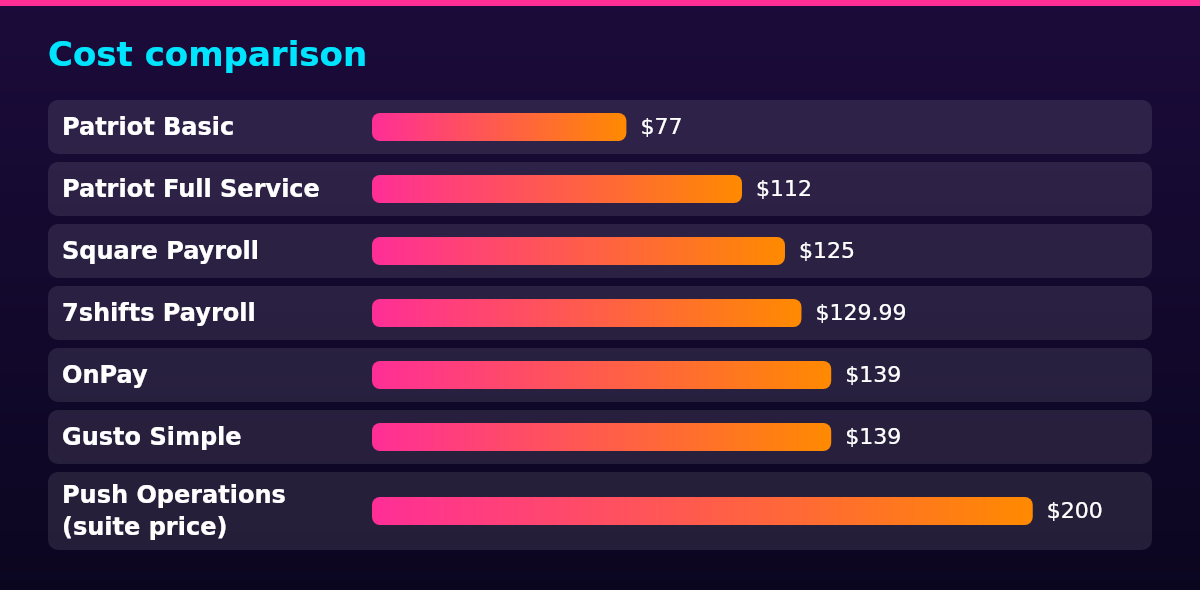
| Tool (15 employees, one location) | Monthly total (USD) |
|---|---|
| Patriot Basic | $77 |
| Patriot Full Service | $112 |
| Square Payroll | $125 |
| 7shifts Payroll | $129.99 |
| OnPay | $139 |
| Gusto Simple | $139 |
| Push Operations (suite price) | $200 |
Restaurant payroll software costs from $77 a month (Patriot Basic, filing the returns yourself) to $200 (Push Operations, whose published Essentials price covers up to 15 employees per location) at a 15-person single-location restaurant, across the tools that publish prices. Each total is the printed base plus 15 workers at the printed per-person rate: Patriot’s $17 plus 15 at $4 and its $37 plus 15 at $5, Square’s $35 plus 15 at $6, 7shifts Payroll’s $39.99 per location plus 15 at $6, and OnPay’s and Gusto’s $49 plus 15 at $6.
Toast and Restaurant365 publish no price, so any quote they give can be held against these published lines at the same headcount. None of these totals includes employer payroll taxes, workers’ compensation premiums or the POS subscription the restaurant-native tools require, and Push’s $200 is its suite floor: payroll ships from its Signature plan up.
Legal compliance in the US
Restaurant payroll runs on the tip credit rules, and the employer owns them: three rules decide which tool fits. Under the federal Fair Labor Standards Act (FLSA), a tipped employee (one who customarily and regularly receives more than $30 a month in tips) can be paid a $2.13 cash wage as long as tips bring them to the $7.25 federal minimum, the employer informs them of the tip credit first, and the employer makes up any shortfall for the workweek (DOL Fact Sheet #15). Tip pooling has its own rules: where a tip credit is taken, only employees who customarily receive tips may share the pool, and managers and supervisors may never keep tips.
State rules change the wage math. Some states allow no tip credit at all; California is one: an employer there may not use tips toward the minimum wage, which is $16.90 an hour statewide as of January 1, 2026, per California’s labor commissioner. The same payroll run needs different wage math per state, and a multi-location restaurant with staff in several states sorts out state tax registration before the first run in each one.
On the tax side, employees who receive $20 or more in cash tips in a calendar month must report their tips to the employer in writing by the 10th of the following month, and the employer withholds on what is reported (IRS tip reporting rules).
Food and beverage employers can also claim the Federal Insurance Contributions Act (FICA) tip credit: Form 8846 credits the employer share of Social Security and Medicare taxes paid on certain employee tips (IRS Form 8846). That filing is worth automating, and OnPay names Form 8846 among its included filings.
Scaling framework
| Stage | What fits and why |
|---|---|
| One location, no or simple tips | Patriot Payroll at $17, or Square Payroll with filings included |
| One location with tip pooling | Toast Payroll or Square Payroll on their own POS, or OnPay for its built-in tip makeup |
| 2 to 5 locations | 7shifts Payroll on the schedule, or Gusto Plus across states at $80 plus $12 per person |
| Groups and franchises | Push Operations or Restaurant365, quote-based pricing with payroll in the suite or the books |
| Staff outside the US | Global payroll platforms rather than restaurant payroll software |
The switch points are tip complexity first, then location count, then borders. A single-location restaurant outgrows a tool when tip pooling starts, a group outgrows per-location billing at the second or third site, and staff abroad belong on global payroll platforms rather than restaurant payroll software at all.
FAQ
No published market-share count names a single owner, so the honest answer splits by type. Restaurants that want tips pulled from the register run Toast Payroll, Square Payroll or 7shifts Payroll on their own POS or schedule, and ones that want a general platform run Gusto, OnPay or Patriot Payroll. The restaurant-native group is chosen for tip handling and POS integration, and the general group for price and multi-state filing.
Toast publishes no price for Payroll & Team: its product page gates pricing behind a demo, so the number has to come from a quote. Its POS pricing is quote-based too, so a restaurant learns both numbers in the same sales conversation.
Toast Payroll & Team is the payroll product inside the Toast platform: it pulls hours and tips from the Toast POS and calculates tip pooling, overtime across locations and tip makeup to minimum, per Toast’s product page.
No. A general AI chatbot can explain the tipped wage rules or draft a schedule, but it files no tax returns, holds no state registrations and pays no one. The tip records, the filings and the liability stay with the employer, which is what payroll software is for.
Small restaurants typically keep cash-basis books, while groups run accrual, and payroll posts to the general ledger either way. Restaurant365 and Toast both sell that auto-posting, which is why integration matters more than the accounting method when choosing payroll software.